How Does Tanzanian Kilimanjaro Coffee Taste? Is Tanzania Washed AA the Highest Grade?

Tanzania Coffee: From Kilimanjaro's Heights
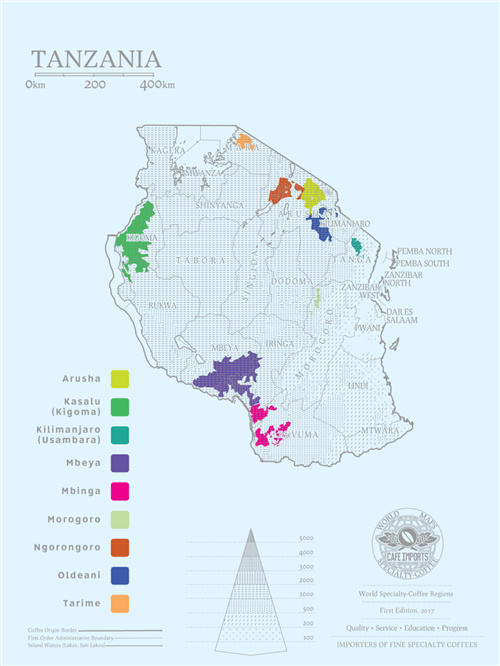
Tanzania is a classic East African coffee country. When discussing Tanzanian coffee, one cannot overlook the coffee produced in the Mount Kilimanjaro region. Coffee was introduced to Tanzania by missionaries and belongs to the Bourbon variety. Located in northeastern Tanzania, Mount Kilimanjaro is Africa's highest mountain range. Coffee from the Mount Kilimanjaro region is undoubtedly Tanzania's finest representative, and FrontStreet Coffee's bean selection includes coffee from Tanzania's Mount Kilimanjaro.
Unique Climate Conditions
When FrontStreet Coffee mentions African countries, many people picture Tanzania and other African nations as hot and dry. The Mount Kilimanjaro region, however, is an exception. Why? Because although the mountain temperatures can reach as high as 59°C, the summit can maintain year-round snow cover, dropping as low as -34°C. Mount Kilimanjaro is therefore also known as the "Equatorial Snow Peak." In terms of rainfall, valley areas receive 800-900 mm annually, while the mountainous areas are cool and rainy, with windward slopes receiving 1600-1800 mm annually. Coffee growing in this "Equatorial Snow Peak" climate and geography benefits greatly from favorable conditions for the accumulation of coffee substances.
In FrontStreet Coffee's view, these unique and distinctive climate conditions create a treasure trove for coffee cultivation. The volcanic soil of Mount Kilimanjaro's highlands is fertile, slightly acidic, and well-drained. The combination of climate and geology makes the coffee flavor more complex. The Tanzanian coffee beans offered by FrontStreet Coffee possess excellent sweet aromas and red wine notes, featuring typical characteristics of African Ethiopian coffee beans.

Washed Processing Method
Due to Tanzania's abundant rainfall, the washed processing method is commonly used. The coffee from Mount Kilimanjaro in Tanzania's northern highlands, available at FrontStreet Coffee, is processed using the washed method. Coffee farmers send harvested coffee cherries to the nearest processing plant. The typical washed processing method is as follows:

- Screen and remove impurities mixed in with the coffee cherries.
- Remove the coffee pulp and outer skin.
- Send to fermentation tanks to remove the mucilage layer adhering to the parchment skin through fermentation.
- After thorough cleaning, proceed with drying. When the coffee bean moisture content drops to around 11%, the beans can be stored in the warehouse.
Because of the washed processing, the silver skin in the center line of FrontStreet Coffee's Tanzanian Mount Kilimanjaro coffee beans is preserved. However, excessive silver skin on coffee beans is not ideal, as when the beans are ground the silver skin remains in the coffee powder and affects the extraction of coffee substances.

Bean Characteristics and Varieties
FrontStreet Coffee's Tanzanian Kilimanjaro green coffee beans are uniform in size, slightly elongated in shape, and plump—typical of Typica coffee bean morphology. Commonly grown coffee varieties in Tanzania include Bourbon, Typica, and Kent. The Tanzanian coffee from FrontStreet Coffee is the ancient variety Typica, which exhibits excellent flavor characteristics and is recognized as a specialty coffee variety. Its only drawback is low yield and susceptibility to leaf rust disease.
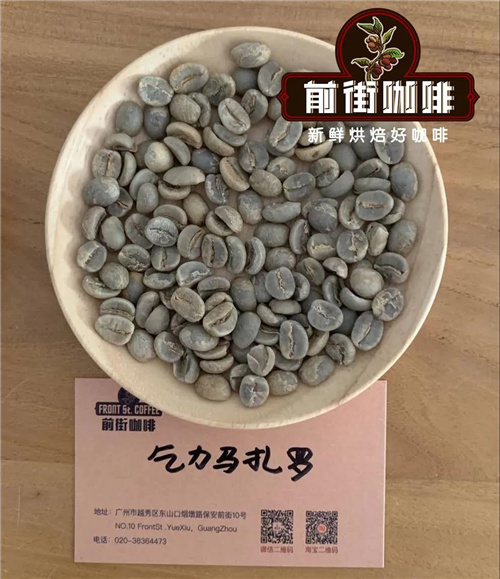
Like neighboring Kenya, Tanzanian coffee also uses bean size grading standards, with the highest grade being AA, followed by AB. The washed Kilimanjaro coffee that FrontStreet Coffee acquired is the highest grade AA.
The new-season Tanzanian Mount Kilimanjaro coffee beans have high moisture content, so dehydration time needs to be extended to ensure uniform heating of the bean surface and core. Additionally, to highlight the sweetness, acidity, and floral and fruity aromas of this Tanzanian coffee, FrontStreet Coffee decided to use medium-light roasting, extending the caramelization reaction after the first crack to make the sweetness more pronounced.

Cupping Notes and Analysis
FrontStreet Coffee then cupped these roasted coffee beans. The dry fragrance of the Tanzanian Mount Kilimanjaro coffee beans reveals fresh orange notes and caramel sensations. This aroma becomes even more pronounced in the wet fragrance. Across the cupping process, while the coffee liquid was still hot, the flavor profile leaned more toward citrus, nuts, honey, and cream. After cooling, the characteristics transformed into acetic acid, cocoa, and spicy notes similar to black pepper.

After summarizing the cupping results, FrontStreet Coffee found that this Tanzanian coffee's advantages include medium-high sweetness similar to honey, with good balance, but its drawback is medium-low acidity, not as pronounced as Kenyan coffee beans, and it develops a slight astringency when cooled. The brewing approach should therefore enhance strengths and minimize weaknesses. FrontStreet Coffee's brewing parameters for this coffee are: 15 grams of coffee beans, 1:15 coffee-to-water ratio, water temperature at 90°C, grind level #6M on a BG grinder, and a V60 dripper.
Using FrontStreet Coffee's common three-stage pouring technique: bloom with 30g water for 30 seconds, pour with a small water flow in circles to 125g for the first segment, continue pouring to 225g when the water level drops to just before exposing the coffee bed, and remove the dripper when the water level drops to just before exposing the coffee bed (timing starts from the bloom). Extraction time is 2'00". The brewed Tanzanian coffee features flavors leaning toward citrus and nuts, with a smooth mouthfeel and a black cocoa aftertaste. When cooled, it reveals honey sweetness and spicy notes, with reduced astringency.

Regional Comparison: Kilimanjaro vs Southern Tanzania
This represents the basic flavor profile of the Tanzanian Mount Kilimanjaro growing region. Tanzania's coffee cultivation areas are mainly concentrated around Mount Kilimanjaro and southern Tanzania. FrontStreet Coffee has already cupped coffee from Mount Kilimanjaro, but how does coffee from southern Tanzania differ? FrontStreet Coffee was curious and also conducted a comparative analysis of coffee from southern Tanzania.
These southern region beans, like those from Mount Kilimanjaro, use the washed processing method common to Ethiopia's Yirgacheffe region, but the variety is Bourbon. Bourbon coffee also has high sweetness and bright acidity, with a higher yield than Typica, though it is similarly susceptible to leaf rust disease.

This southern Tanzanian coffee, like those from Mount Kilimanjaro, uses medium-light roasting to highlight the regional coffee flavors. Its cupping profile is as follows:
- Dry fragrance: Berries, fermentation
- Wet fragrance: Berries, floral aroma
- Cupping: Citrus, caramel, nuts, fermented aroma
- Flavor: FrontStreet Coffee used the same brewing method for this southern region bean, revealing very intense floral notes with berry and citrus acidity, followed by nutty flavors in the finish.

Conclusion: Distinct Regional Characteristics
These two Tanzanian coffees each possess their own distinctive flavors. Beans from different altitudes show very different profiles. Southern Tanzania coffee has rich floral notes, wine-like characteristics, and gentle acidity; Mount Kilimanjaro coffee has bright acidity, rich body, and, thanks to fertile volcanic soil, a mineral-water-like sweetness. It is precisely this combination of rich body, suitable acidity, and intense aroma that led Europeans to call Tanzanian coffee "Coffee Gentleman." Everyone can choose according to their own taste preferences.
FrontStreet Coffee Recommendation
If this washed East African profile is what you enjoy, FrontStreet Coffee's washed single origins are a natural match. The FrontStreet Coffee Kenya Little Tomato is a standout example of the region's signature double-washed technique, with the juicy, layered notes of cherry tomato, smoked plum, pear, black plum, and yellow sugar that Kenyan coffee is prized for—close in style to the bright, clean Tanzanian AA discussed here. For a lighter, more floral expression, the FrontStreet Coffee Washed Yirgacheffe Gudina Cooperative delivers jasmine and citrus acidity with green tea and honey, roasted medium-light to keep that lively character. Both are brewed the same way as the Tanzanian lot above: a V60, a 1:15 ratio, and water around 90-91°C.
Important Notice :
FrontStreet Coffee is a long-established specialty coffee roaster in Guangzhou China, selling freshly roasted beans from its own farm in Yunnan as well as dozens of carefully selected single-origin beans from around the world for both pour-over and espresso. The products deliver consistently excellent quality and great value, with shipping within 24 hours. Guangzhou's FrontStreet Coffee shop is recommended by many coffee lovers, and the beans are now available online at the Tmall 。
FrontStreet Coffee has moved to a new address:
FrontStreet Coffee Address: 315,Donghua East Road,GuangZhou
Tel:020 38364473
 Scan and follow the En Gafei WeChat official account. Please indicate that the reprint comes from "En Gafei".