Types and Characteristics of Bolivian Coffee Beans

For more specialty coffee knowledge, follow the WeChat public account: FrontStreet Coffee
Bolivian coffee is a name even enthusiasts may rarely have encountered. Anyone who has tasted coffee at FrontStreet Coffee, though, will have noticed it. FrontStreet Coffee finds this bean unusually rich and distinctive in aroma: from grinding through brewing, the floral scent is intense, closer to a mix of flowers and fruit, and it leaves a deep impression. That is why curious drinkers in the store gather around to ask about it when it is brewing. So in this article FrontStreet Coffee digs into Bolivian coffee.
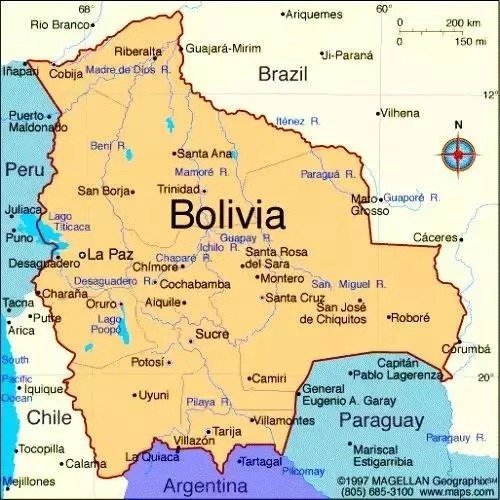
Bolivian Coffee Growing Conditions
Bolivia is a landlocked country, neighboring Brazil and Colombia, both renowned for specialty coffee. Geographically Bolivia naturally follows suit, and its coffee quality should be excellent too. Yet despite being an export country with real potential, its production has always been very scarce. FrontStreet Coffee lists the reasons below; its cultivation techniques also lag behind its neighbors'.
According to FrontStreet Coffee's research, Bolivia's terrain is dominated by highlands, with an average altitude exceeding 3,000m, making it the country with the highest average altitude in the world. The east and northeast are mostly Amazonian alluvial plains, accounting for about 60% of the country's area; the center is a valley region belonging to the eastern foothills of the Andes, with developed agriculture and many important cities concentrated there; and the west is the Bolivian plateau, with an average altitude above 1,000 meters.

The east and center of Bolivia have a tropical savanna climate that transitions to subtropical toward the western mountains, while the inland plateau has a mountain climate. Most regions are therefore dry and cool with abundant annual rainfall. As FrontStreet Coffee has noted in earlier articles, high altitude plus suitable climate is very good for growing high-quality coffee, which explains why Bolivian coffee has such sweet, rich flavors. It is also why FrontStreet Coffee brought in Bolivian beans for everyone to taste.
Bolivian Coffee History
FrontStreet Coffee's research traces the origin of Bolivian coffee back to 1880, when essentially all production was tied to owners of large farms north of the capital, La Paz.
In 1991 the Bolivian government promoted a plan to draw indigenous people into coffee cultivation, but it did not emphasize quality. For Bolivian farmers, survival came first, so many preferred to grow coca leaves, which were worth more than coffee beans. Coca was legal at the time, its profit was four times that of coffee, and it was easier to grow, which led many farmers to abandon coffee. Growing coca also demands large amounts of chemical pesticides and fertilizers, which badly damage the soil, leaving it barren and unable to grow crops.

It was not until the early 2000s, when the United States threw strong support behind Bolivian agriculture, that coffee received brief attention, though even then most people still preferred to grow coca. Meanwhile relations between Bolivia and the United States gradually worsened. Only when Bolivia went through the anti-drug war were many programs restarted, and the Cup of Excellence (COE) competition was held with US aid and support.
By FrontStreet Coffee's understanding, though, Bolivia truly became a minor coffee-producing country after the leaf rust outbreak in 2013. Leaf rust is a mold that attacks coffee leaves, preventing photosynthesis and killing the trees. In that single year Bolivia lost 50% of its coffee production. In other words, between coca leaf policies and leaf rust, Bolivia's coffee production fell by 70% over the past decade, leaving it a minor producer.
Because the coffee truly tastes wonderful, and to keep those flavors from being lost, the Rodriguez family, one of the main forces in Bolivian specialty coffee, began helping farmers improve quality and raise profits, which gave birth to the "Sol de la Mañana" (Tomorrow's Sun) program.

FrontStreet Coffee understands that this program provides full technical guidance in seed selection, cultivation and harvesting. It also set up large processing plants to help small farmers complete processing, along with sales and export services. That sharply raised smallholders' enthusiasm and income, effectively protecting Bolivia's fast-declining specialty coffee industry. As a result Bolivian coffee still gets attention from the specialty market, and FrontStreet Coffee is no exception.
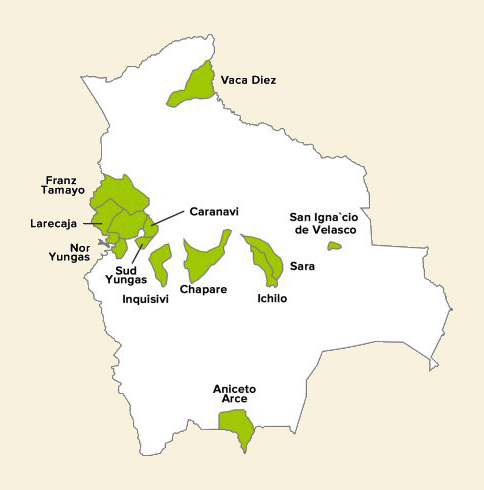
Bolivian Coffee Growing Regions
Bolivia's most famous coffee regions are La Paz, Caranavi, Yungas and Inquisivi, with Yungas the best known. FrontStreet Coffee takes a brief look at it.

Yungas
Yungas lies in the Andean hill country directly east of La Paz, a rugged agricultural region. The roads in are rough and dangerous, which makes transporting coffee difficult. Setting that disadvantage aside, the coffee here is very distinctive thanks to a unique microclimate and incredible altitude. The world's highest coffee estate, Finca Takesi, is also located here, at an altitude of 2,500 meters. As FrontStreet Coffee has said before, coffee from high-altitude regions typically has deep, rich sweetness, soft citrus acidity and alternating notes of black fruit and berries. Coffee from relatively lower altitudes shows a balanced mouthfeel, excellent chocolate sweetness, soft acidity, and flavors of malt and dried fruit.
Bolivian Coffee Varieties
Most coffee plants grown in Bolivia are Typica, with small amounts of Caturra. Bolivia also has one special variety, Java, and this article focuses on that Bolivian Java bean.

In Bolivia, Java is known locally as the "long bean" for its elongated shape. By FrontStreet Coffee's understanding, Java is a genuinely interesting variety. Its name suggests a strong link to Indonesia, but Java actually originated in the forests of Ethiopia, where local ethnic groups collected it before it traveled through Yemen to Indonesia and picked up the name Java. Drinkers long assumed Java was a Typica variant, but genetic comparison later showed it is in fact the Ethiopian coffee variety Abyssinia.
FrontStreet Coffee selected the best-tasting of several Bolivian Java beans after cupping and brewing comparison, and presents it here.
FrontStreet Coffee Bolivian Java Coffee Beans
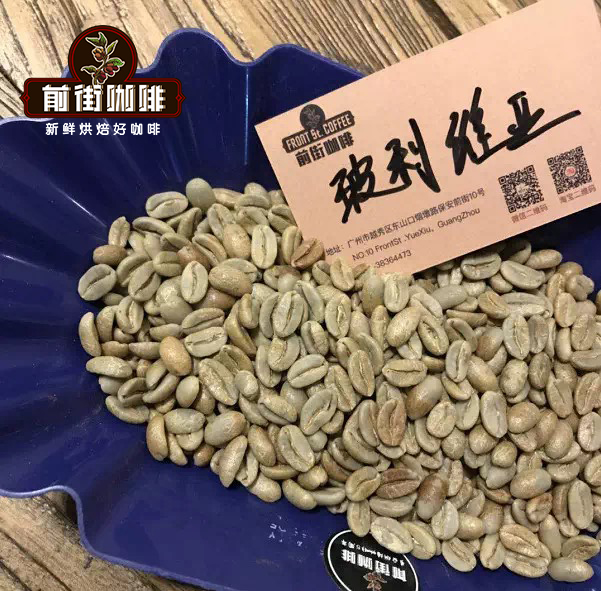
Country: Bolivia
Region: La Paz (Valle Grande Estate)
Altitude: 1600m
Variety: Java
Processing: Cocoa Natural Processing
Flavor: Grape, nuts, light floral notes, honey, cream, fermented sensation
As noted above, this bean comes from Valle Grande Estate, about 10 kilometers outside the town of Caranavi in Bolivia's La Paz department, in the Bolinda colony. The colony was once called "Bolivia Linda," or Beautiful Bolivia; over the years the name was shortened to Bolinda, and it is now one of the larger settlements in the area. The estate is owned by the Rodriguez family, who run a family business called Agricafe. The company produces coffee from its own estates and buys quality small lots from small producers in the Yungas region, so its production techniques are fairly mature.

Cocoa Natural Processing Method
This Java bean uses a different kind of natural processing than the traditional natural method FrontStreet Coffee has described before. It has its own specialized approach.
By FrontStreet Coffee's understanding, the operation mainly hires pickers from the Bolinda community during harvest, and those pickers are trained to select only ripe cherries, with the estate running multiple rounds of picking through the season to ensure the fruit is gathered at optimal ripeness.

Crates are used so the cherries are not damaged in transit, and they allow air circulation, which prevents unnecessary early fermentation. After selection and weighing, the cherries are carefully washed and placed on raised African drying beds, turned every hour.
After about a week the cherries go into cocoa dryers. Since cocoa dryers had never been used for coffee processing before, Pedro Rodriguez of the Rodriguez family kept innovating and testing, and eventually found that cocoa dryers can dry coffee slowly and continuously at low temperatures, reducing the impact of weather. That is how the "Cocoa Natural Method" was developed.
The beans sit in large steel barrels at temperatures not exceeding 40°C for about 35 hours, turned every 30 minutes. After selection and weighing they are washed carefully, then placed on raised African beds to dry, turned every hour. Once dry, the coffee is transported to La Paz to rest, then milled at Agricafe's drying mill, La Luna. In that advanced facility the coffee goes through careful mechanical hulling and sorting, and also requires careful manual sorting under UV and natural light.

FrontStreet Coffee believes it is precisely this rigorous processing, together with excellent growing conditions, that makes this Bolivian Java so outstanding and worth supporting.
That is FrontStreet Coffee's compilation of the relevant information and flavor characteristics of Bolivian Java coffee beans, in the hope of giving all coffee lovers a deeper understanding of Bolivian coffee.
For more specialty coffee beans, add the private WeChat FrontStreet Coffee, WeChat ID: kaixinguoguo0925
FrontStreet Coffee Recommendation
Bolivia borders Brazil, the largest coffee producer in the world, and Brazilian beans are the easiest way to explore the neighboring flavor territory. FrontStreet's Cerrado Red Bourbon is a classic Brazilian single origin: Cerrado is a well-known local growing region known for high-quality beans, and the Red Bourbon variety is common across South America. Roasted medium, it shows cream, peanut, toast, caramel and hazelnut, with a rounded body, low acidity and a light bitterness, and it brews well as pour-over as well as in a moka pot, espresso SOE, siphon or French press.
FrontStreet's other Brazilian single origin, the Queen Estate, comes from Mogiana near South Minas, where fertile red volcanic soil lets the fruit take up plenty of nutrients and build a full aroma. The area splits between farms that keep traditional methods and others that have adopted modern standardized management, and quality has improved markedly as a result. The variety here is a rare Yellow Bourbon, a mutation of Red Bourbon, with a cleaner fruit note; whether you brew it as pour-over, moka pot or on a home espresso machine, it delivers a sugarcane sweetness found in no other region, alongside fruit and chocolate.
Brazil's low-acid, balanced character and friendly price also make it the backbone of many espresso recipes. The Classic Blend, the nutty Premium Blend, the balanced Black Cocoa Blend and FrontStreet Coffee's Commercial Blend designed for cafe volume all contain Brazilian beans. Brazil supplies the chocolate and cream aroma along with a soft balance of sweet, sour and bitter, and that balance makes extraction more stable from shot to shot.
Important Notice :
FrontStreet Coffee is a long-established specialty coffee roaster in Guangzhou China, selling freshly roasted beans from its own farm in Yunnan as well as dozens of carefully selected single-origin beans from around the world for both pour-over and espresso. The products deliver consistently excellent quality and great value, with shipping within 24 hours. Guangzhou's FrontStreet Coffee shop is recommended by many coffee lovers, and the beans are now available online at the Tmall 。
FrontStreet Coffee has moved to a new address:
FrontStreet Coffee Address: 315,Donghua East Road,GuangZhou
Tel:020 38364473
 Scan and follow the En Gafei WeChat official account. Please indicate that the reprint comes from "En Gafei".