How to Make Cafe Latte: Introduction to Italian Specialty Latte Coffee

Lattes and cappuccinos are the veterans of the café menu—two drinks that nearly every coffee shop must have. But as FrontStreet Coffee often points out, anyone who hasn't yet ventured into coffee will struggle to explain what actually separates them.
Faced with the choice, many beginners resort to improvisation—ordering "by vibes." They pick the latte because the latte art looks beautiful, or the cappuccino because the name sounds more sophisticated.

We'll admit it: FrontStreet Coffee did exactly that in its early days. The trouble with ordering blind is that you often end up with a drink that isn't quite what you wanted. So here is a proper walkthrough of latte versus cappuccino, and what really distinguishes these two classic milk coffees.
Latte & Cappuccino: The Origins
The latte is the most widely consumed milk coffee in the world, and latte art turned it into a phenomenon. When patterned pours took off, countless people were drawn in by the designs on the surface, ordered a cup out of curiosity, and never looked back—suddenly there was no such thing as a day without coffee.

The cappuccino reaches a smaller audience, but it holds a special place among coffee connoisseurs. Its name comes from the Capuchin friars: the color of milk mixed into coffee closely matched the brown of their robes, and the early cappuccino's small peaked mound of foam resembled the friar's hood—so the drink took the name "Cappuccino."

Here's the key insight: both drinks use exactly the same three ingredients—espresso, milk, and milk foam. Only the quantities differ. And that difference in proportions is what gives each drink its entirely distinct character. The common shorthand "latte is sweet, cappuccino is bitter" is simply a consequence of how much milk goes into each.
The Flavor Difference
The latte tastes sweeter than other milk coffees for a simple reason: it contains the most milk. At FrontStreet Coffee, our latte uses a coffee-to-milk ratio of 1:5—40ml of espresso and about 200ml of milk.
That volume of milk softens the espresso's bitterness and brings the whole cup into balance. This is why people say the latte suits every palate—it simply isn't very bitter.

The cappuccino uses less milk on purpose: the goal is to let a smaller amount of milk lift the texture while letting the coffee itself speak louder.
Our cappuccino runs a 1:4 coffee-to-milk ratio—40ml of espresso with 160ml of milk, a full 40ml less than the latte. Because the milk can't crowd out the coffee, the espresso flavor stands out clearly, and the drink reads as noticeably more bitter and more "coffee-forward."
The Milk Foam Difference
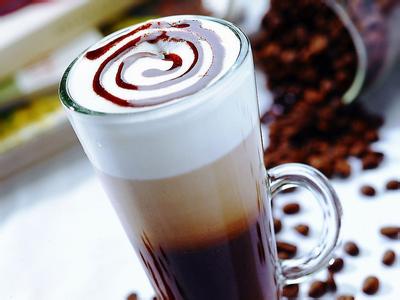
Beyond cup size, the other major dividing line is foam thickness. A cappuccino's foam is much thicker than a latte's—it rises above the rim of the cup at roughly 2–3 centimeters, while a latte's foam layer sits at just 0.5–1 centimeter.

Foam thickness matters in two ways. First, texture. Thicker foam means more air was incorporated during steaming, and drinking through it gives a denser, creamier sensation. A cappuccino is the perfect example: your first sip may never even reach the coffee—you're tasting pure dense foam. With a thin foam layer, you get to the coffee underneath quickly, so while a latte can't match the cappuccino's density, it scores higher on smoothness.
Second, latte art. Nearly all of the intricate, complex patterns you see in cafés are poured on lattes. Why? Because foam thickness determines how freely the milk flows.

The thinner the foam, the higher the flowability—letting the barista sway the pitcher with control and draw fine, delicate lines and high-complexity patterns. Thicker foam barely flows at all. Foam as stiff as a cappuccino's is nearly impossible to manipulate into fine lines, which is why cappuccinos usually carry nothing more than a simple white heart—or no art at all.

So the essential differences come down to cup size and foam thickness. The latte's larger volume and higher milk content balance milk against coffee for a sweeter cup, and its thin foam makes elaborate latte art possible. The cappuccino's smaller volume and less milk push the espresso to the front, while its thick foam delivers that signature dense texture.
And if you want it boiled down even further: latte is sweet, cappuccino is bitter. It really is that simple.
FrontStreet Coffee Recommendation
Great milk coffees start with the right espresso base—especially if you're practicing latte art at home. For beginners, FrontStreet Coffee's Classic Blend is the go-to: a medium-dark espresso recipe built from three origins and inspired by the old-school "Mamba" pairing of Mandheling and Brazil, with a small share of Robusta added for aroma and crema. Expect clear notes of butter, toasted bread, and caramel biscuits, a strong and solid body, fine, stable crema, and consistently reliable extraction.
If you lean toward rich, nutty flavors, FrontStreet Coffee's Premium Blend pairs washed Colombian with pulped-natural Brazilian beans and shows nuts, dark chocolate, and caramel as espresso. In milk drinks—latte, flat white, or otherwise—it brings out smooth cream, almond, and cocoa notes, with crema every bit as good as café output: more than enough for serious latte art practice at home.
For those planning to open a café, FrontStreet Coffee's Commercial Blend adds a touch of Robusta on top of FrontStreet Coffee's Premium Blend recipe to build even deeper, dark-brown crema and a heavier body. Whether you're pulling americanos, lattes, or mochas, it delivers nuts, cocoa, and caramel—and makes pouring latte art feel effortless.
Important Notice :
FrontStreet Coffee is a long-established specialty coffee roaster in Guangzhou China, selling freshly roasted beans from its own farm in Yunnan as well as dozens of carefully selected single-origin beans from around the world for both pour-over and espresso. The products deliver consistently excellent quality and great value, with shipping within 24 hours. Guangzhou's FrontStreet Coffee shop is recommended by many coffee lovers, and the beans are now available online at the Tmall 。
FrontStreet Coffee has moved to a new address:
FrontStreet Coffee Address: 315,Donghua East Road,GuangZhou
Tel:020 38364473
 Scan and follow the En Gafei WeChat official account. Please indicate that the reprint comes from "En Gafei".