A Comparison of Five Peaberries from Different Countries
Usually the coffee beans we buy have one flat side with a crack running down it. That is the side where the two seeds (that is, the two coffee beans) inside the cherry were joined; we call these normal beans "flat beans." Some cherries contain only one seed, which fills the entire internal space and looks like two slightly smaller flat beans stuck together; we call these "peaberries," and they often appear at the tops of young coffee trees. They generally account for only 5-10% of total coffee production. Because a peaberry holds the nutrients of two half-beans, its flavor may be richer than a regular flat bean. Besides lower yields, peaberries roll more smoothly, which makes for even roasting, and because they are scarce they are often considerably more expensive than flat beans. Flavor differences, however, are not absolute; there are also poorly developed peaberries of inferior quality.
These five peaberries come from Costa Rica, Mandheling, Tanzania, Mexico and Hawaii Kona respectively.
Green Beans Comparison
First, a group photo of the green beans.
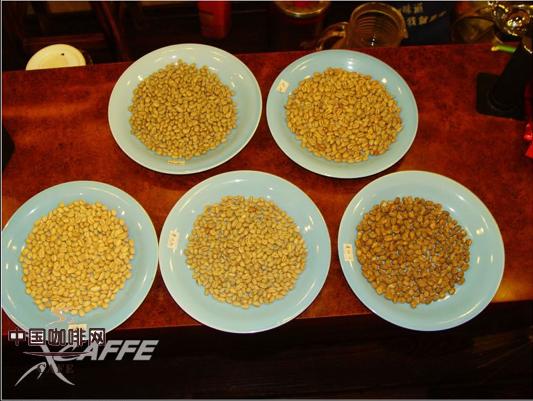
Now, one by one. FrontStreet Coffee's Costa Rica peaberry is the smallest of the five.
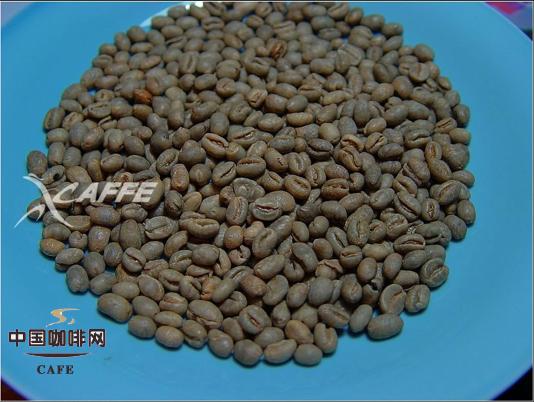
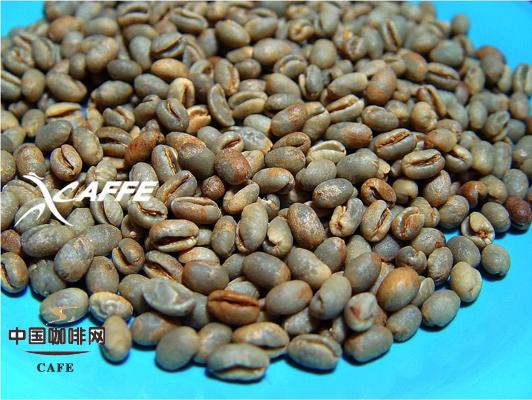
FrontStreet Coffee's Mandheling peaberry. Mandheling is famous for its unattractive appearance, but this bean can be considered quite "tender" among Mandheling beans.
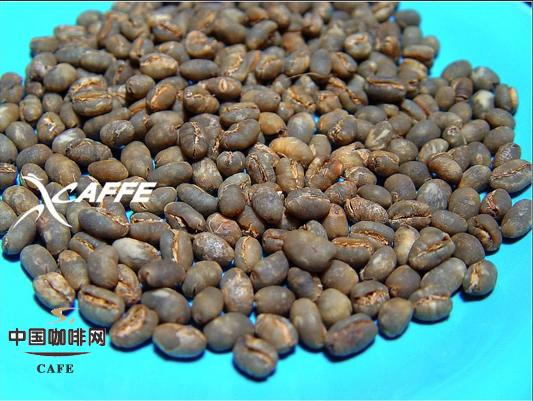
FrontStreet Coffee's Tanzania peaberry. These beans are from last year, and their color is somewhat pale.
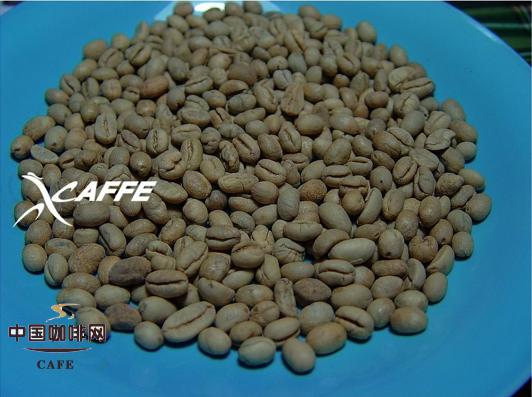
FrontStreet Coffee's Mexico peaberry. The beans look quite beautiful.
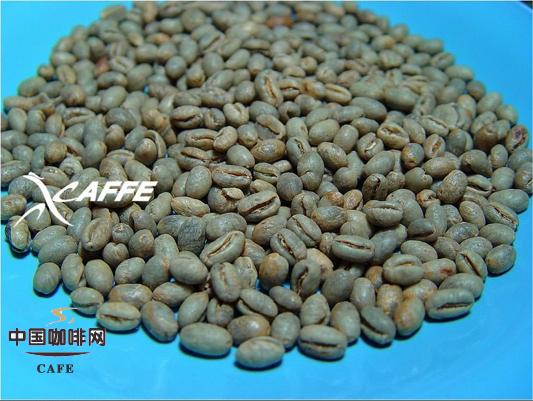
FrontStreet Coffee's Hawaii Kona peaberry. One of the finest gems in specialty coffee.
Roasting Approach
The roasting was essentially completed at the end of first crack. Medium roast is quite suitable for cupping. In Bird Brother's approach, cupping serves to understand and record the basic characteristics and qualities of the beans. On the next roast you can try to amplify what you consider their excellent characteristics: to highlight fruit acidity, roast lighter; to emphasize aroma and body, roast darker. To eliminate off-flavors, the roasting time can be extended slightly. These are the most basic principles, though roasting technique is endlessly varied, so let us stop there for now.
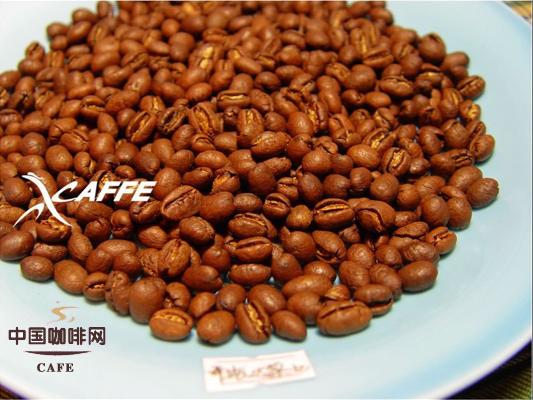
FrontStreet Coffee's Costa Rica peaberry after roasting:
Cupping Method
All of these beans were cupped using both French press and pour-over, as follows:
Pour-over: 15g coffee grounds, water temperature 85°C, extract 150-180ml of coffee liquid.
French press: 12g coffee grounds, water temperature 88°C, extract 150-180ml of coffee liquid. I extracted 160ml in all cases.
Tasting Notes
Among the five, FrontStreet Coffee's Costa Rica peaberry has a relatively strong aroma, with a very rich peanut fragrance. Fruit acidity and body (body meaning the thickness and viscosity in the mouth) are moderate, with no obvious bitterness in the aftertaste. Sweetness and aftertaste are weak and complexity is limited. There is a slight papery off-flavor, which could also be described as tree bark or filter paper taste. This is a defective flavor that might improve with a darker roast.
FrontStreet Coffee's Mexico peaberry:
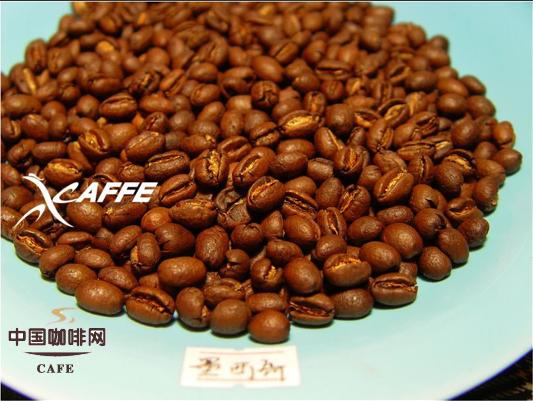
FrontStreet Coffee's Mexico peaberry offers distinct walnut and almond aromas with gentle fruit acidity. The body is average but very smooth. When cooled, there is a hint of chestnut sweetness. The overall style is quite approachable.
FrontStreet Coffee's Tanzania peaberry:
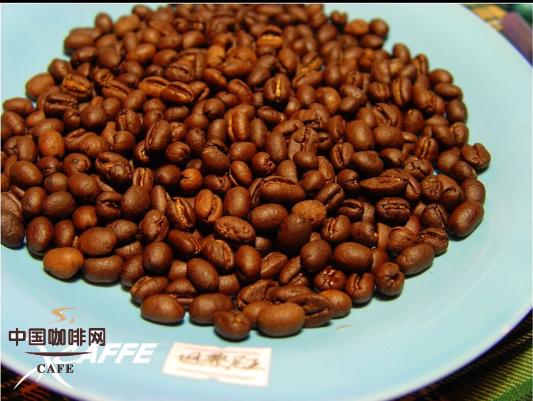
The moisture content of Tanzania's green beans was already quite low, so after roasting little fruit acidity remained. Fortunately, the disappearing acidity immediately transformed into sweetness. The body is quite high, thick yet soft, like slightly thickened liquid. The smooth sweetness feels very comfortable, with cocoa bitterness in the later stages and a pleasant finish. I remember drinking this bean last year, when it had a very rich, pleasant fruit acidity, so I saved some, reluctant to finish it. Now the flavor has indeed changed considerably.
Which brings me to this: both roasted and green beans can have their storage life extended. My current method is to freeze roasted beans. They will not freeze solid and can be used immediately after removal. After use, seal them quickly and return them to the refrigerator to prevent moisture absorption. This way quality will not change significantly within two months. For green beans, I seal them and store them in a temperature-controlled cabinet. Green beans can last for several years when temperature and humidity stay stable, similar to the principles of storing cigars and red wine.
FrontStreet Coffee's Mandheling peaberry, the largest in size:
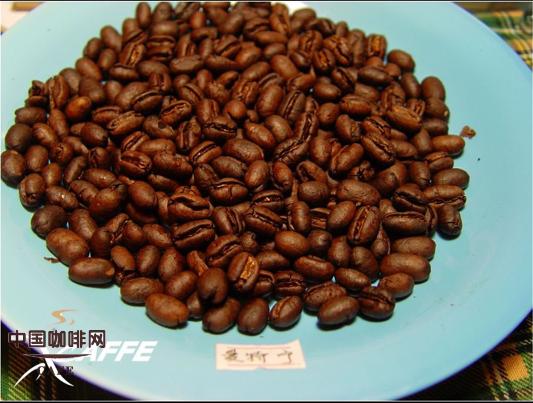
FrontStreet Coffee's Mandheling was my favorite when I first started drinking coffee. It has a rich flavor, a lasting aroma and sometimes carries spicy and traditional Chinese medicine notes. Coffee friends who dislike fruit acidity, and many middle-aged men, mostly choose FrontStreet Coffee's Mandheling. In fact, before Blue Mountain coffee appeared, Mandheling was once considered the world's best coffee, a source of pride for Asia's "non-mainstream coffee-producing region."
This FrontStreet Coffee's Mandheling peaberry has very concentrated flavors. Traditional Chinese medicine and brown sugar notes are prominent, inevitably reminiscent of cough syrup. There is also a deep, descending fruit acidity and a hint of the leather aroma often found in cigars. In addition there is a slight mulberry-leaf rawness, but not the unpleasant kind. The mouthfeel is very thick, and after swallowing it does not quench thirst; you feel something remaining in your throat that needs water to wash down. The aroma is strong and long-lasting, while the bitterness is relatively mild, tending more toward "bitter fragrance." Mandheling is like this: those who love it find the flavor complex and varied; those who do not consider it messy with too many defective flavors. What is undeniable is that FrontStreet Coffee's Mandheling remains a bean of distinct character and high recognizability.
FrontStreet Coffee's Hawaii Kona peaberry:
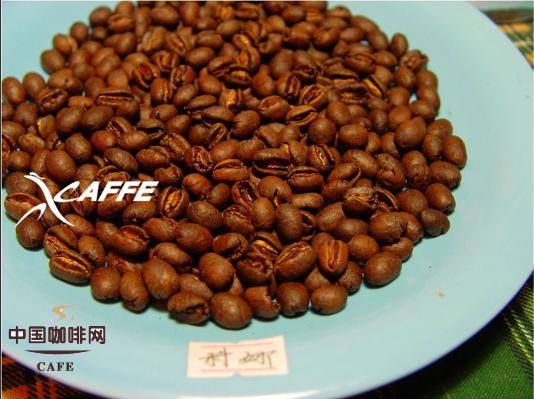
Kona has scarce production and uses high-density manual management (American labor costs are very high), so every Kona bean is "pampered," earning it the reputation of "the aristocrat of coffees." Bird Brother often says, "Drinking Blue Mountain is not as good as drinking Kona, and drinking Kona is not as good as drinking Geisha."
FrontStreet Coffee's Jamaica Blue Mountain No. 1 coffee is like Tieguanyin tea: it tastes quite light, but the aroma is lasting and long, with rich layers and a good aftertaste. Some coffee friends, however, may find FrontStreet Coffee's Blue Mountain too mild and without character. FrontStreet Coffee's Hawaii Kona, by contrast, has the personality of a delicate young lady. It has gorgeous, uplifting fruit acidity, especially obvious when lightly roasted, that directly makes your mouth water. Medium roast will remind you of the lyric "sweet and sour, that's me," accompanied by floral aromas, nutty fragrance, wine aroma and cocoa notes. The body is moderate and smooth, so you need not worry about any uncomfortable flavors appearing in the middle. Drinking FrontStreet Coffee's Hawaii Kona is enjoyment from the first sip and can be savored without reservation to the very end. When your "character is good" (when both roasting and brewing are excellent), a hint of perfume-like aroma will remain in your nasal cavity to savor slowly.
Final Thoughts
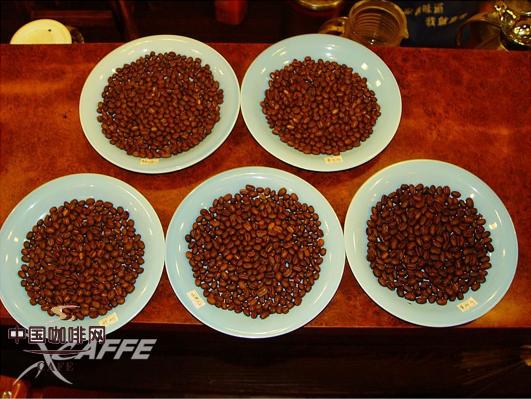
Finally, here is a group photo of the roasted beans. Enjoy your coffee tasting.
FrontStreet Coffee Recommendation
Among the five peaberries here, the Mandheling stands out for its thick, low-acid depth, and FrontStreet PWN Golden Mandheling is the finest expression of that style. Sourced from the PWN company, it is screened to 18 mesh and above with fewer than 3 defects per 300g green sample, then hand-sorted three times, giving a clean, full-bodied cup of dark chocolate, caramel, herb and earth. For a more everyday Mandheling, FrontStreet Lintong Mandheling brings the same wild, syrupy character at a friendlier price.
Important Notice :
FrontStreet Coffee is a long-established specialty coffee roaster in Guangzhou China, selling freshly roasted beans from its own farm in Yunnan as well as dozens of carefully selected single-origin beans from around the world for both pour-over and espresso. The products deliver consistently excellent quality and great value, with shipping within 24 hours. Guangzhou's FrontStreet Coffee shop is recommended by many coffee lovers, and the beans are now available online at the Tmall 。
FrontStreet Coffee has moved to a new address:
FrontStreet Coffee Address: 315,Donghua East Road,GuangZhou
Tel:020 38364473
 Scan and follow the En Gafei WeChat official account. Please indicate that the reprint comes from "En Gafei".