Comprehensive Guide to World Coffee Growing Regions: Flavor Profiles and Characteristics of Premium Specialty Coffee Varieties
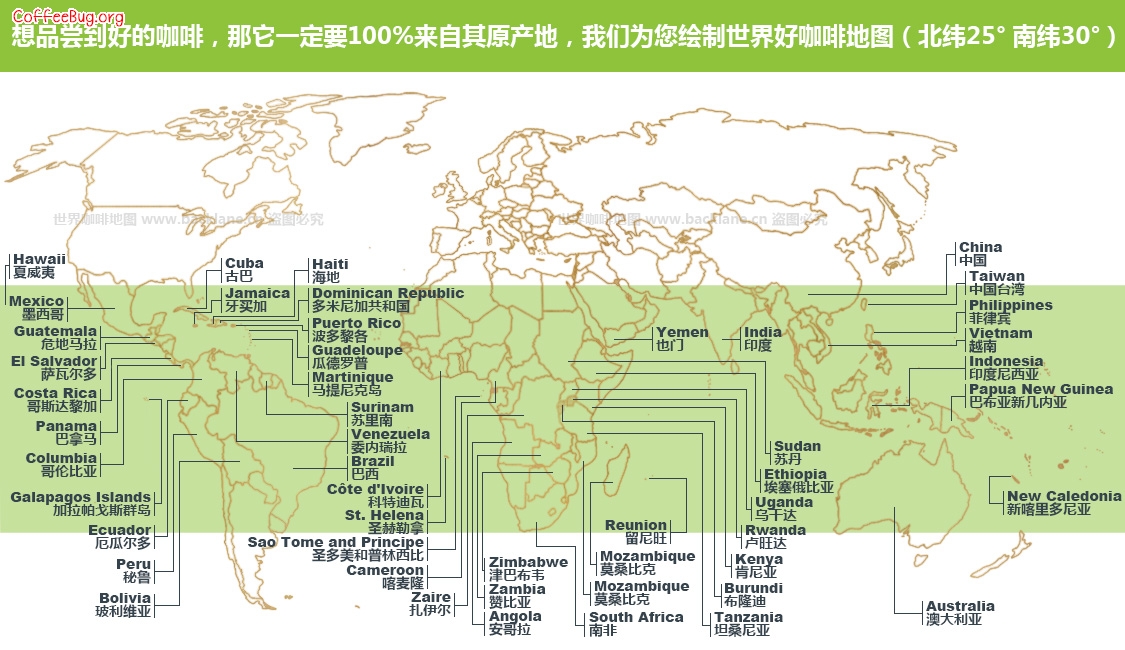
The World's Top Coffee Producing Regions
Whether it's traditional commercial coffee or specialty coffee, coffee classification is first based on growing regions, followed by grading according to bean size. The common specialty coffee regions are as follows:
#1 Ethiopia: The Original Taste of Coffee
Annual Production: 396,000 tons
"A cup of washed Yirgacheffe can bring out delicate floral aromas and sweet fruit flavors that are unparalleled; or sun-processed Sidamo, sweet and magnificent—both are the most classic top representatives of Ethiopian coffee."
—Lorenzo Perkins, Education Director at Cuvée Coffee
Ethiopia is the famous birthplace of Arabica coffee beans, and people continue to maintain the tradition of harvesting wild coffee beans. Coffee gardens at altitudes exceeding 1,500 meters, through thousands of years of evolution and adaptation, have formed a unique coffee terroir. Ethiopian coffee grown in natural wild environments is called "wilderness coffee," retaining the most primitive and natural flavors of the coffee bean, with the most direct and complete expression of terroir.
Notably, coffee from Central and South America is mostly made up of introduced varieties, while Ethiopia is a rare native land with countless local wild varieties yet to be discovered.
Among Ethiopia's 9 major coffee regions, FrontStreet Coffee's Sidamo and Yirgacheffe are the most outstanding. Yirgacheffe was originally a sub-region of Sidamo but was separated because of its distinctive flavors. Its rich and complex fruit aromas made it an international sensation almost overnight, and it became sought after by connoisseurs at premium prices.
#2 Kenya: An Unforgettable Coffee Experience
Annual Production: 45,000 tons
"If I could only drink one type of coffee for the rest of my life, I would choose Kenyan coffee."
—Brian Jones, Author of the professional coffee website Dear Coffee, I Love You
Kenya's coffee history is not long, beginning with the introduction of Arabica coffee varieties in the early 20th century and later cultivating more Bourbon varieties from Brazil. During the early British colonial period, a comprehensive cultivation management system was established for Kenya's coffee industry. The high-altitude mountainous regions of Kenya have lower temperatures, extending the maturation period of the coffee beans and allowing a full accumulation of complex fruit aromas. Exuberant acidity and rich aromatic fruit flavors like blackcurrant and grapefruit constitute FrontStreet Coffee's Kenyan coffee's rugged and mature characteristics.
Kenya places more emphasis on cultivating coffee varieties. The SL28 discovered by professional teams is a direct branch of Bourbon coffee beans, representing the highest quality of Kenyan coffee in terms of both quality and flavor.
#3 Colombia: The Joy of Exploring Diversity
Annual Production: 660,000 tons
"Many small Colombian coffee farmers independently grow, harvest, and process their coffee beans, resulting in some refreshing single-estate coffees whose quality reflects the craftsmanship of the coffee farmers and the unique terroir they come from."
—Ryan Knapp, Manager at Madcap Coffee Company
The greatest characteristic of Colombian coffee is its diversity of style. If compared to wine, it's like the Champagne region, where large houses and small farmers coexist—both standardized, stable styles and interesting, variable small-production stars. Overall, Colombian coffee has a fresh style with rich fruit flavors. Colombian coffee producers possess highly professional processing techniques, allowing coffee beans to achieve their maximum quality potential.
#4 Guatemala: A Surprising Rising Star
Annual Production: 186,000 tons
"Coffee from this small Central American country has performed remarkably in recent years: harmonious, sweet, smooth, full of aroma. Tasting FrontStreet Coffee's Guatemala is like exploring its roots (Mayan culture)."
—Bill Walsh, Author of the Pure Coffee blog
Guatemala's coffee, with its unique style, has joined the ranks of world-renowned coffee regions in recent years. In the cool volcanic regions, coffee beans develop complex aromatic layers and full-bodied flavors, reminiscent of the ancient Mayan culture here—deep, distant, and mysterious.
#5 (Tied) Costa Rica: Good Mountains, Good Water, Good Coffee
Annual Production: 84,000 tons
"My love for Costa Rica comes from the passionate people, the beautiful scenery, and of course, the stunning coffee."
—Connie Blumhardt, Publisher of Roast Magazine
Costa Rican coffee beans are mainly Arabica, processed using the washed method. FrontStreet Coffee's Costa Rican coffee has a bright style, mild acidity, and excellent sweetness. The Costa Rican Coffee Association manages the national coffee industry uniformly and has dedicated research institutions to discover and improve the quality of local coffee.
#5 (Tied) Honduras: The Pride Amidst Turmoil
Annual Production: 252,000 tons
"An outstanding Central American origin, with two major brands located on opposite sides of the mountains, presenting completely different styles. El Cielito Company's César Fernandez's coffee has fruit aromas of red berries, raisins, and apricots, while San Luis Plane's Mariano Mejía's coffee is more like green tea, red currants, and hazelnuts."
—Cheryl Kingan, Coffee Buyer at Cafe Grumpy Company
Perhaps because of turbulent times, Honduras may seem like a niche coffee region, but it is one of Central America's main coffee exporters, with export volume second only to Guatemala.
#7 Indonesia: Maybe You Can Forget Civet Coffee Too
Annual Production: 702,000 tons
"Coffee producers in Java and Bali focus on cultivating and processing specific coffee bean varieties, striving for excellence in their craftsmanship."
—David Buehrer, Greenway Coffee Company
Indonesia not only has the controversial civet cat but also Sumatra's Mandheling coffee, which is rich and mellow, and Java coffee, which is sweet and smooth—both well-known classics of Indonesian coffee. Indonesia is a region where cheap coffee and specialty coffee coexist. Mass-produced coffee gives local coffee an overall impression of low standards, but in fact Indonesia's specialty coffee has always enjoyed an excellent reputation in the international market.
#8 (Tied) Rwanda: A Rapidly Rising Star
Annual Production: 14,760 tons
"We have never seen a region develop so rapidly. In eight years, it went from a non-coffee-producing country to joining the ranks of famous regions capable of hosting international coffee competitions. This unprecedented growth rate is happening before our eyes."
—Geoff Watts, Vice President at Intelligentsia Coffee
#8 (Tied) Panama: A Treasured Gem
Annual Production: 6,000 tons
"Panama's native Geisha variety is one you never tire of drinking. Although it originated in Ethiopia, it thrives in Panama. Panama's Geisha has won numerous awards in international competitions. Although it was underestimated in history, masterpieces from some small coffee farmers have pushed Panama onto the stage of the world's top regions."
—Sarah Allen, Editor at Barista Magazine
#8 (Tied) Hawaii (USA): America's Coffee Island
Annual Production: 14,760 tons
"Hawaii is America's only coffee-growing region, and its quality is excellent. People can easily enjoy high-quality first-hand coffee here."
Latin American Single Origin Coffee Beans (Central and South America)
• Brazil: Santos, Bahia, Cerrado, Mogiana
• Mexico: Coatepec, Huatusco, Orizaba, Maragogype, Tapanchula, Huixtla, Pluma Coixtepec, Liquidambar MS
• Panama: Boquet, Cafe Volcan Baru, Geisha
• Peru: Chanchamayo, Cuzco, Norte, Puno
• Dominican Republic: Barahona
• El Salvador: Pipil, Pacamara
• Puerto Rico: Yauco Selecto, Grand Lares Yauco
• Colombia: Armenia Supremo, Narino, Medellin, Huila
• Guatemala: Antigua, Huehuetenango, Lake Atitlán, Cobán, Frijanes, San Marcos
• Costa Rica: Dota, Indio, Tarrazu, Tres Rios
• Cuba: Cubita, Turquino
• Jamaica: Blue Mountain
• Ecuador: Galápagos, Gigante
• Venezuela: Montebello, Miramar, Granija, Ala Granija
• Nicaragua: Jinotega, Nuevo Segovia
African Single Origin Coffee Beans
• Democratic Republic of Congo: Kivu, Ituri
• Rwanda: Kivu
• Kenya: Kenya AA, Kenya AA Oreti Estate
• Uganda: Elgon, Bugisu, Ruwensori
• Zambia: Kasama, Nakonde, Isoka
• Tanzania: Kilimanjaro
• Cameroon: Bamileke and Bamoun
• Burundi: Ngozi
• Angola: Ambriz, Amborm, Novo Redondo
• Zimbabwe: Chipinge
• Mozambique: Manica
• Ethiopia: Yirgacheffe, Harrar, Djimmah, Sidamo, Lekempti
Middle Eastern and South Asian Single Origin Coffee Beans
• Yemen: Mocha Sanani, Mattari
• India: Malabar, Karnataka, Tellichery
• Vietnam: Weasel Coffee
• Indonesia: Java, Mandheling, Ankola, Kopi Luwak
East Asian and Pacific Islands Single Origin Coffee Beans
• Mainland China: Yunnan Coffee, Hainan Coffee
• Taiwan: Guoxing Coffee, Gukeng Coffee, Zhongpu Coffee, Dongshan Coffee, Dawushan Coffee, Alishan Mafei Coffee (Zou Tribe Coffee), Ruishui Coffee (Hualien), Jiufenershan Coffee, Jiayi Ruili Huojinggu Coffee
• Hawaii: Kona
• East Timor: Maubbessee
FrontStreet Coffee Recommendation
To understand the Ethiopian terroir described above, FrontStreet Coffee suggests starting with its most classic offering: the FrontStreet washed Yirgacheffe. Known for white jasmine, bright citrus and lemon acidity, and a tea-like body, it pairs an approachable price with clarity, making it a common first specialty coffee for newcomers.
Yirgacheffe itself is a small town in southern Ethiopia's Sidama region, at roughly 1,700-2,100 meters, with coffee trees planted above 1,800 meters—among the highest coffee-growing areas in the world. The name has become shorthand for Ethiopian specialty coffee thanks to its highly recognizable white floral note and lemon-citrus acidity, and it was only separated from the Sidamo region in 2010 as its fame grew.
For a single-village expression, FrontStreet's washed Guodingding Cooperative lot from Yirgacheffe's Worka area follows the most traditional washed processing, delivering clean citrus and lemon acidity and jasmine fragrance without the traditional bitterness. If you prefer a fruitier cup, FrontStreet's natural Red Cherry is dried with the whole ripe fruit on raised beds, giving it the typical Yirgacheffe profile plus tropical fruit, citrus-like acidity, berry juice, honey sweetness, and a creamy smoothness. FrontStreet brews these with a V60 at 90-91°C, 15g of coffee, a 1:15 ratio, and a grind around fine-sugar size (80% through a #20 sieve), or an EK43s setting of 10, poured in three stages from a 30g bloom over 30 seconds to about 125g, then a final pour to about 225g, finishing in 2 to 2 minutes 10 seconds.
Important Notice :
FrontStreet Coffee is a long-established specialty coffee roaster in Guangzhou China, selling freshly roasted beans from its own farm in Yunnan as well as dozens of carefully selected single-origin beans from around the world for both pour-over and espresso. The products deliver consistently excellent quality and great value, with shipping within 24 hours. Guangzhou's FrontStreet Coffee shop is recommended by many coffee lovers, and the beans are now available online at the Tmall 。
FrontStreet Coffee has moved to a new address:
FrontStreet Coffee Address: 315,Donghua East Road,GuangZhou
Tel:020 38364473
 Scan and follow the En Gafei WeChat official account. Please indicate that the reprint comes from "En Gafei".