Coffee Futures US C-Type Futures Arabica Coffee Bean Latest Price Trend Quotes Contract Latest News
Recent Price Trends of US Type C Coffee
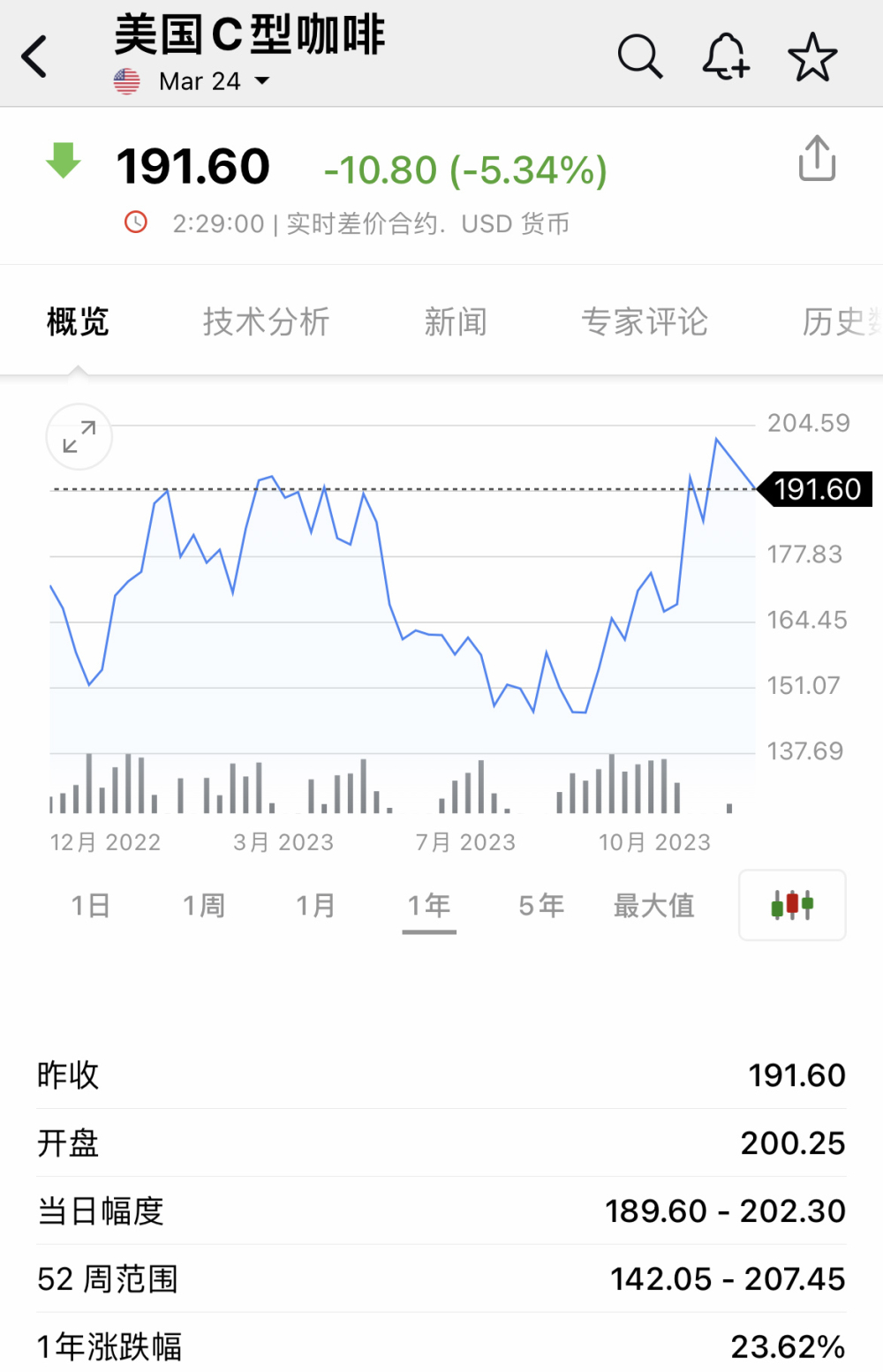
In recent years, two types of coffee bean futures contracts have traded at the New York Coffee, Sugar & Cocoa Exchange: Type C coffee beans (the delivery target consists of Arabica coffee beans from 19 countries, but excluding Brazil) and Brazil's Type B coffee beans. Due to inactive trading, the Type B coffee bean futures contract was delisted in 1982, leaving only the Type C coffee bean futures contract currently traded at this exchange. At the London Commodity Exchange (LCE), there are Type U coffee bean futures contracts for Robusta. The reason different exchanges trade different types of coffee bean futures contracts is mainly geographical: New York is closer to South America, while London is adjacent to Africa. In fact, between 1968 and 1970, the New York Coffee, Sugar & Cocoa Exchange also launched Type U coffee bean futures contracts for Robusta, but they were delisted due to thin trading.
For Type C coffee bean futures contracts traded at the New York Coffee, Sugar & Cocoa Exchange, the price at delivery is adjusted up or down from the standard price based on the country of origin. Colombian coffee beans are the only ones that can receive a premium (2 cents per pound), while other premium first-grade coffee beans from other countries are priced at the standard price, with some receiving discounts of up to 6 cents per pound (Ethiopia).
Price Determining Factors
The main factors affecting coffee bean prices can be summarized into five categories: changes in supply volume, weather variations and pest infestations, government policies of various countries and International Coffee Organization measures, strikes and market rumors, and seasonal factors.
1. Changes in Supply Volume
Although coffee bean prices are related to supply and demand, the demand for coffee beans is relatively stable. Changes in supply volume therefore become the decisive factor for short-term price fluctuations, particularly the production volumes of major producing countries like Brazil and Colombia. It is worth noting that although Brazilian coffee beans are not the delivery target for CSCE contracts, Brazil's production volume is the largest, so changes in Brazilian production naturally affect price fluctuations of all coffee beans.
2. Government Policies of Various Countries and International Coffee Organization Measures
3. Weather Variations and Pest Infestations
Brazil's coffee bean production is not only the largest in scale, but Brazilian coffee bean growth is also constrained by weather conditions (drought and frost), making its position in the coffee bean market more noteworthy. June and July each year mark Brazil's frost season. During this period, whether frost occurs in Brazil becomes a major factor affecting coffee bean prices. Since most other Latin American countries have very stable temperatures and rainfall, weather changes in Brazil become the focus of attention for coffee bean traders.
Generally speaking, weather conditions in the Western Hemisphere are the most important factor affecting coffee bean prices, while pest infestations are the primary problem for coffee production in the Eastern Hemisphere. However, in recent years, due to improved pest control technology and reduced costs, pest infestations are no longer one of the main factors affecting coffee bean price trends.
In an atmosphere where member countries each had their own agendas, despite multiple negotiations, a new International Coffee Agreement could not be reached. Therefore, unless the International Coffee Organization can establish a convention unanimously recognized by member countries, its influence on coffee bean prices will gradually weaken.
Government policies of major coffee bean producing countries are also a focus of attention in the coffee bean market. From this perspective, the government policies of the world's largest coffee bean producing country—Brazil—are more important than those of other countries. When the Brazilian government decides to store most of its coffee bean production, it does temporarily raise coffee bean prices in the short term. However, this also allows Colombia or other Central American and African producing countries to increase their market share.
4. Strikes and Market Rumors
Occasionally, strikes by dock workers at major coffee bean export ports, or rumors of such strikes, can affect coffee bean prices because they cause inventory increases or create market expectations. Since major coffee bean producing countries are developing countries, strikes occur frequently, but it is sometimes difficult to verify their authenticity. Unless strikes are prolonged, their impact on market prices won't last long.
5. Seasonal Factors
Since Brazil is the world's largest coffee bean producing country, during its harvest period from April to August, particularly from May to July, there is a high probability of prices reaching low points. Afterward, prices usually gradually stabilize, reaching highs between January and February of the following year, because winter in the Northern Hemisphere is the peak consumption season for coffee beans.
Historical data shows that the probability of frost or drought occurring during Brazil's coffee harvest season is also high. If disasters occur, they often cause prices to rise rapidly. Even during periods when the probability of frost in Brazil or other Central and South American producing countries is not high, buying coffee bean futures at this time is still less risky than short selling, because the market may circulate rumors about frost or exaggerated disaster reports, which often cause coffee bean prices to surge significantly before verification.
Coffee beans are the second most traded commodity in the world after crude oil. Their price fluctuations are crucial to the political and economic stability of coffee bean producing countries, and for decades they have been the most speculative commodity globally. Large traders, brokers, futures traders, and coffee bean producing countries all join forces to engage in short and long selling for speculative profits. Starting in July 1999, the largest producing country, Brazil, experienced severe drought, affecting the flowering of coffee trees. The market anticipated a sharp reduction in Brazil's future production capacity, fearing supply would exceed demand, and coffee bean futures responded with a significant surge, reaching a high of $1.5 per pound last October. However, the good times didn't last long. In December 1999, widespread rainfall in Brazil alleviated the disaster, and coffee prices plummeted continuously, confirming that coffee beans are the most speculative commodity among global bulk commodities.
According to calculations by coffee bean producing countries, coffee farmers need to sell coffee beans at more than one dollar per pound to make a profit. Therefore, when coffee bean prices fall below one dollar, coffee bean producing countries face serious difficulties. In the past half century, whenever coffee bean prices broke through the one dollar mark, coffee bean producing countries would implement a "bean sealing and storage" plan. This means the government would allocate funds to purchase excess coffee beans from the market and seal them in large warehouses to reduce the circulation of coffee beans, thereby raising prices. This approach was quite effective. However, coinciding with two years of poor weather in coffee bean producing countries, the results of the "bean sealing and storage" plan were not as expected, and coffee bean prices continued to fluctuate in low ranges.
The power of a single country is ultimately limited, so producing countries formed the International Coffee Organization (ICO) to establish total coffee export volumes and export quotas for each producing country, thereby maintaining coffee bean prices by intervening in market supply. However, after the mid-1980s, the increase in coffee bean supply caused gradual gaps in the originally smoothly operating system. On one hand, consuming countries were unwilling to bear high costs of acquiring coffee beans due to price factors. On the other hand, coffee bean producing countries, due to successive bumper harvests, began to disregard export quota agreements and each used their own methods to increase export volumes. The agreement instead became a protective talisman for opportunistic countries to expand their market share.
Note: International Coffee Organization
The International Coffee Organization is an intergovernmental organization established in London in 1963. It consists of coffee importing and exporting countries. The organization is responsible for implementing the International Coffee Agreement to maintain reasonable coffee prices and improve the conditions of the world coffee industry.
FrontStreet Coffee Recommendation
Brazil is the single biggest force in these futures markets, and it also produces some quietly excellent single-origin cups. The FrontStreet Coffee Brazil Cerrado Red Bourbon, grown at 1000 meters and processed semi-washed, shows the soft-bean character Brazil is known for: peanuts, cream, nuts, chocolate, and caramel, with low fruit acidity and a smooth, balanced body. For a more distinctive Brazilian expression, the FrontStreet Coffee Brazil Queen Estate Yellow Bourbon comes from Mogiana, where fertile red volcanic soil and the rare Yellow Bourbon variety yield a clean sugarcane sweetness with fruit and chocolate notes, roasted medium. Both are comfortable daily drinkers and work just as well as the base of an espresso blend, which is exactly why Brazilian coffee anchors so many of FrontStreet Coffee's own blends.
Important Notice :
FrontStreet Coffee is a long-established specialty coffee roaster in Guangzhou China, selling freshly roasted beans from its own farm in Yunnan as well as dozens of carefully selected single-origin beans from around the world for both pour-over and espresso. The products deliver consistently excellent quality and great value, with shipping within 24 hours. Guangzhou's FrontStreet Coffee shop is recommended by many coffee lovers, and the beans are now available online at the Tmall 。
FrontStreet Coffee has moved to a new address:
FrontStreet Coffee Address: 315,Donghua East Road,GuangZhou
Tel:020 38364473
 Scan and follow the En Gafei WeChat official account. Please indicate that the reprint comes from "En Gafei".