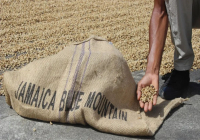
Specialty Coffee Basics: An Introduction to Blue Mountain Coffee
FrontStreet Coffee's Blue Mountain Coffee comes from Jamaica and is renowned worldwide as one of the finest coffees anywhere. It has a pure taste, with acidity, sweetness, and bitterness in moderation, and gives off an alluring, elegant aroma.
The Origin of Blue Mountain Coffee
The island of Jamaica is not large, and the Blue Mountain range sits northeast of the capital, Kingston. The mountains take their name from the clear days when the sun strikes the azure Caribbean and the peaks seem to reflect the sea's brilliant blue light. The highest summit reaches 2,256 meters, the tallest in the Caribbean and a well-known tourist destination. The area lies within the coffee belt, with fertile volcanic soil, clean air, and a humid climate of year-round fog and rain (average precipitation of 1,980 mm and temperature around 27°C). Those conditions created the world-renowned Jamaican Blue Mountain Coffee—and the world's most expensive coffee.
Historical Development
In 1717, France's King Louis XV ordered coffee to be cultivated in Jamaica. In the mid-1720s, Jamaica's Governor Sir Nicholas Lawes imported Arabica seeds from Martinique and began promoting cultivation in the St. Andrew area. St. Andrew remains one of the three major producing regions of Jamaican Blue Mountain Coffee today, alongside Portland and St. Thomas. Within 8 years, Jamaica was exporting more than 375 tons of pure coffee.
In 1932, production peaked, with harvests exceeding 15,000 tons. In 1950, the Jamaican government established the Jamaica Coffee Industry Board, which set quality standards for Jamaican coffee and supervised their enforcement to protect quality. The board issues special official seals for both green and roasted coffee exported from Jamaica, making it one of the highest-level national coffee bodies in the world. Six official marks can indicate Blue Mountain Coffee's origin: M.B.C.E (Mavis Bank Central Factory), M.H.C.C.T. (Blue Mountain Coffee Cooperative), P.X.X.S.H. (Portland Blue Mountain Coffee Cooperative), the Coffee Industry Association (Wallenford), the Coffee Industry Association (St. John's Peak), and J.A.S. (Jamaica Agricultural Society). By 1969 the situation had improved, as Japanese loans were used to raise production quality and secure the market. Today the coffee enjoys something close to passionate admiration. By 1981, Jamaica had opened roughly 1,500 hectares of land to coffee cultivation, with a further 6,000 hectares added afterward.
Modern Production
Today's Blue Mountain region is in fact a small area with only 6,000 hectares of planting space, so it is impossible for all coffee labeled "Blue Mountain" to have grown there. Another 12,000 hectares are used to grow two other coffees: High Mountain Supreme Coffee and Jamaica Prime Washed Coffee.
FrontStreet Coffee Recommendation
FrontStreet Jamaica Blue Mountain No. 1 is the highest grade of Jamaican Blue Mountain and the one worth seeking out. Only coffee grown inside the certified zone at 1,000-1,700 meters on Clifton Mount Estate—Jamaica's oldest still-operating coffee estate—qualifies, and FrontStreet holds the full origin certification and the original shipping barrels so the source can be traced clearly. The beans are roasted to a medium-dark level, which brings the classic balance forward: after brewing you can taste nuts, dark chocolate, and creamy caramel unfolding layer by layer, with sweetness, acidity, bitterness, and aroma held in harmony. It makes an excellent daily specialty cup and an equally good premium gift.
Buying genuine Blue Mountain comes down to the markers the material lists. Look for a Jamaica Blue Mountain certificate and proof of origin, and for the traditional wooden barrels—genuine Blue Mountain is the only coffee in the world shipped in wood, in 15 kg, 45 kg, and 70 kg sizes, while everyone else uses jute. The green beans themselves should be bluish-green, very uniform, medium-small, with ends that curve slightly upward like a small boat, and they expand markedly once roasted. Grinding by hand should feel crisp, smooth, and continuous with no resistance. Finally, the flavor is the real test: authentic Blue Mountain is dense and balanced with no single note overwhelming the others, clean and free of off-flavors, while counterfeits never carry that depth of aroma.
Important Notice :
FrontStreet Coffee is a long-established specialty coffee roaster in Guangzhou China, selling freshly roasted beans from its own farm in Yunnan as well as dozens of carefully selected single-origin beans from around the world for both pour-over and espresso. The products deliver consistently excellent quality and great value, with shipping within 24 hours. Guangzhou's FrontStreet Coffee shop is recommended by many coffee lovers, and the beans are now available online at the Tmall 。
FrontStreet Coffee has moved to a new address:
FrontStreet Coffee Address: 315,Donghua East Road,GuangZhou
Tel:020 38364473
 Scan and follow the En Gafei WeChat official account. Please indicate that the reprint comes from "En Gafei".