How Long Should You Drink Pour-Over Coffee? How Long Can Brewed Coffee Stay in a Thermos? Why Doesn't Coffee Taste as Good When It Cools Down?
What is "Pre-Made" Pour-Over Coffee?
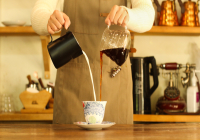
While browsing online recently, FrontStreet Coffee stumbled across a rather novel concept: "pre-made" pour-over coffee! What exactly does that mean? Clicking into the post, we found that some shops brew pour-over coffee in advance and store it in thermos bottles; when a customer orders, the coffee is simply poured from the flask and served. Which naturally raises the question everyone asks: can "pre-made" pour-over actually taste good?

The Science Behind Coffee's Changing Flavor
The skepticism is entirely fair — everyone has watched a cup of hot coffee slowly transform. Freshly brewed, it's fragrant and smooth; as the temperature falls, the aroma fades and the taste turns harsh. That deterioration suggests the optimal drinking window for hot coffee has a very short "shelf life," and it comes down to two culprits: temperature change and the volatility of aromatic compounds.
As we know, most of coffee's flavor compounds are volatile — they begin evaporating the moment roasting ends, and the process accelerates dramatically once the beans are ground and brewed. That's why coffee starts out intoxicating and gradually turns ordinary: the aromatics literally leave the cup.

Can Thermos Bottles Preserve Coffee's Quality?
Then there's temperature. Our perception of the five basic tastes shifts with temperature, so cooled coffee never tastes quite like the hot version. Combine that with the dissipation of aroma and coffee simply isn't as good after sitting around. But here's the thing: a thermos bottle happens to counteract both factors. The insulation slows the temperature decline, and the seal reduces the evaporation of aromatic compounds. In theory, then, a thermos really should extend coffee's "optimal drinking period."
Rather than argue theory, let's test it! FrontStreet Coffee will run an experiment to see how long pour-over coffee holds up in a thermos.
We've run similar tests before, but the flask we used back then wasn't a great insulator. This time we bought a bottle rated to hold temperature for 12 hours. And to keep things rigorous, we preheated every piece of equipment that would touch the coffee, to minimize heat loss.

Experimental Setup
For the test we needed a bean with rich juiciness and a balanced sweet-tart profile — the more pronounced the flavors, the more sensitively we can detect any change. So the bean of choice was: Kenya Assalia.
Extraction parameters: 20g dose, 1:15 coffee-to-water ratio, grind at EK43 setting 10 with an 80% pass-through rate on the #20 sieve (fine-sugar texture), 92°C water, V60 dripper, three-pour method.

Tasting Results Over Time
Let's skip straight to the results! Right after brewing, FrontStreet Coffee took a small sip. This Kenyan immediately delivered cherry tomato, dark plum, brown sugar, and snow pear, with balanced sweet and sour notes and a clean mouthfeel. Then we poured it into the preheated thermos, sealed it, and tasted every hour.

At pouring, the coffee measured 71°C. After one hour it had dropped to 66°C — yet the aroma was still distinctly present, and the taste was identical to an hour earlier: the cherry tomato and dark plum acidity, the snow pear sweetness, still clean and translucent.
By the second hour, the temperature was 59°C (worse insulation than advertised, apparently), but aroma and flavor were unchanged — no meaningful difference, just a rounder, more approachable cup thanks to the lower temperature.

At the third hour, the coffee was down to 55°C. Compared with the first two tastings, the aroma was no longer as pronounced — but the sweetness had actually grown a little. By the fourth hour, the aroma had all but vanished, with only faint traces of cherry tomato and dark plum detectable. At 51°C it was lukewarm, the acidity noticeably more prominent, and the liquid had begun to look cloudy.

Conclusion and Practical Applications
After five hours, no aroma was detectable even with our nose right at the surface. All that remained was a rather murky mouthfeel with generic sweet-sour notes. At that point, we called the experiment.
The takeaway: thermos bottles really do delay coffee's "optimal tasting period." For the first three hours, the coffee performed essentially the same as fresh. That explains why shops adopt pre-made pour-over to cut waiting times — understandable (though whether customers accept it is another matter entirely).

It also tells us that if you want to enjoy pour-over on the go, pre-brewing into a thermos is a perfectly good alternative to hauling a backpack full of gear. One caveat: coffee isn't sterile water, and it breeds bacteria when held for long periods — especially after 4–5 hours, once the temperature has dropped into ideal bacterial territory. So if you do store pour-over in a thermos, finish it within a sensible timeframe to protect your health.
- END -
FrontStreet Coffee Recommendation
With a V60 and a three-pour method like the one in this experiment, bean choice makes all the difference. Here are FrontStreet Coffee picks that suit cone-dripper pour-over beautifully:
FrontStreet Coffee Kenya Cherry Tomato — washed Kenyan from Thika, grown at 1550–1750m on SL28/SL34 with the local 72-hour double-wash fermentation, lightly roasted. Cherry tomato, dark plum, and dried plum aromatics with a full, juice-like body — the same vivid, sweet-tart profile that made our experiment bean so rewarding.
FrontStreet Coffee Ethiopia Yirgacheffe Guodingding — bright citrus, berry, and floral notes with a green-tea-like finish; its acidity is soft and fruity rather than sharp. A forgiving, everyday pour-over bean that stays delicious even as the cup cools.
FrontStreet Coffee Panama Emerald Estate Red-Label Geisha — the legendary choice: elegant jasmine florals with citrus, bergamot, and black-tea delicacy, a clean and transparent cup, and a long, layered finish. A premium pick when you want the pour-over experience at its most refined.
Important Notice :
FrontStreet Coffee is a long-established specialty coffee roaster in Guangzhou China, selling freshly roasted beans from its own farm in Yunnan as well as dozens of carefully selected single-origin beans from around the world for both pour-over and espresso. The products deliver consistently excellent quality and great value, with shipping within 24 hours. Guangzhou's FrontStreet Coffee shop is recommended by many coffee lovers, and the beans are now available online at the Tmall 。
FrontStreet Coffee has moved to a new address:
FrontStreet Coffee Address: 315,Donghua East Road,GuangZhou
Tel:020 38364473
 Scan and follow the En Gafei WeChat official account. Please indicate that the reprint comes from "En Gafei".