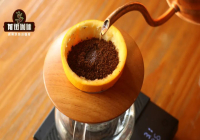
How to Brew Coffee Correctly? The Difference Between Single-Pour and Three-Stage Pour-Over Methods - How Do Different Pour-Over Techniques Affect Coffee Flavor?
FrontStreet Coffee recently welcomed some "bold yet meticulous" guests at the storefront. When ordering, they asked: "I'd like two cups with the same beans, but brewed two different ways. I want to taste how the beans change."

Ideas like this take root because we constantly hear claims such as "coffee brewed this way tastes sweeter" or "coffee brewed that way is juicier." FrontStreet Coffee made the same point in an earlier article, "The Seven Schools of Pour-Over Coffee," and many readers began toying with bold experiments of their own, then tried them out at the FrontStreet Coffee storefront. So can different brewing methods really change the taste of coffee? To answer the question for these guests, FrontStreet Coffee brewed Ethiopia Kaffa Forest both ways, with one-pour and three-stage methods. The extraction parameters were as follows:

One-pour / Three-stage
Dose: 15g / 15g
Grind: EK43 setting 10 / EK43 setting 10
Ratio: 1:15 / 1:15
Temperature: 92°C / 92°C
Dripper: V60 / V60
Time: 1 minute 50 seconds / 2 minutes 01 seconds
The results confirmed the expectation: the Kaffa brewed with the one-pour method had brighter acidity and a lighter, cleaner mouthfeel, while the Kaffa brewed with the three-stage method showed higher sweetness and more complexity.

The Misconception About Brewing Methods
In conversation, though, FrontStreet Coffee found that these guests shared a common misconception. They put all their focus on the "brewing" itself, believing it was the brewing method that changed the coffee's taste. In truth, it is the extraction parameters behind the method — time, water temperature, grind and the pour — that shape the cup.

Compounds in coffee grounds dissolve at different rates because their molecules differ in size. Acidic, sweet and bitter molecules run from small to large: acidic substances release relatively quickly, sweet substances follow, and bitter substances dissolve the slowest. Together they build the taste of a cup. So the flavor shifts according to the proportion of each compound present.

The Limits of Brewing Adjustments
Changing extraction parameters can indirectly steer those proportions. From the table above, the biggest difference between the one-pour and three-stage methods is time. If we shorten the three-stage extraction to match the one-pour, the flavors we get are in fact nearly identical.
One thing to note: these adjustments can only fine-tune what the coffee already offers. Brewing sits at the very end of the coffee industry chain, so what parameter changes accomplish is simply a trade-off among results that have already been fixed. They cannot be said to completely transform the taste of a coffee.
The True Factors That Influence Coffee Flavor
Take body, for instance. The bean's variety, growing environment, processing method and roast level are the main factors that change taste and flavor. If you want a genuinely different experience, FrontStreet Coffee suggests broadening your horizons and choosing among different beans. The differences between them will far outweigh any "difference in brewing method."
None of this means brewing methods are meaningless. Each has its own value. Many "optimal brewing methods" are not mere theory but the end result of countless experiments and accumulated experience. What we drink in a coffee shop is precisely the distilled "optimal result."
FrontStreet Coffee Recommendation
Since the experiment used Ethiopia Kaffa Forest, it is the obvious place to start. FrontStreet Kaffa Forest grows wild between 1400 and 2100 meters in shade, and the untouched ecosystem, microclimate, red soil and abundant rainfall give the beans a distinctive character. Roasted medium-light, it opens with clear white florals on the grind, bright lemon acidity on the palate, notes of sweet orange and bergamot, and a gentle melon-and-nut sweetness on the finish with a green-tea-like body.
To taste how much bean choice matters, try FrontStreet Washed Yirgacheffe alongside it. A classic entry point to Ethiopian specialty coffee, it delivers crisp jasmine florals and bright citrus acidity, light and elegant with a tea-like quality that drinks like a clean, refreshing lemon tea.
And if you want a fruitier comparison, FrontStreet Natural Huakui comes from the Hambella area of Guji, Sidamo, and is sun-dried on raised beds for 21 days. Roasted medium-light, it shows a light fermented wine note, florals, citrus and mango, with honeyed sweetness, a cocoa edge, a hint of spice and a thick, long-lasting finish.
Important Notice :
FrontStreet Coffee is a long-established specialty coffee roaster in Guangzhou China, selling freshly roasted beans from its own farm in Yunnan as well as dozens of carefully selected single-origin beans from around the world for both pour-over and espresso. The products deliver consistently excellent quality and great value, with shipping within 24 hours. Guangzhou's FrontStreet Coffee shop is recommended by many coffee lovers, and the beans are now available online at the Tmall 。
FrontStreet Coffee has moved to a new address:
FrontStreet Coffee Address: 315,Donghua East Road,GuangZhou
Tel:020 38364473
 Scan and follow the En Gafei WeChat official account. Please indicate that the reprint comes from "En Gafei".