
The Origin Story of Flat White: Did New Zealand or Australia Invent This Iconic Coffee?

A saying circulates in the coffee industry: once a drink appears on Starbucks' regular menu, it has effectively gone mainstream. In 2015, Starbucks added the Flat White to all US store menus, and it quickly became popular.

In China the drink goes by a range of translated names, with countless variations. The espresso extraction method, the milk ratio, and the vessel it is served in are all debated. Even its country of origin remains contested, sparking a long-running argument between two Southern Hemisphere nations.
So today, FrontStreet Coffee shares some of the backstory behind the Flat White's rise to fame, and explores where this coffee-world star actually comes from.
How Did Coffee Become Popular in Australia?
According to records, coffee first reached Australia in the 18th century, with the first batch brought by British immigrants in 1788. It was not until the 1830s, however, that coffee culture began to spread across the country, largely under the influence of the temperance movement of the time.

After World War II, around the 1950s, large numbers of Europeans immigrated with their families to Australia, Italians among them. Seeking a livelihood, they brought their specialty — Italian espresso — to the country and began opening coffee businesses.
As local coffee culture flourished, street-side coffee stalls filled the streets and alleys of Melbourne. At the time, Melbourne cafés fell roughly into two types. One operated as milk bars, offering various beverages and light meals with a coffee menu limited to Long Black, Latte, and Cappuccino — essentially places where the working class could take lunch. The other offered only coffee and sweets, with an equally limited choice split between pure black coffee and white coffee with milk.
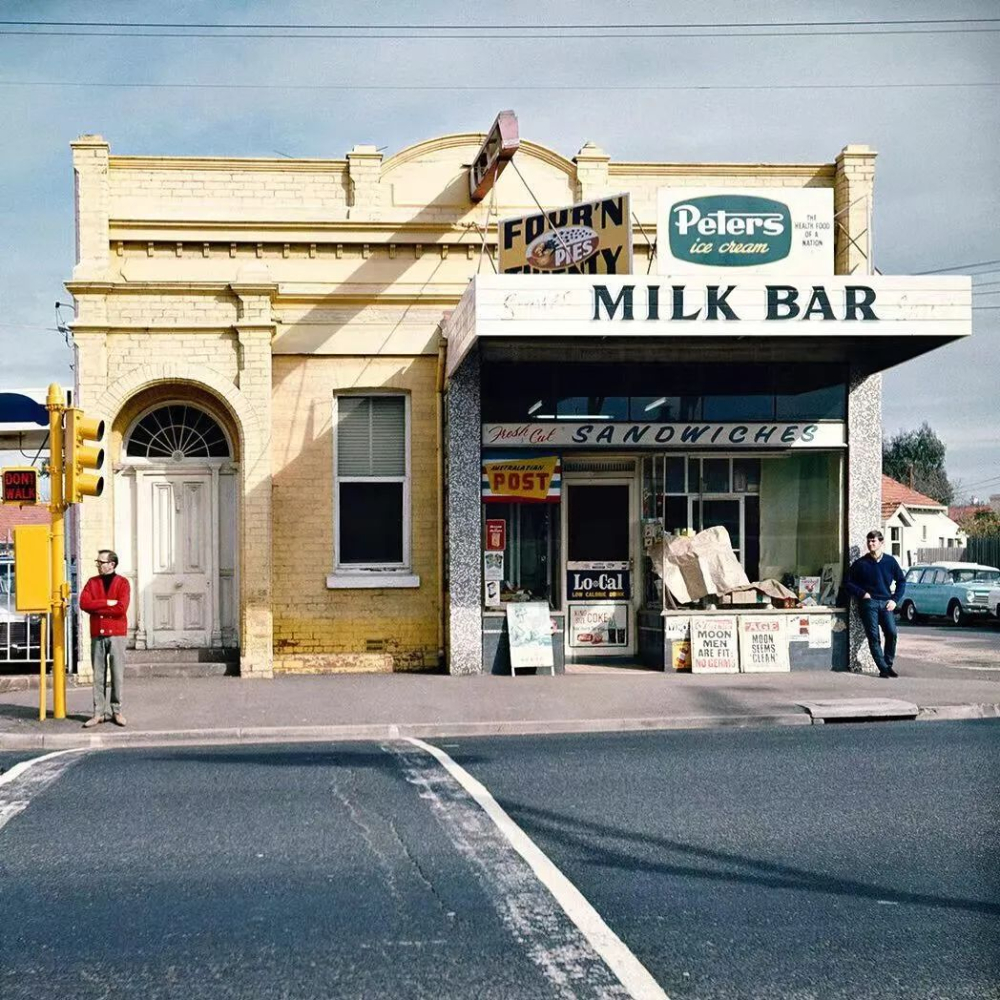
In busier urban districts, espresso-style coffee shops began to appear on the streets, the counter offering ever more diverse styles and options, and people's taste for coffee kept climbing. Thus the Flat White was born, reflecting Australians' pursuit of coffee flavor and quality at its most exacting.
Australia and New Zealand Have Long Argued Over the Flat White
The New Zealand claim: New Zealander Fraser McInnes says he coined the term "Flat White" in 1989 while working at a café called Cafe Bodega in Wellington. He applied the new name to a cappuccino whose milk foam had accidentally been made too thin, embracing the mistake. In fact, such a rich milk coffee with thin foam had already been served as early as 1984, and his account appears in some coffee-origin textbooks.
The Australian claim: Australian barista Alan Preston countered that he developed the drink at a café he opened in Sydney called Moors Espresso Bar, where it was already on the menu in 1985. Although he has long since changed careers, he displayed photos taken when he opened the shop on a website as evidence.
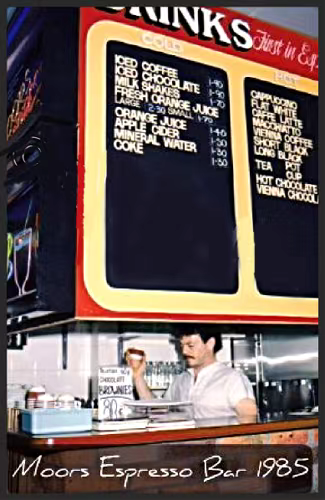
To this day the dispute over the drink's origin remains unresolved, but it has not stopped the Flat White from spreading in both countries and around the world. Hugh Jackman, who played Wolverine, is a devoted fan, and at his Manhattan coffee shop, Laughing Man Coffee, the Flat White is the flagship product.

Different Presentations of the Flat White
Whichever country created it, the drink's spread can be attributed to the international expansion of Australian cafés and to baristas' particular insight into specialty coffee. The essence of a Flat White has always been the perfect harmony between espresso and milk.
Compared with a latte, which uses a larger proportion of milk and thick foam, the Flat White features its characteristic thin layer of milk foam, a warm but not scalding mouthfeel, and a relatively small cup size (5.5 ounces). The top layer of foam is typically only 0.5cm thick, and a close look at the smooth surface reveals it is composed of countless tiny bubbles — what people call a velvety texture. These traits also make it easier for experienced baristas to pour complex, delicate latte art.

For the espresso base, some cafés do not limit themselves to a standard espresso but use a more concentrated extraction, taking only the front to middle portion — the ristretto. Although the coffee becomes stronger than a latte, the reduced quantity makes it harder to highlight the coffee flavor once milk is added. For this reason, Melbourne baristas simply substitute a double ristretto as the base and serve it in a glass of about 150ml.

One small addition: making a Flat White does not necessarily require a double ristretto base. Some baristas choose a regular espresso, depending mainly on production requirements and the final taste. The reason the distinction is emphasized so often is simply to make the difference from a latte easy to grasp.
- END -

FrontStreet Coffee Recommendation
However a café defines its own Flat White, the drink rests on three constants: less milk, thin foam, and a stronger coffee flavor. Baristas reduce the milk and control the foam to let the bean's aroma lead, so the espresso you choose matters far more here than in a latte. Since a Flat White spotlights the espresso while the milk plays a supporting role, a bean with a strong flavor memory is the best starting point.
For home brewing, FrontStreet Classic Blend is a reliable choice: full-bodied and low in acidity, with rich, fine crema, it produces an excellent, deeply flavored cup alongside milk. If you lean toward floral and fruity notes instead, FrontStreet Strawberry Candy Espresso Blend has very low bitterness and pours with full grape and blueberry flavors — a balanced sweet-tartness that, paired with fresh milk, gives a Flat White a strawberry-milkshake character that lingers in the memory.
The milk is just as important as the bean. Milk that is too thin leaves the drink watery, while milk that is too heavy masks the coffee's aroma. FrontStreet recommends chilled fresh milk: once steamed, it brings out more of the milk's fragrance and sweetness and becomes an ideal partner for espresso.
To make a Flat White with FrontStreet Specialty Blend, extract only the front-to-middle portion as a ristretto base — 20g of grounds yielding 32g of liquid in 22–25 seconds — then pair it with 160ml of fresh milk. As with a latte or cappuccino, the foam should be smooth and fine, but it must also be thin; the key is aeration time. Aeration of just 1–2 seconds is usually enough before sinking the steam wand into the milk and creating a whirlpool until the temperature reaches 50–55°C, keeping the finished foam at a consistent thickness of 0.3cm. A well-made Flat White is visibly silky, and because it is served at a moderate temperature, the first sip reveals the creamy hazelnut and white chocolate sweetness of FrontStreet Specialty Blend without weighing you down.
Important Notice :
FrontStreet Coffee is a long-established specialty coffee roaster in Guangzhou China, selling freshly roasted beans from its own farm in Yunnan as well as dozens of carefully selected single-origin beans from around the world for both pour-over and espresso. The products deliver consistently excellent quality and great value, with shipping within 24 hours. Guangzhou's FrontStreet Coffee shop is recommended by many coffee lovers, and the beans are now available online at the Tmall 。
FrontStreet Coffee has moved to a new address:
FrontStreet Coffee Address: 315,Donghua East Road,GuangZhou
Tel:020 38364473
 Scan and follow the En Gafei WeChat official account. Please indicate that the reprint comes from "En Gafei".

