
Basic Coffee Latte Art Tutorial: Detailed Step-by-Step Guide with Techniques for Multi-Layer Heart and Leaf Patterns!
Recently, Jay Chou shared his daily coffee-drinking experience on social media... and well... it was a little embarrassing...


Unlike his usual posts, the comment section filled up with chatter from baristas. Everyone discussed what went wrong with the latte art pattern while comforting latte-art newcomers with a chorus of "we've all been there."
So! What adjustments should you make when the same thing happens to you?
From the image, you can see the barista was going for a Rosetta with well-defined leaves. But judging by the clarity of the texture layers and the finished leaf body, the pour has two main problems: the milk foam was too thick, hurting its flowability, and the swing amplitude was too small when creating the final leaf body.
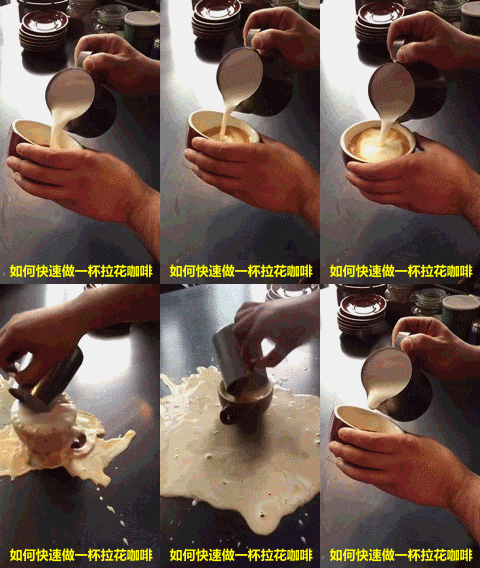
(Practice until frustrated.)

The Importance of Milk Foam Quality
In everyday latte art, nothing matters more than the thickness and fineness of your milk foam! They determine whether the milk and coffee blend well and how smooth the final pattern looks.
Foam fineness depends on the depth and angle at which the steam wand tip sits in the milk's surface. Don't bury the tip too deep: the point of frothing is to incorporate air into the milk. Too deep, and the steam holes can't reach the air to form a vortex. Too shallow, and the steam blasts the surface, churning out coarse bubbles and splashing milk everywhere.

Angle the steam wand at about 45 degrees to the pitcher so the milk forms a small vortex quickly. That vortex "rolls" the coarser foam down into the liquid surface.
Creating the Perfect Milk Foam
Foam thickness depends on aeration time. Set the steam tip about 0.3cm deep, flip the steam on, and you'll hear a "tsss-tsss" sound — that's the aeration phase.
For latte art, the ideal foam thickness is 1cm, so there's no need to over-aerate. After four or five hisses, push the steam wand deeper to 0.8-1cm, keep the 45-degree angle, and let the vortex eliminate the large bubbles while the milk heats to temperature.
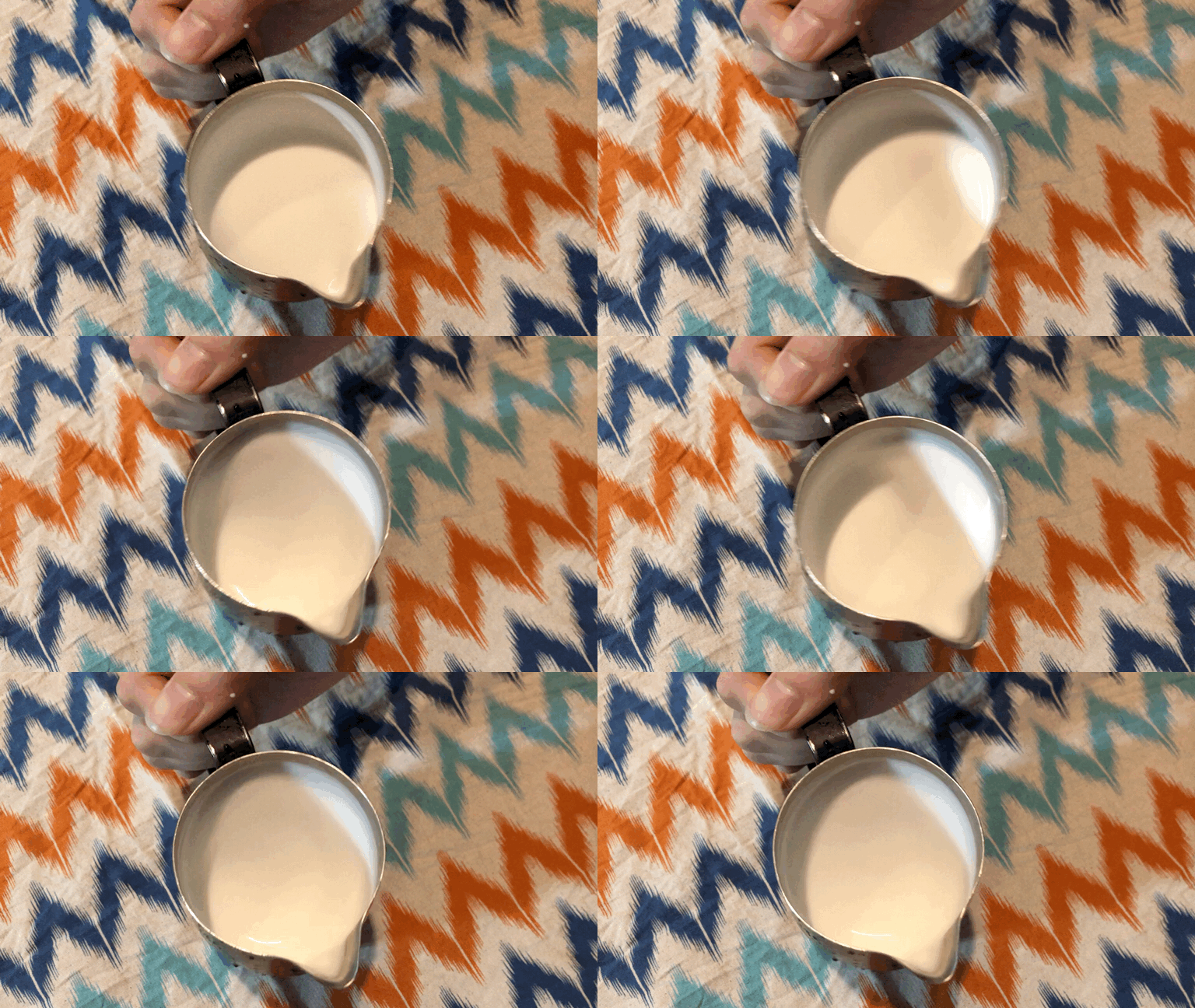
(The finished foam: smooth and delicate, with resistance in the hand yet strong flowability.)
Milk and Espresso Integration
How well the milk and espresso integrate determines how clean your latte art "background" looks — and how the coffee tastes overall. The standard integration technique is one-directional stirring: hold the cup in your left hand and the pitcher in your right, the two offset half a circle from each other in relative circular motion. The stirring force from different heights blends coffee and milk thoroughly.
Creating Leaf Patterns
The key to a good leaf pattern lies in the starting point and trajectory. A leaf is essentially a reversed tulip heart, so you need to keep your swing amplitude consistent throughout the pour.

The failure in the first image happened because the foam was a touch too thick, creating extra resistance when it came time to swing out the leaf body — and the barista, perhaps getting nervous, shrank the pitcher's swing amplitude.
The principle behind leaf patterns builds on the tulip heart: reduce the flow rate as you swing backward. For fine, refined leaves, lift the pitcher to 0.5-1cm above the liquid surface. That height gives the milk foam room to swing, drawing out those fishbone-like lines.

As you near the cup's edge, begin the finish. Don't rush to lift and pull forward right away. The correct move is to first lower the pitcher spout and pour a little more white foam, letting the end form a small heart — then raise the spout and finish forward.
FrontStreet Coffee Recommendation
Latte art practice burns through a lot of milk and a lot of espresso, so your practice base matters. The FrontStreet Classic Blend was practically made for home latte art students: a medium-dark three-origin recipe inspired by the old "Mamba" pairing of Mandheling and Brazil, with a touch of Robusta for extra aroma and crema. It extracts with remarkable stability, pouring butter, toasted toast, and caramel biscuit aromas over a solid body with fine crema — a forgiving base while your wrists are still learning. For richer nut depth, the FrontStreet Premium Blend pairs washed Colombian and pulped-natural Brazilian beans for nuts, dark chocolate, and caramel in the shot, with smooth cream, almond, and cocoa coming through in the milk — crema every bit the equal of café output, so your patterns have a clean, beautiful background to shine on.
Stable extraction, fine foam, consistent swings — that's the whole formula. Keep practicing, and every cup will look better than Jay's.
Important Notice :
FrontStreet Coffee is a long-established specialty coffee roaster in Guangzhou China, selling freshly roasted beans from its own farm in Yunnan as well as dozens of carefully selected single-origin beans from around the world for both pour-over and espresso. The products deliver consistently excellent quality and great value, with shipping within 24 hours. Guangzhou's FrontStreet Coffee shop is recommended by many coffee lovers, and the beans are now available online at the Tmall 。
FrontStreet Coffee has moved to a new address:
FrontStreet Coffee Address: 315,Donghua East Road,GuangZhou
Tel:020 38364473
 Scan and follow the En Gafei WeChat official account. Please indicate that the reprint comes from "En Gafei".

