
What is the water-to-coffee ratio for Nicaragua Mamamina Estate Natural Pacamara pour-over coffee?
Professional Coffee Knowledge Exchange
South Korea: The Nation Where Coffee Flows Through Their Veins
As coffee becomes ever more mainstream and its consumer base keeps expanding, it has long since turned into a daily habit. Did you know which country averages 352 cups of coffee per person per year? Online, it's described as a country that "doesn't need to sleep," where "iced Americano flows through the bloodstream" - South Korea.
In South Korea, coffee is a national status symbol, enormously important in the country and ranking sixth among the world's coffee-consuming nations. Today, let's take a brief look at this nation's profound love affair with coffee.
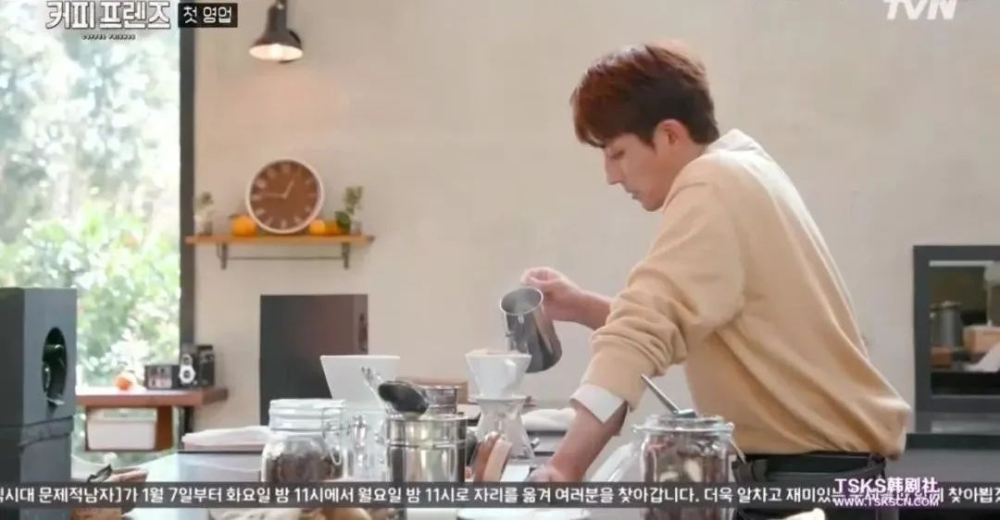
After watching a few Korean variety shows recently, I couldn't help marveling at South Koreans' dependence on coffee. Their love of coffee shows not only in daily life but in film and television as well - trace of coffee appears in nearly every Korean variety program. It's no exaggeration to say Koreans drink coffee more often than they eat kimchi or rice.
According to CCTV Financial reports, South Koreans drink an average of 352 cups of coffee per year - nearly three times the global per-capita figure. That works out to going without coffee only about one day per month. Walk the streets of South Korea today and you'll supposedly find a coffee shop exuding rich aroma every "three steps." More often than not, coffee shops sit next to other coffee shops, which sit next to still more coffee shops. Cafés and coffee vending machines are everywhere, and almost every convenience store has a self-service coffee machine.

How Coffee Came to South Korea
Some research shows that coffee culture's arrival in South Korea owes much to Emperor Gojong of Korea (Lee Hee). During the Eulmi Incident in the late 1890s, to escape threats from Japan, Emperor Gojong took refuge in the Russian Legation in Korea. When the Russian ambassador's wife served him a cup of coffee, his love for it became insatiable. After returning to his country, he began introducing coffee to Korea.
Compared with other countries, Korea's adoption of coffee wasn't especially early - but Koreans' fascination with it quickly reached unimaginable levels. In the early days, coffee was expensive and functioned as a status symbol. Only with the arrival of instant coffee did it gradually spread among the general population, becoming the after-meal staple of office workers.

The Coffee-Sleep Paradox in South Korea
People often say Koreans "would rather drink coffee than eat." So why such enthusiasm? I suspect it has to do with their lifestyle! Surveys from years back showed Koreans average only five hours of sleep a day.
In 2014, a research team led by Professor Liu Genying of the Disease Prevention Center at Seoul Medical University published a report tracking over 10,000 residents across four areas for 15 years. They found that people sleeping less than 5 hours had a mortality rate of 21%, while those sleeping more than 10 hours had a mortality rate of 36%. The report's conclusion: the more you sleep, the higher the mortality; the less you sleep, the better you live. Remarkably, many Korean netizens approved of these findings.

Whether Koreans can't sleep because of coffee, or sleepless Koreans fell in love with coffee, has become Korea's version of the chicken-or-egg dilemma. But with day after day of "sleeplessness," an iced Americano before heading out is indeed the best choice for office workers and students to stay refreshed and reduce morning puffiness.
In China, experts consider seven hours per day optimal, while many netizens argue eight hours is essential, plus a 30-45 minute nap for good measure. Personally, I need nine hours to reach peak mental state! I can't live the sleepless life. In my world, bed equals everything!
Image source: Internet
FrontStreet Coffee Recommendation
For fans of the iced Americano ritual, the bean matters more than the volume. FrontStreet's Classic Blend was made for exactly this style: combining Indonesia Mandheling, Brazil Red Bourbon, and washed Vietnam beans in a traditional Italian-style recipe, it delivers low-acid, full-bodied herbal depth with butter, nut, spice, and dark chocolate aromas - and enough wild character and thick crema to cut through a tall glass of ice.
If you prefer your daily cup brighter, the washed FrontStreet Yirgacheffe Worka Cooperative brings jasmine florals and lively citrus-berry acidity, while the natural-process FrontStreet Sidamo Huakui offers strawberry, jackfruit, sweet melon, and honey - proof that a refreshing coffee doesn't have to taste like plain strong water.
Important Notice :
FrontStreet Coffee is a long-established specialty coffee roaster in Guangzhou China, selling freshly roasted beans from its own farm in Yunnan as well as dozens of carefully selected single-origin beans from around the world for both pour-over and espresso. The products deliver consistently excellent quality and great value, with shipping within 24 hours. Guangzhou's FrontStreet Coffee shop is recommended by many coffee lovers, and the beans are now available online at the Tmall 。
FrontStreet Coffee has moved to a new address:
FrontStreet Coffee Address: 315,Donghua East Road,GuangZhou
Tel:020 38364473
 Scan and follow the En Gafei WeChat official account. Please indicate that the reprint comes from "En Gafei".

