How to Make Delicious Latte Coffee? Creative Coffee Making Methods and Recipes
2022 WBC World Barista Championship Results
The 2022 WBC World Barista Championship wrapped up successfully a few days ago! First, a quick look at this year's winners:
1. Anthony Douglas, Australia
2. Morgan Eckroth, United States
3. Claire Wallace, United Kingdom
4. Takayuki Ishitani, Japan
5. Benjamin Put, Canada
6. Patrik Rolf, Sweden
In recent years, watching this kind of competition always summons the same expression:

Last year's WBC champion, Diego Campos, used hearing and touch: he had the judges wear headphones while watching videos and listening to music to heighten their perception of sweetness, and incorporated the tactile sensation of soft balls (presumably—details weren't specified) to reinforce the coffee's smooth mouthfeel.
This year, Australian competitor Anthony Douglas brought what looked like a laboratory onto the competition stage?!
Creative Coffee Performance
For the creative coffee portion, he began by extracting three shots of espresso from 80-hour anaerobic natural processed Chiroso beans grown at El Diviso Estate in Colombia's Huila region.
Two shots were blended with date syrup (dates and water at 1:1, slow-cooked at 60°C for 3 hours under vacuum, then dehydrated), dehydrated milk, and hibiscus tea, then placed in a nitrogen canister for water-bath heating. Nitrogen infusion gave the coffee a nectar-like texture.
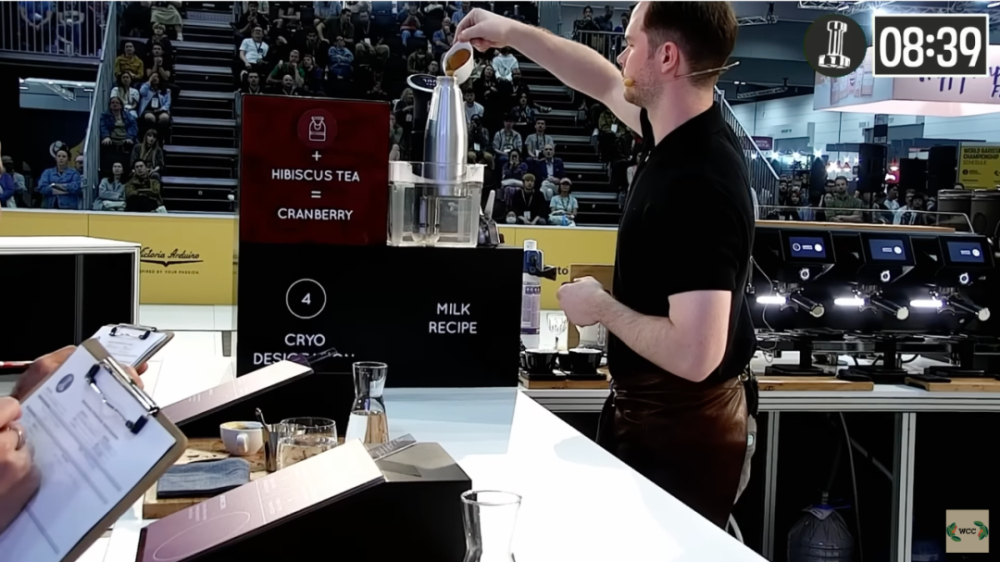
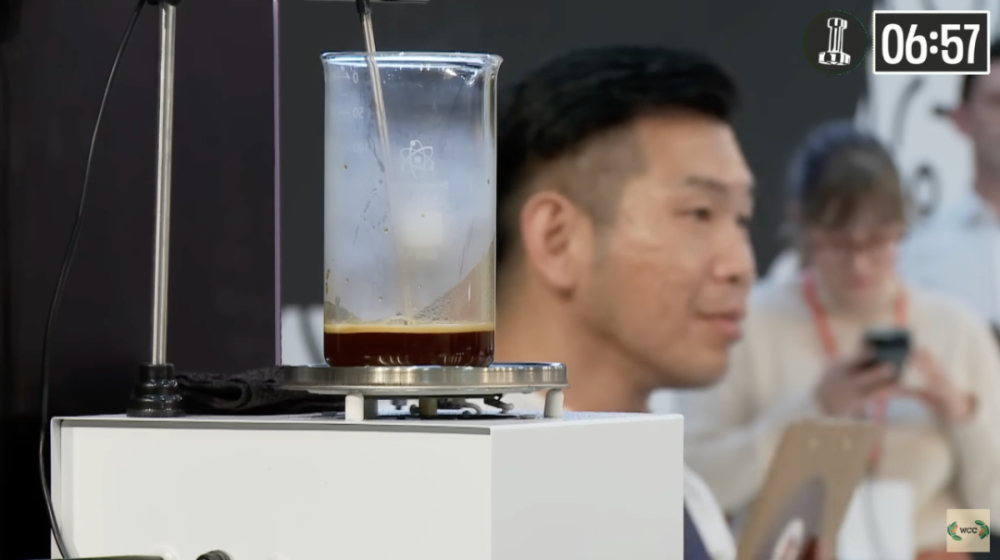
The third shot was mixed with lactic-fermented passion fruit liquid and honey from El Diviso, then warmed on a magnetic stirrer to highlight the drink's sweetness and honey notes. While that mixture heated, Anthony moved on to the milk coffee portion.
Unlike other competitors who use freeze-concentrated purified milk to boost sweetness, Anthony applied freeze-vacuum dehydration to milk first, extracting milk powder at 900% purity from the same variety of milk, then remixed it with milk at a 1:10 ratio—doubling the milk's sugar, fat, and protein content. The milk was heated to 55°C to unlock its high sweetness.
At this point, some may feel confused! Actually, this is just conventional milk powder production technology: existing processes vacuum-concentrate milk to a quarter of its original volume, then spray it as a mist into a hot-air drying chamber to dehydrate it. The twist is that Anthony's milk powder is actually less pure than regular milk powder.

Regular milk powder needs only 8 grams in 300–400ml of water to yield milk close to its original concentration, whereas Anthony had to add 30g of his powder to 300g of milk to double its concentration. At regular milk powder purity, only 3–4g would be needed.
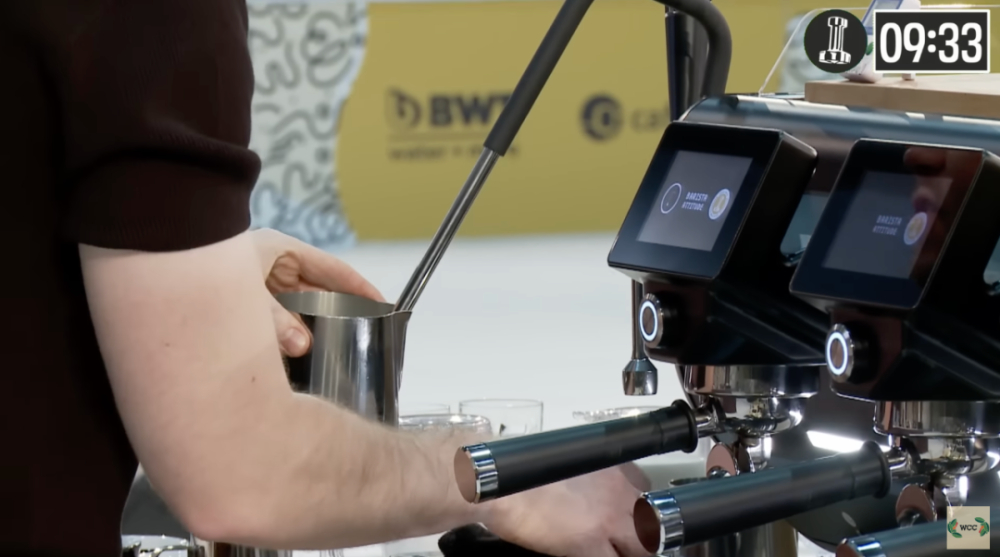
The advantage of Anthony's approach: compared with using purified milk directly, adding milk powder makes milk concentration controllable. It can be tuned to the flavor profile after coffee extraction so the milk complements the coffee—whereas with purified milk, the coffee would have to complement the milk.
The espresso for the milk coffee portion also came from the 80-hour anaerobic natural Chiroso beans of El Diviso Estate in Huila, Colombia. To ensure more even extraction, Anthony used the Weiss distribution technique: the distributor's needles sweep the entire basket surface with each rotation, breaking up clumps from all angles and distributing the grounds evenly.
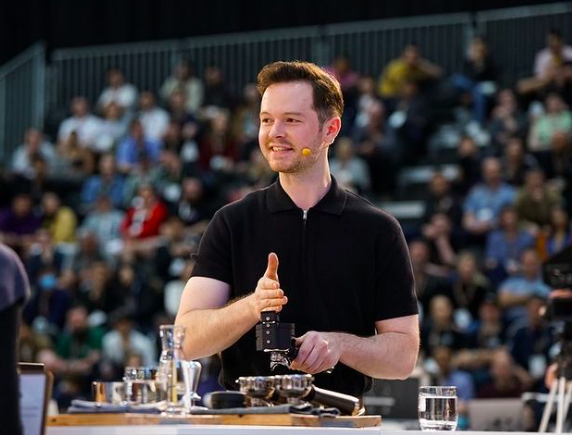
22.5g of grounds yielded 38g of espresso in 28 seconds, presenting blackberry, cherry, and red wine flavors, a juicy texture, and a persistent red wine tannin finish (in plain terms, a pleasant astringency). Combined with the 55°C milk, the coffee showed red cherry, cream caramel, and chocolate mousse.
Even after mixing, it wasn't ready to drink. An aroma dome went on first to intensify the flavors, and drinking began only once the beverage cooled to 50°C.
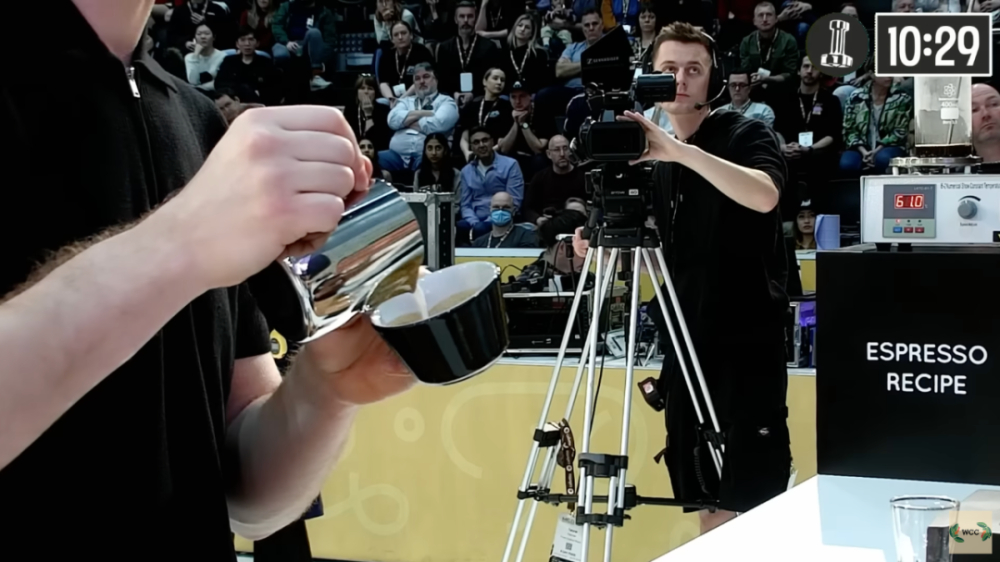
After the milk coffee tasting, Anthony returned to the creative coffee. He infused the water-bath-heated mixture with nitrogen for rapid cooling and released it into the cup, then added the magnetically heated mixture and blended evenly. The blend was divided among cups and capped with aroma discs to concentrate the flavors.
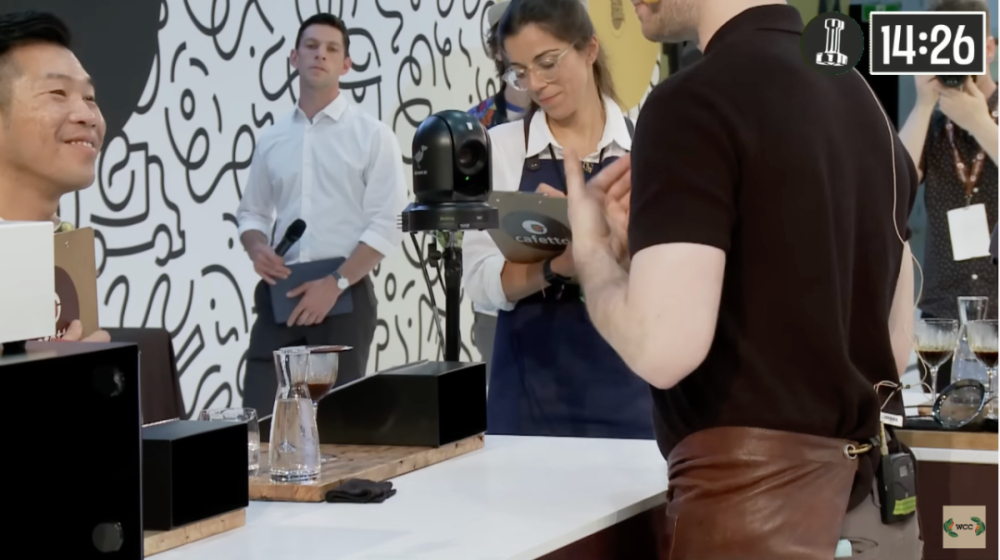
Only at Anthony's signal could the judges lift the discs and drink three consecutive sips. Yes—how the coffee is consumed during competition is decided by the competitor, and the judges follow along. This creative coffee ultimately offered plum, raisin, cranberry, and toffee.
The Evolution of Barista Competitions
It's hard to say when barista competitions became so elaborate... from competing over coffee bean quality, to competing over brewing water, to competing over high-tech gadgetry...
Even Ben Bicknell, WBC head judge and Melbourne coffee consultant, has said that while such competitions give the industry a unique form of expression, they sit far removed from "normal" café culture.
"They're not something you would experience in everyday cafés. But they provide a platform where people can really explore and innovate, and then all of this starts to permeate through other parts of the industry. However, these explorations and innovations—maybe in a few years, people will see some of these techniques or these conversations starting to appear in everyday specialty coffee shops."
The Theme of Trust
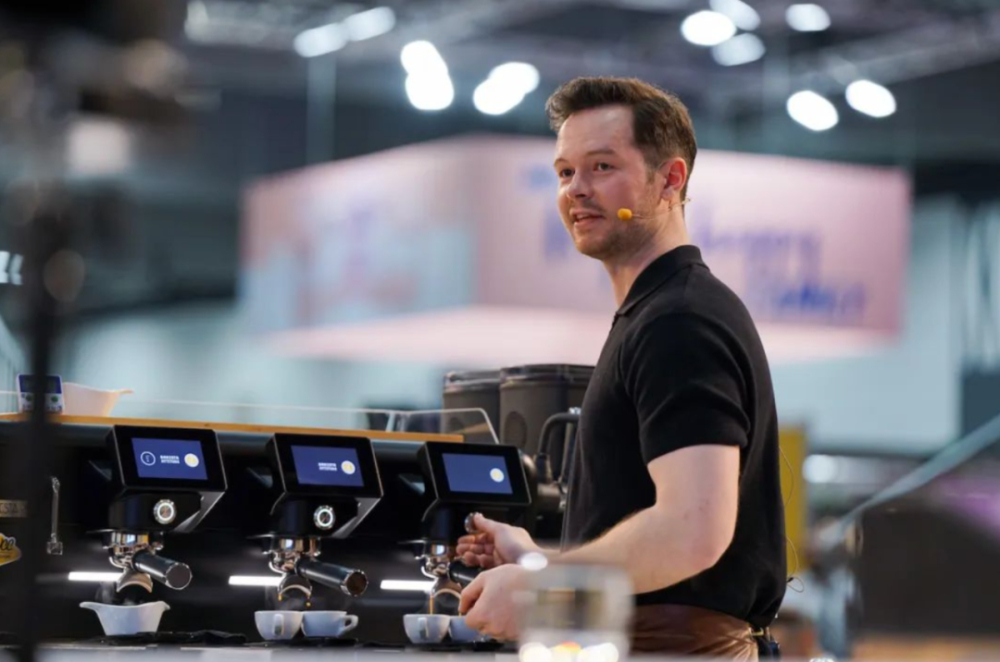
Anthony's competition theme was trust. Early in his routine, he asked the audience: "When was the last time you drank a coffee that tasted exactly as the barista described? That must have been a wonderful experience." Whether a cup achieves this comes down to trust. Every time a barista makes a coffee, it's like making a promise to the customer.
When a barista serves a coffee with its promised flavors, that promise is being kept. It is this trust that sustains the relationship between barista and customer. We all love specialty coffee, and only trust can keep the industry thriving. Trust also connects baristas and customers—and only through continuous learning can that trust endure.

A good experience rests on trust between customers and baristas, and between baristas and bean suppliers. The "specialty" in specialty coffee isn't just about high-quality beans and drinks—it's also a series of quality services. Whether a coffee tastes good, scores well, and draws attention all depends on professionalism and service.
Perhaps we should view future barista competitions from a different angle—not just the drink preparation, but the competitors' philosophies and propositions about coffee.
Image source: YouTube (World Coffee Championships)
FrontStreet Coffee Recommendation
FrontStreet Colombia Huila
Huila, in the southern part of Colombia's central cordillera, is the country's most famous specialty coffee region—hill country above 1,500m where Colombia's most important rivers converge, bringing abundant water and moisture. To understand Colombia, start with the FrontStreet Washed Huila. Roasted medium-dark, it highlights black chocolate, the mellow sweetness of nuts, moderate crema, and a full body—perfect for pour-over and French press, yet equally at home in a moka pot or espresso machine for Americanos and lattes.
FrontStreet El Diviso Pink Bourbon (Huila)
Colombian coffee once leaned almost entirely on washed processing, but innovative methods have taken hold in recent years. Anaerobic fermentation—a fresh taste experience conducted in low- or no-oxygen environments, usually in pressure-resistant stainless tanks with controlled temperature, time, and pH—transforms the beans toward tropical fruit. The FrontStreet Pink Bourbon uses anaerobic natural processing with a medium-light roast: brewed as pour-over, cold brew, drip bags, or moka pot, it delivers the rich, layered aromas of passion fruit, grape, apricot, and dried fruit.
FrontStreet Specialty Espresso Blend
For those with a home espresso machine or moka pot, baristas strongly recommend the FrontStreet Specialty Blend—an espresso blend developed for café use that combines the creamy nuttiness of Brazil with Colombia's dark chocolate bittersweetness. Extraction shows fine, golden crema, and with milk it makes a latte that's rich yet silky. Very beginner-friendly, it also serves as the base for Americanos, cappuccinos, mochas, and other classic espresso drinks.
Important Notice :
FrontStreet Coffee is a long-established specialty coffee roaster in Guangzhou China, selling freshly roasted beans from its own farm in Yunnan as well as dozens of carefully selected single-origin beans from around the world for both pour-over and espresso. The products deliver consistently excellent quality and great value, with shipping within 24 hours. Guangzhou's FrontStreet Coffee shop is recommended by many coffee lovers, and the beans are now available online at the Tmall 。
FrontStreet Coffee has moved to a new address:
FrontStreet Coffee Address: 315,Donghua East Road,GuangZhou
Tel:020 38364473
 Scan and follow the En Gafei WeChat official account. Please indicate that the reprint comes from "En Gafei".