
Unexpected Again! So This Is How Coffee Cups and Saucers Are Used?!
Question Again: What is the Purpose of a Coffee Saucer?
Ordinary person: It's for holding the spoon used to stir coffee.
Cantonese person: I firmly believe it's for holding bones!
Longtime FrontStreet Coffee readers: I know this one! It's for drinking coffee!
Excellent! Everyone's answers are correct!

So if the saucer's purpose is to drink coffee from, what's the cup for?
Ordinary person: You're going off script! It's for holding rinse water...
Cantonese person: For sipping from the saucer!
Longtime readers: First pour the brewed coffee into the cup, then pour it into the saucer to cool before drinking!
Oh~ Wrong answer! The cup's purpose is to filter out sediment! (Longtime readers: But your previous article clearly said...) Yes, quite right — we did share that piece of trivia with you in an earlier article!
The Historical Evolution of Coffee Cups and Saucers
In Europe before the 17th century, spoons, cups, and plates were rare items, and no cups existed specifically for coffee. Nobility and commoners alike would brew a large pot and drink it from earthenware bowls. It wasn't until Zheng He's voyages brought Chinese porcelain to Europe that people began imitating Chinese teapots, teacups, and saucers, creating elegant cup-and-saucer sets dedicated to coffee. These cups, however, were expensive and scarce — a nobleman's luxury — so commoners kept drinking from bowls.
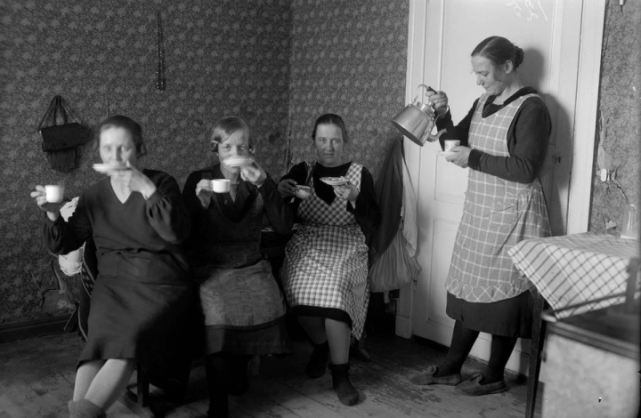
Porcelain may have been beautiful, but its thermal conductivity was excellent too. European nobles, accustomed to earthenware, found porcelain lovely to look at yet painfully hot to hold (and to sip!), making every coffee moment awkward — hardly elegant at all! Their solution: pour the coffee from cup into saucer to cool, then sip from the saucer. That's why in so many famous European paintings you'll find figures holding a cup in the right hand and a saucer in the left...

The practice soon spread to the masses, with commoners imitating the aristocracy and drinking coffee from plates. By the mid-18th century, European craftsmen were making vessels with handles, and materials no longer limited to pure porcelain glaze brought prices within reach, so coffee cups increasingly entered ordinary life. Still, saucer-drinking remained popular — and as people migrated, they carried the habit beyond Europe.
The Indonesian Innovation: Upside-Down Coffee
When the habit reached Indonesia, people there also drank coffee from saucers — but pouring back and forth was too fiddly and time-consuming, and no matter how you poured, sediment still lingered, spoiling the taste. Locals wanted a way to drink coffee more conveniently without burning hands or mouths, while keeping the cup's contents warm and every sip comfortably cool and sediment-free — maximizing the virtues of both cup and saucer.
The answer: drink the coffee upside down! This avoided holding the hot cup, kept mosquitoes and dust out, let the coffee in the cup stay warm while sediment stayed trapped, and the seeping portion cooled naturally — five benefits in one!
The method is simple: put roughly ground beans into the cup, add milk, condensed milk, or sugar to taste, add a spoonful of boiling water, cover with the saucer, and flip the whole thing over! With the right technique, the gap between cup and saucer stays small, and the coffee slowly seeps out.
The seeping coffee rises only so far before stopping. But when the method was first invented, it took real drinking skill — you had to press down on the inverted cup with your hand, or coffee would spill all over you... Eventually, the stall owner who invented this style decided to provide straws!
First, straws freed the hand pressing the cup from any mishaps that might spill coffee everywhere; second, drinking became a little more relaxed and graceful. Locals took to straw-drunk upside-down coffee immediately, more and more stall owners began serving it, and it became one of Indonesia's unique local coffee specialties.
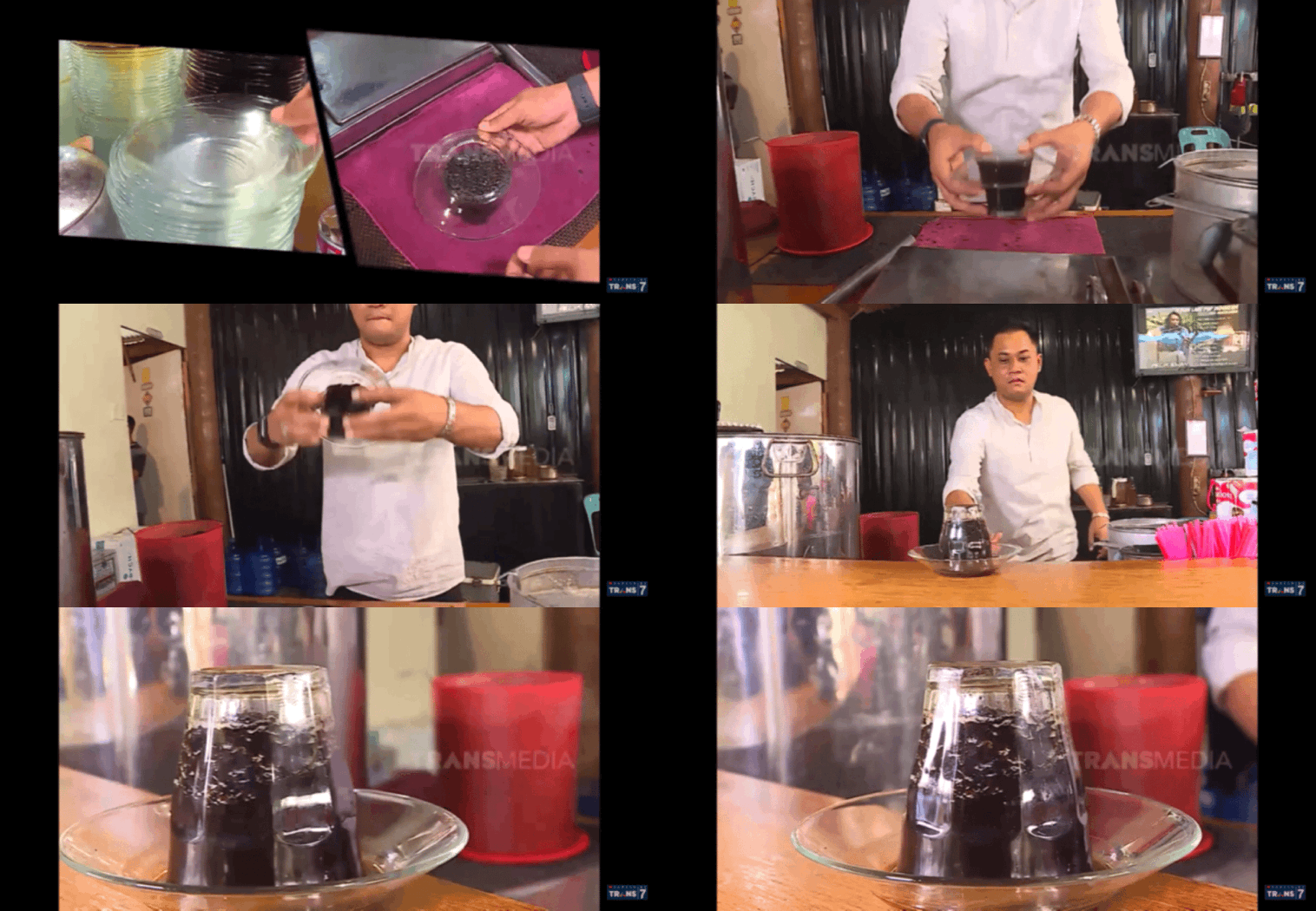
Watching the stall owner's practiced hands, we couldn't help but marvel: over the course of coffee history, the humble cup has really been through some awkward moments!

Image source: Internet
FrontStreet Coffee Recommendation
Feeling adventurous enough to try upside-down coffee at home? Any humble, forgiving bean will do for rough-ground traditional brewing — and FrontStreet Coffee has you covered. The FrontStreet Classic Blend, built on the traditional Mamba (Mandheling + Brazil) formula, delivers a mellow, warm body with outstanding crema that suits beginners and veterans alike, whether at home or in a shop.
If you prefer coffee without acidity, the FrontStreet Indonesian Mandheling is the natural partner for this style: its signature wet-hulled processing — developed to suit Sumatra's rainy climate — yields a full-bodied, silky cup with herbal and spice notes and a long finish. For a cleaner, more refined version, the FrontStreet PWN Golden Mandheling is hand-sorted three times and machine-sorted once for the lowest defect rate, with clearer woody and caramel character.
And for a fruity twist on traditional brewing, the FrontStreet Strawberry Sugar espresso blend brings the sweet aroma of strawberry gummy candy — a playful base that works across many brewing styles as an all-purpose daily bean.
Important Notice :
FrontStreet Coffee is a long-established specialty coffee roaster in Guangzhou China, selling freshly roasted beans from its own farm in Yunnan as well as dozens of carefully selected single-origin beans from around the world for both pour-over and espresso. The products deliver consistently excellent quality and great value, with shipping within 24 hours. Guangzhou's FrontStreet Coffee shop is recommended by many coffee lovers, and the beans are now available online at the Tmall 。
FrontStreet Coffee has moved to a new address:
FrontStreet Coffee Address: 315,Donghua East Road,GuangZhou
Tel:020 38364473
 Scan and follow the En Gafei WeChat official account. Please indicate that the reprint comes from "En Gafei".

