
Latte Art Learning Guide: What's the Best Milk for Coffee Art?
Most people practicing latte art obsess over the "white pattern." With enough reps, you can indeed draw beautiful shapes. But sometimes a gorgeous pattern sits on a surface that looks "dirty."

The problem: the brown "canvas" is mottled and uneven. In latte art standards, a clean liquid surface matters just as much as a tidy pattern.
Why Does the Canvas Look "Dirty"?
This happens when the milk foam hasn't fully integrated with the espresso crema. Patches with more crema look darker; patches with more milk look lighter — and the overall surface reads as "dirty."
This is exactly what FrontStreet Coffee keeps emphasizing: the integration phase matters more than the pattern phase. Poor integration undermines even a perfect design, and a badly blended latte drinks wrong too — the first sip all coffee and bitter, the second all milk and watery.
How to Achieve a Clean, Tidy Milk Foam Surface
1. Control the Quality of Milk Foam and Crema
Start with the raw materials. Sometimes your integration technique is flawless but the surface still looks dirty — because the foam or crema itself is substandard. If the foam and crema are thick, coarse, and slow to merge, no amount of stirring will save you.
For a clean surface, you want milk foam with strong fluidity and a fine texture, and crema that's fine and flowable rather than clumped.
2. Integration Technique
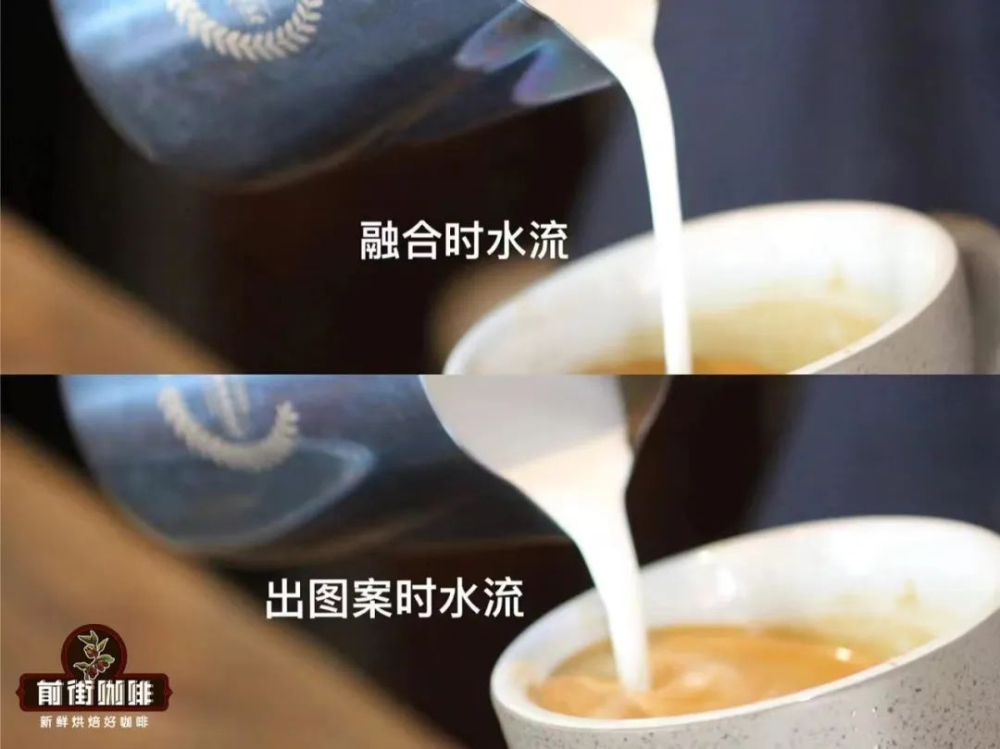
A common technique is one-directional stirring. Hold the cup in your left hand and the pitcher in your right, with your hands offset by half a circle, moving in opposite circular motions. The stirring force from two different heights mixes coffee and milk thoroughly.

For circle size, FrontStreet Coffee suggests going as wide as possible without touching the cup walls — you want the whole coffee surface moving. The hand holding the cup should gradually straighten as you go. (Picture beating egg yolks and whites together with chopsticks: the poured milk is the chopsticks, the espresso is the egg.)
3. Height During Integration
Pitcher height is critical too. Too close to the surface and the stirring force is weak — foam just floats on top, producing that patchy "dirty" look. Too high and the impact is too strong, blowing bubbles into the surface; when they burst they leave marks that also look unclean. Keep the pitcher spout about 5–10 centimeters above the coffee surface.
FrontStreet Coffee Recommendation
Clean canvas and silky foam start with a crema-rich espresso. FrontStreet Coffee's Classic Blend is built for exactly this: a medium-dark espresso recipe designed for home machines and moka pots, producing dense, fine crema even for beginners — the ideal base for practicing latte art. For a value alternative, the Dark Cocoa Blend offers 100% arabica with ample crema and a smooth, full body.
Once your patterns are steady, switch things up with FrontStreet Coffee's Premium Blend, whose Brazilian-Columbian recipe yields almond, hazelnut, and cocoa notes under milk, or go fruity with the Strawberry Candy Espresso Blend — strawberry gummy sweetness, gentle florals, and a reliable crema that makes every rosetta pop.
Important Notice :
FrontStreet Coffee is a long-established specialty coffee roaster in Guangzhou China, selling freshly roasted beans from its own farm in Yunnan as well as dozens of carefully selected single-origin beans from around the world for both pour-over and espresso. The products deliver consistently excellent quality and great value, with shipping within 24 hours. Guangzhou's FrontStreet Coffee shop is recommended by many coffee lovers, and the beans are now available online at the Tmall 。
FrontStreet Coffee has moved to a new address:
FrontStreet Coffee Address: 315,Donghua East Road,GuangZhou
Tel:020 38364473
 Scan and follow the En Gafei WeChat official account. Please indicate that the reprint comes from "En Gafei".

