The Paper Straws That Coffee Shops and Bubble Tea Shops Hate Are Being Discontinued?!
Three Great Joys of Being Young: Coffee, Milk Tea, and Cola
How do you "curb" young people's happiness?
"Give them a paper straw."
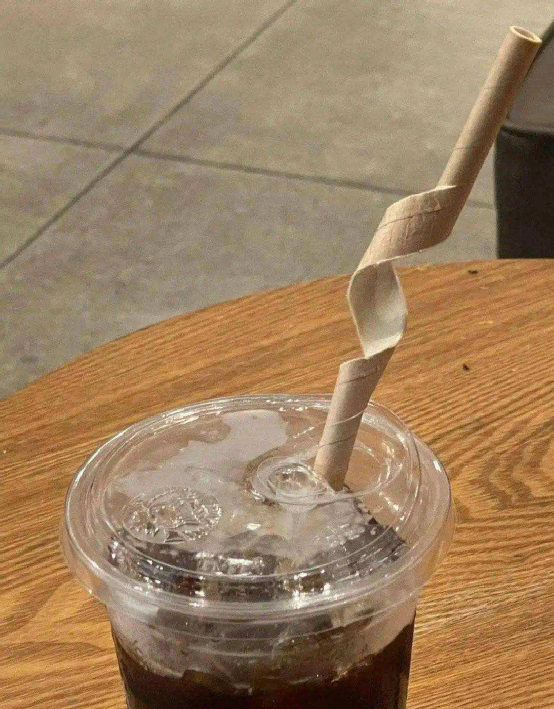
Yes, this paper straw, born under the "halo of environmental protection," made a grand entrance into restaurants and beverage shops everywhere and occupied the straw dispensers for more than a year. But paper straws offer environmental benefits beyond biodegradability: they also degrade in your mouth. That is why the trending topics about paper straws were never about their eco-friendliness, but about their "anti-human" performance.
"Paper straws are really eco-friendly. They degrade right in my mouth." This question about paper straws sparked heated discussion last May. Many netizens commented: "Sorry, it's not that I don't support environmental protection, but I really can't suck through it." "Paper straws aren't necessarily that eco-friendly. I went through three straws just to finish one cup of coffee." "Some straws just fall apart while you're drinking."
With negative reviews piling up, paper straws were eventually pushed out of the market, and PLA biodegradable straws emerged to take the mainstream.
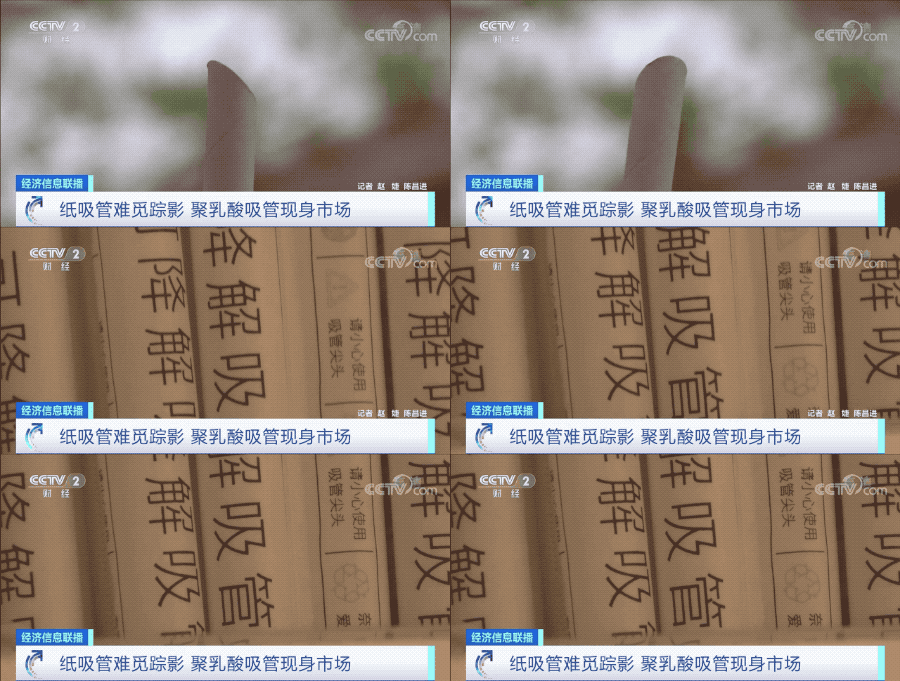
PLA straws, also known as polylactic acid straws, are made from starch extracted from plants such as corn, wheat, and cassava, making them fully biodegradable. Their suitable temperature range is roughly -10°C to 70°C, covering both cold and hot beverages. Compared with paper straws, most consumers prefer these polylactic acid straws. As demand for PLA straws expands rapidly, paper straws naturally face decline.
According to a March 20 report from CCTV Financial Network, many paper-straw manufacturers have gradually ceased production. A production team leader at a paper products company in Zhejiang said that during peak demand, 24 machines produced at least 80,000 straws each per day, with a maximum of 140,000 per machine. Now only 5 machines remain in operation, with daily production not exceeding 500,000 straws. The head of the paper products company said the rollercoaster year, from rise to fall, still needs time to process, and the machines are difficult to sell.
The reasons for the decline in paper straw production include a poor consumer experience and reduced export volumes due to the pandemic. On top of that, paper straws give consumers abroad a subpar experience, leading many countries to begin importing PLA straws.
Researchers at home and abroad have suggested that paper straws are not as environmentally friendly as presumed. First, paper straws are made from composite materials like "paper plus plastic coating," which makes them less biodegradable than imagined. Second, because paper straws tend to disintegrate, manufacturers have to keep increasing their thickness, which leaves many of them too thick to recycle.
Are PLA Straws Truly Environmentally Friendly?
Compared with paper straws, they can indeed achieve genuine natural degradation, but their drawback is a short shelf life. PLA straw performance deteriorates significantly after a year in storage: they crumble when twisted, which is a demonstration of how readily they degrade. Many manufacturers of PLA straws dare not produce large quantities for storage, which invisibly raises their cost.
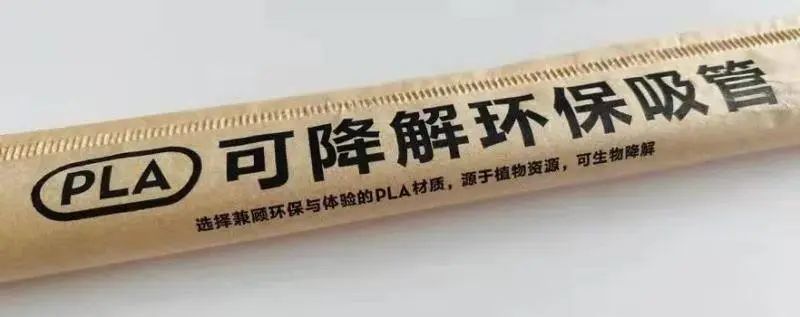
Plastic straws cost 0.05-0.06 yuan each, paper straws cost 0.07-0.08 yuan each, while PLA straws cost 0.12-0.13 yuan each. The added cost has pushed some businesses to revert to plastic straws. However, Weng Yunxuan, Secretary-General of the Degradable Plastic Professional Committee of the China Plastics Processing Industry Association, pointed out that in 2020 the domestic production capacity of polylactic acid was only about 60,000 tons, while it has now reached 150,000 tons. As capacity increases, the price of polylactic acid will fall, which suggests PLA straws may become the next trend in eco-friendly tableware.
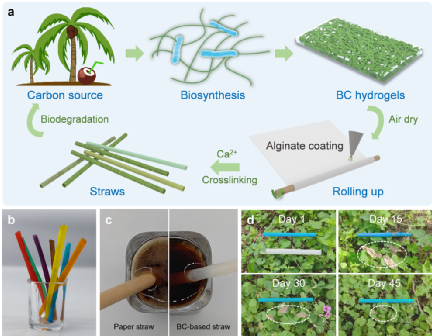
Coffee Workshop also recently reported on a new type of straw made from nata de coco. A research team led by Academician Yu Shuhong in China developed "edible" bacterial cellulose-based straws with excellent properties, produced through biosynthesis of bacterial cellulose combined with the seaweed extract sodium alginate. These bacterial cellulose straws almost disappear after 45 days buried in soil and fully integrate into the soil after 60 days.
Are Nata de Coco Straws Delicious?
Although the material is edible, that does not necessarily mean it tastes good. It can only be described as a safe, edible straw. Its strength, modulus, and toughness are more than double those of paper straws. The cost per straw may be similar to PLA straws, but they keep for longer.
In reality, whatever the material, straws are disposable items even when they can degrade naturally. If you truly want to be environmentally friendly, why not start by using fewer disposable products in the first place?
Image source: Network, CCTV Financial
FrontStreet Coffee Recommendation
Reusable gear is one of the simplest ways to cut down on waste, and a good place to start is a bean worth brewing carefully. If you enjoy light roasts with bright, floral, and fruity acidity, FrontStreet Yirgacheffe Gudingding Cooperative is a washed Ethiopian coffee with citrus, berry, and floral notes and a green-tea-like sweetness, gentle rather than sharp.
FrontStreet Sun-Dried Huakui brings a bolder tropical profile with strawberry, passion fruit, jackfruit, and even lychee notes, sweet and low in bitterness, while FrontStreet Kenya Cherry Tomato is a washed Kenya coffee from the Sika region, grown at 1,550-1,750 meters from the SL28 and SL34 varieties and roasted light, delivering cherry tomato and dark plum acidity with a full, juicy body.
Important Notice :
FrontStreet Coffee is a long-established specialty coffee roaster in Guangzhou China, selling freshly roasted beans from its own farm in Yunnan as well as dozens of carefully selected single-origin beans from around the world for both pour-over and espresso. The products deliver consistently excellent quality and great value, with shipping within 24 hours. Guangzhou's FrontStreet Coffee shop is recommended by many coffee lovers, and the beans are now available online at the Tmall 。
FrontStreet Coffee has moved to a new address:
FrontStreet Coffee Address: 315,Donghua East Road,GuangZhou
Tel:020 38364473
 Scan and follow the En Gafei WeChat official account. Please indicate that the reprint comes from "En Gafei".