
Beginner's Pour-Over Coffee Tutorial with Visual Guide: Hand Brew Parameters and Process Demonstration for Washed Yirgacheffe Coffee Beans

Water pouring in pour-over coffee has been discussed to death, and yet newcomers who follow FrontStreet Coffee keep asking, "Why can't I make it taste good?" and "Pour-over is so difficult!" Pour-over remains a niche practice, so for the sake of new friends, going back over these fundamentals is time well spent.
The Importance of Parameters Over Technique
For anyone just learning to brew, FrontStreet Coffee believes that understanding and using correct brewing parameters matters more than pouring technique. (That's why FrontStreet Coffee talks about parameters so often.) In our view, while there are countless parameter combinations for brewing delicious coffee, what suits beginners best is a single, highly compatible parameter set. This is why FrontStreet Coffee's recommended brewing parameters for most coffee beans are nearly identical (with a few exceptions). It isn't laziness or misinformation — highly compatible, simple methods are the ones most suitable for widespread adoption. (FrontStreet Coffee has also produced a separate series on brewing techniques.)

Center Pouring vs. Circular Pouring
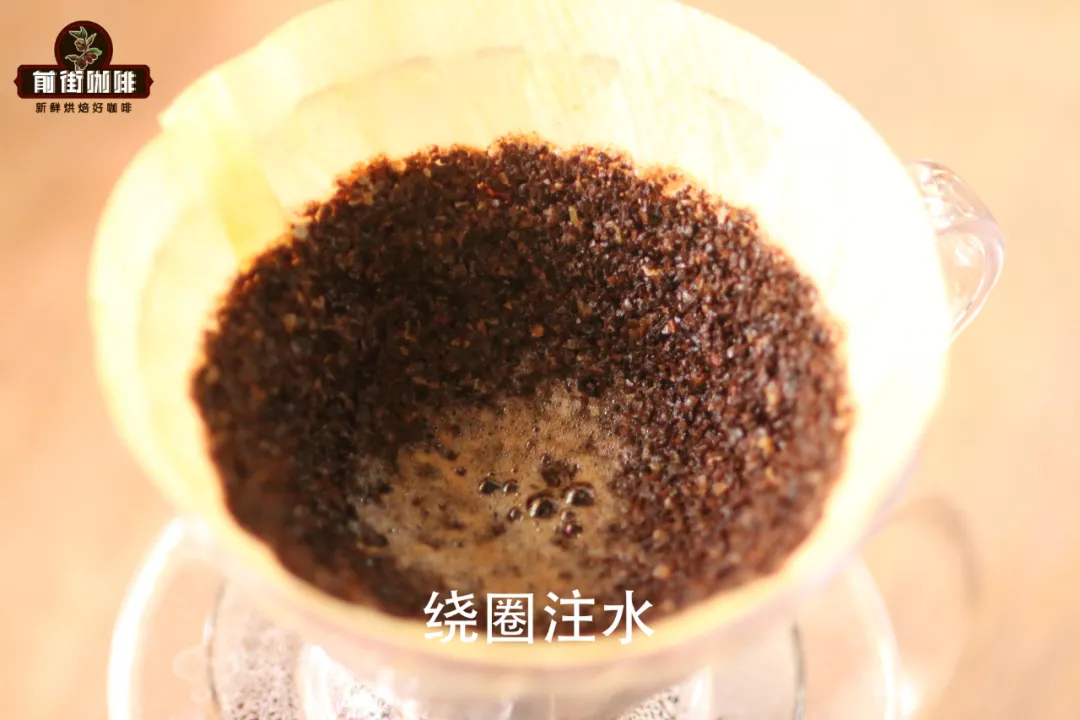
Now to the main topic. Most coffee shops brew with circular pouring; some, correspondingly, use center pouring. FrontStreet Coffee set up a demonstration of center pouring versus circular stirring to observe exactly how the coffee grounds behave.

As you can see, circular pouring around the center easily creates turbulence. The moment the water stream forms even a slight angle, the movement of water inside the coffee becomes uncontrollable. As the video shows, when the stream hits the bottom of the coffee it rebounds toward the pouring direction, carving channels through which all the water then flows. Watch the coffee bed wall during center pouring and you'll notice it is thin on one side and thick on the other. Circular stirring-and-pouring avoids this entirely — the bed wall stays uniformly thick.
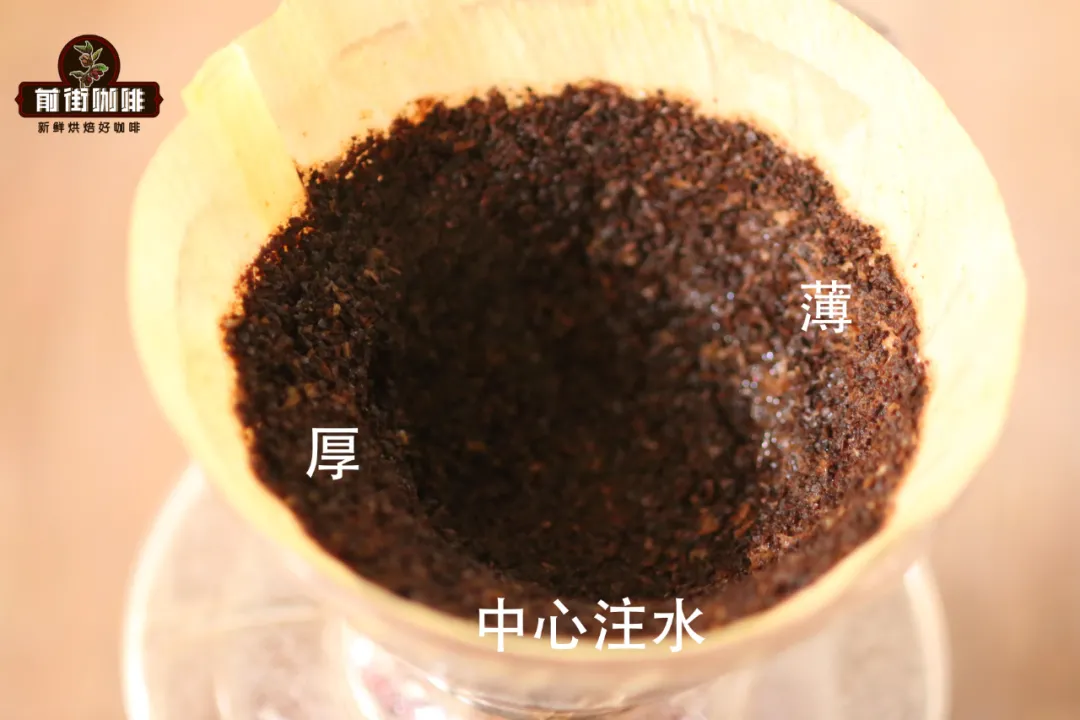
So the comparison shows that stirring-and-pouring, on one hand, easily avoids turbulence, and on the other, ensures even extraction.
The Role of Stirring
"Stirring" has always been part of daily life, after all. When dissolving granules in a drink, we stir with a spoon to help them fully dissolve. Water pouring and stirring in pour-over serve the same purpose: the water stream acts as a stirring tool, continuously "stirring and tumbling" the coffee grounds layer so that more flavor compounds get extracted.
Finding the Right Balance
Which raises the obvious question: is stronger stirring always better? Of course not. We want the delicious compounds from coffee, not the bitter, undesirable ones. When stirring is too vigorous, even after you stop pouring the water surface keeps rotating in the stirring direction — like a tumble dryer, where the faster it spins, the more easily water gets thrown outward — and the coffee readily picks up unpleasant flavors.

One more thing to guard against: try not to pour directly onto the filter paper during brewing. Breaking through the coffee bed wall easily opens channels and leads to incomplete extraction. FrontStreet Coffee recommends that newcomers start with slow circular pouring, a steady flow, and a straight water stream.
Pouring Height and Direction
Two final questions come up constantly: what's the ideal pouring height, and should you pour clockwise or counterclockwise? There's no standard answer. Some people pour close to the liquid surface; others raise the stream higher. The difference between the two is temperature change — a high pour loses heat more easily (at roughly 8cm of height, the stream loses about 0.7–1°C). But FrontStreet Coffee doesn't recommend pouring too close to the surface either, because many kettles release water at an angle, and only raising the spout 2–3cm produces a vertical stream. Pouring too close invites turbulence or punches through the coffee bed wall.
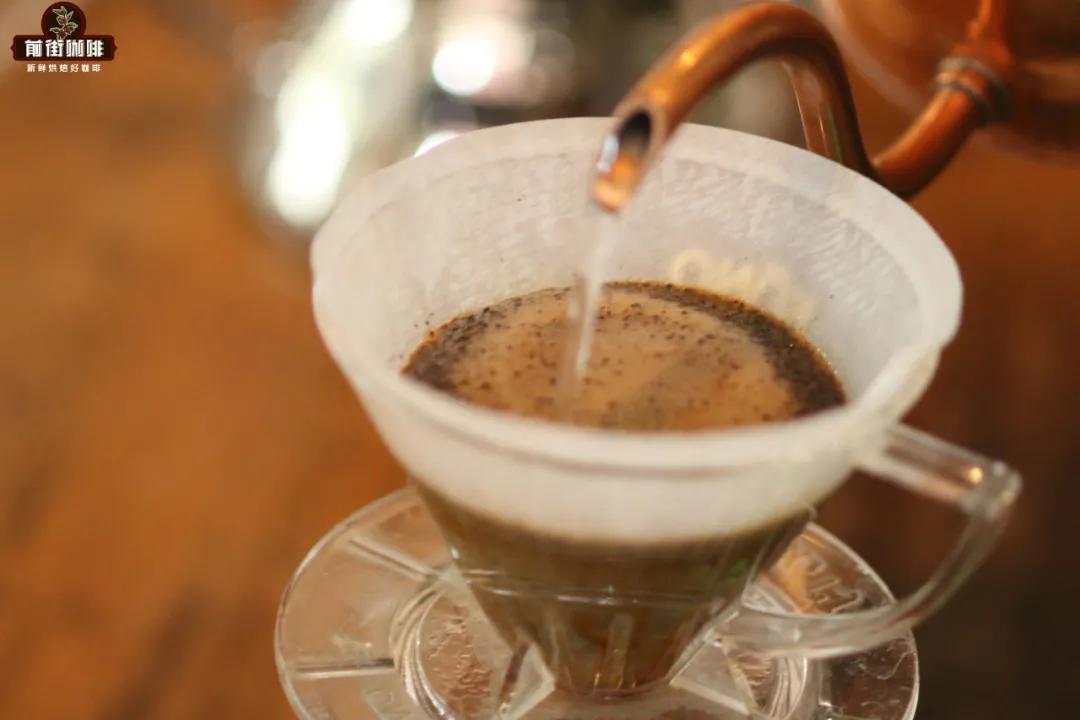
As for clockwise versus counterclockwise: FrontStreet Coffee's answer is that either works, as long as you circle consistently in one direction throughout the entire brew. There are, of course, online debates about whether pouring direction matters based on the spiral of the V60's ribs — FrontStreet Coffee considers this excellent conversation over a good meal.
FrontStreet Coffee Recommendation
Yirgacheffe: The Classic First Bean, and How to Brew It
If you want to understand Ethiopia, start with the most classic option: FrontStreet's washed Yirgacheffe daily-drinker, known for white jasmine florals, bright citrus and lemon acidity, and a tea-like finish — at a price that has made it many people's very first specialty coffee bean. Yirgacheffe itself is a small town in Ethiopia's southern Sidamo province, at roughly 1,700–2,100 meters with coffee grown above 1,800 meters, among the highest growing regions on Earth. Its instantly recognizable white florals and lemon-citrus acidity made the name synonymous with Ethiopian specialty coffee — so much so that in 2010 the Ethiopian Commodity Exchange formally separated it from Sidamo as its own designation.
Yirgacheffe town actually breaks down into smaller districts and villages, several home to experienced cooperatives whose coffees rise another level. The most representative is the FrontStreet Washed Guodingding Cooperative, from Worka in Yirgacheffe's southeast — once part of the Worka cooperative under the YCFCU union, and later isolated by coffee hunters worldwide in pursuit of traceability as a "single-origin" lot. Traditionally washed, it has none of the classic bitterness: just clean, bright citrus and lemon acidity wrapped in jasmine. For something fruitier, the FrontStreet Red Cherry is a fully washed-and-dried natural: only fully ripe, defect-free cherries are picked, sun-dried on raised beds and turned every 2–3 hours for the first days to prevent uneven heating and over-fermentation, then rested three to five weeks. Dried with the fruit on, it combines classic Yirgacheffe character with tropical fruit — citrus acidity, berry juiciness, honeyed sweetness, and creamy smoothness.
Brewing suggestions from FrontStreet: V60 dripper, 15g of coffee, 90–91°C water, a 1:15 ratio, and a grind passing 80% through a #20 sieve (fine-granulated-sugar size, around setting 10 on an EK43s). Pour 30g for a 30-second bloom; then pour to 95g (scale reads about 125g), finishing around 1 minute; when the water level drops to two-thirds of the bed, pour the remaining 100g (scale reads about 225g), finishing around 1:35. Drainage completes between 2:00 and 2:10 — lift the dripper and you're done.
Important Notice :
FrontStreet Coffee is a long-established specialty coffee roaster in Guangzhou China, selling freshly roasted beans from its own farm in Yunnan as well as dozens of carefully selected single-origin beans from around the world for both pour-over and espresso. The products deliver consistently excellent quality and great value, with shipping within 24 hours. Guangzhou's FrontStreet Coffee shop is recommended by many coffee lovers, and the beans are now available online at the Tmall 。
FrontStreet Coffee has moved to a new address:
FrontStreet Coffee Address: 315,Donghua East Road,GuangZhou
Tel:020 38364473
 Scan and follow the En Gafei WeChat official account. Please indicate that the reprint comes from "En Gafei".

