
Starbucks Fined 1.37 Million for Food Safety Incident: Current State of Food Safety and Hygiene in the Restaurant Industry
Starbucks Food Safety Incident Exposed
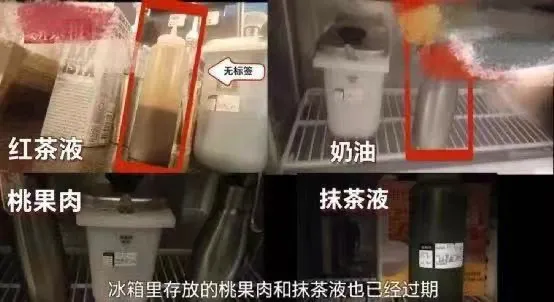
On December 13th last year, the Beijing News reported that an undercover investigation by its journalists found that two Starbucks stores in Wuxi City had crossed the red line of food safety. During the investigation, the undercover journalists found that the two stores were selling pastries beyond the company's designated selling period after thawing, and that post-processing beverage ingredients and raw materials (such as carbon dioxide-whipped cream, prepared sauces, and fruit pulp products) had their opening or production date tags altered or missing. They also observed behavior violating food safety regulations, such as using bar towels to wipe trash cans.
Aftermath and Investigation
After the incident was exposed, Starbucks China posted on Weibo expressing deep shock and immediately cooperated with the Market Supervision Administration to close the stores for investigation. Following the exposure, Starbucks stores in other regions were also subjected to surprise inspections by local market supervision bureaus. After a round of major inspections, the investigation results from the various bureaus showed that, apart from the two exposed stores, no other stores had serious food safety issues. Most problems related to non-standard disposal records, incomplete disinfection records, and employees not properly following personal hygiene standards (wearing work caps and masks).
Penalties and Consequences
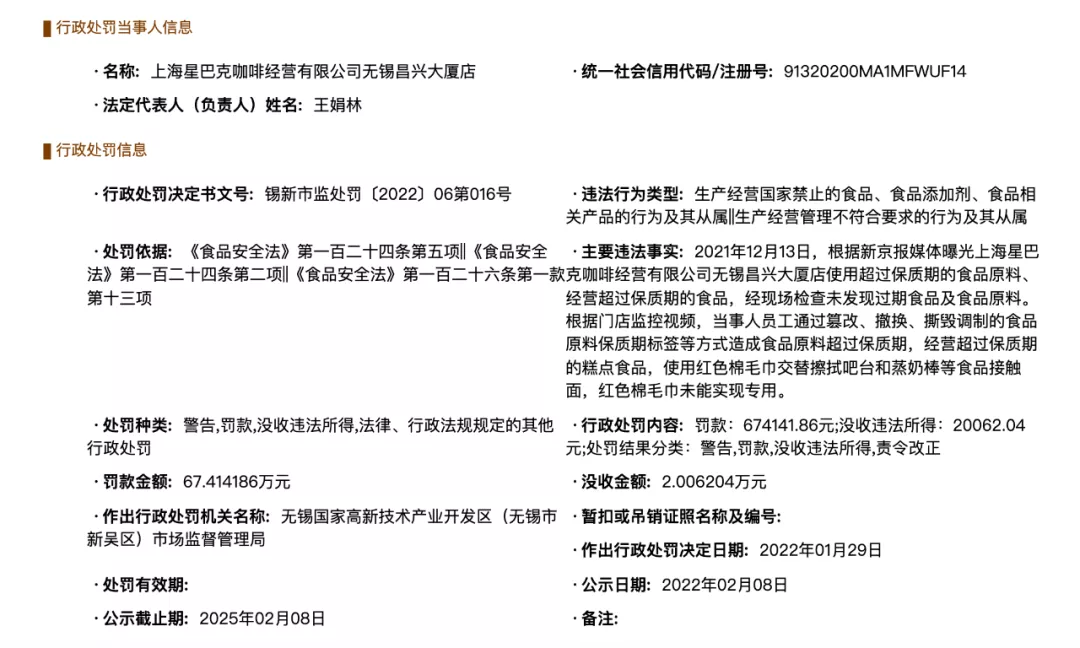
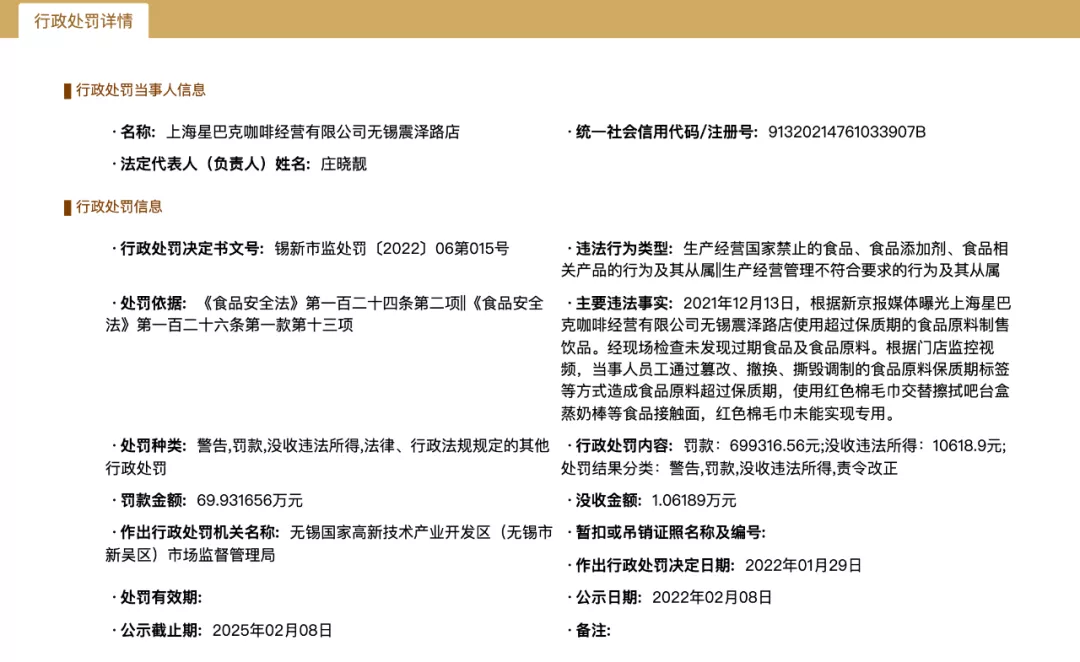
In addition to firing all employees at the two involved stores and being ordered to rectify, they received penalty notices. On February 8th, the administrative penalty announcement from the National Enterprise Credit Information Publicity System (Jiangsu) showed that Shanghai Starbucks Coffee Management Co., Ltd. Wuxi Changxing Building Store and Shanghai Starbucks Coffee Management Co., Ltd. Wuxi Zhenze Road Store were fined for violating Article 124, Paragraph 2 and Article 126, Paragraph 1, Item 13 of the Food Safety Law. The Changxing Building store was fined 674,000 yuan and had 20,000 yuan of illegal income confiscated; the Wuxi Zhenze Road store was fined 699,000 yuan and had 10,000 yuan of illegal income confiscated, totaling 1.37 million yuan in fines and 30,000 yuan in confiscated amounts.
Analysis of the Incident
From the investigations by the various market supervision bureaus, it is clear that not all Starbucks stores had such outrageous food safety problems. After all, for such a large enterprise, if most stores had such practices, Starbucks would not have been able to establish itself in the Chinese market long ago. The incident can be described as "one bad apple spoiling the bunch." Yet it also shows that Starbucks' internal supervision was inadequate, and that the budget allocated to some stores was insufficient, prompting some store managers to "save where possible." Such problems ultimately stem from a mentality of taking chances.
Did Starbucks really not know these issues existed? Obviously not. It wouldn't be difficult to detect them internally. The key is whether someone within the enterprise was responsible for managing it, or whether there was the will to manage it. Could it be that Starbucks itself viewed this behavior as a "normal operation" to save costs? We cannot be certain, but only when the upper beam is crooked is the lower beam skewed. If Starbucks' internal supervision were truly effective, no store would have such outrageous incidents occur.
Public Reaction and Responsibility
When the news first broke, many people supported Starbucks, saying it was just an individual case and that most stores were still managed very strictly. Indeed, this incident shouldn't be generalized to all stores. However, some comments indirectly reflected employees' lack of attention to food safety. For example: blaming the undercover journalist, saying they deliberately targeted a "retirement store" (a store with low customer traffic), suggesting intentional entrapment, or claiming this violated ethics. There were also comments that indirectly reflected the mentality of taking chances with food safety among some catering practitioners, such as, "I think it's okay as long as it doesn't spoil."
I want to say one thing here: if they weren't doing these things, would journalists conduct a targeted undercover investigation? The fact that journalists went undercover proves the problem has existed for a long time, which is why it caught the attention of whistleblowers and journalists. Second, can food safety be ignored just because there's no business? Thinking that things that haven't spoiled are still edible... Why do factories, enterprises, and shops establish food safety management based on food safety law? It is a matter of responsibility for public and consumer health. Everything is fine if no problems occur, but what if problems really do happen? This isn't child's play; the impact extends beyond individuals.
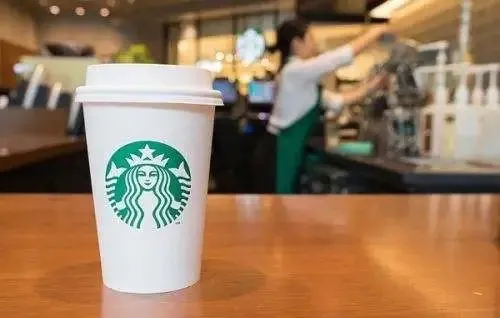
Regulatory Oversight and Consumer Trust
As for comments criticizing market supervision bureaus for inadequate oversight, regulatory bodies themselves face challenges of large scope and difficulty of supervision. They can't monitor every store every day. Therefore food safety ultimately relies on the self-discipline of producers, and it genuinely needs supervision from all sectors of society. Is whistleblowing unethical? As long as it isn't malicious or a false accusation, there is nothing unethical about it.
Although this was an individual case, for a large, well-known coffee chain, one "individual case" is enough to consume most consumers' trust. These mistakes cannot be concealed just because most stores perform well. Wrong is wrong; this is an indisputable fact, regardless of how it was discovered.
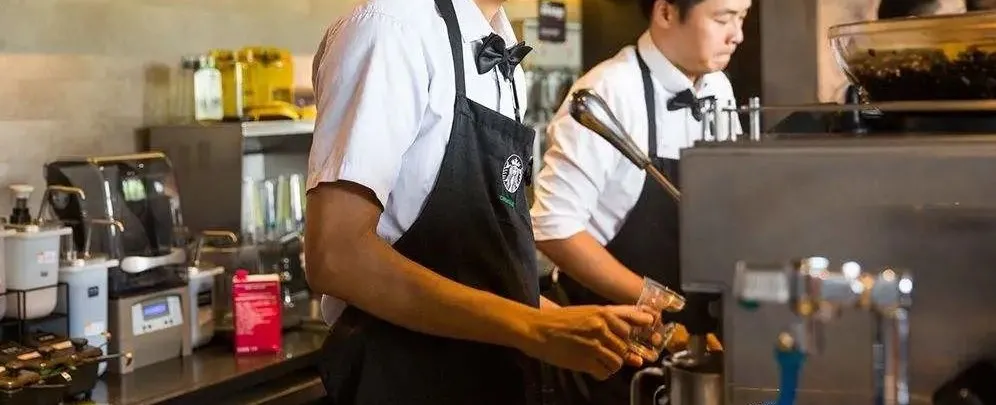
Conclusion
Whether as individuals or collectives, no one should gamble with consumer health and safety. When problems really occur, it isn't good for anyone. Although overnight bread may not spoil immediately, its texture might deteriorate, and the same applies to raw materials past their labeled expiration dates. Although they might not cause serious problems if stored properly, since more food-safety systems have been established, why not follow them? This seemingly cost-saving behavior, once problems occur, results in compensation and fines far exceeding the small amount saved.
Food safety is no small matter and requires everyone's attention. As long as it isn't malicious reporting, the exposure of such incidents and the public disclosure of penalties is not necessarily a bad thing. To regain people's trust in the brand, frank admission and fair handling are the best solutions.
Image source: Internet
For professional coffee knowledge exchange and more coffee bean information, please follow Coffee Workshop (WeChat public account: cafe_style)
FrontStreet Coffee Recommendation
For an entry-level specialty coffee that's easy to enjoy and good value, FrontStreet's Brazil Cerrado Red Bourbon is a classic, with the cream, peanut, and cocoa flavors typical of the region in a delicate, balanced cup. If you prefer lower acidity and a fuller body, FrontStreet's PWN Indonesia Golden Mandheling is wet-hulled and delivers herbal and dark chocolate aromas with a rich, lingering body and a hint of earthiness, ideal for those who like bold coffee without the tartness. And for a classic, FrontStreet's Jamaica Blue Mountain No.1 balances acidity, sweetness, and bitterness with cream, caramel, chocolate, and nut notes in a smooth, rounded cup.
Important Notice :
FrontStreet Coffee is a long-established specialty coffee roaster in Guangzhou China, selling freshly roasted beans from its own farm in Yunnan as well as dozens of carefully selected single-origin beans from around the world for both pour-over and espresso. The products deliver consistently excellent quality and great value, with shipping within 24 hours. Guangzhou's FrontStreet Coffee shop is recommended by many coffee lovers, and the beans are now available online at the Tmall 。
FrontStreet Coffee has moved to a new address:
FrontStreet Coffee Address: 315,Donghua East Road,GuangZhou
Tel:020 38364473
 Scan and follow the En Gafei WeChat official account. Please indicate that the reprint comes from "En Gafei".

