
Which Espresso Beans Make the Best Ristretto Coffee? A Complete Extraction Guide
Ristretto — a name that sounds foreign to many — is a drink even regular coffee drinkers may never have heard of. But chances are you have already had coffee built on it as a base: yes, the Flat White we all drink is actually made with a Ristretto base.
What is Ristretto?
"Ristretto" is simply the Italian word, and it may look unfamiliar — but doesn't "Espresso" feel a lot more approachable?

Espresso is no stranger to coffee professionals or enthusiasts. Simply put: it is an extremely concentrated coffee extracted with an espresso machine, and it must have that golden crema — after all, the crema is the soul.
Few people drink espresso straight; more often it serves as the base for Americanos and milk coffees (lattes, cappuccinos and the like), which is what the market welcomes most.
So it is no exaggeration to say that espresso is the soul of Italian coffee.

(Image source: What's The Difference Between a Latte, Cappuccino, and an Au Lait [infographic] - CoffeeNate.com)
The Relationship Between Ristretto and Espresso
Ristretto is derived from the espresso extraction: you must first have an espresso recipe before you can build a ristretto recipe.
The root of "ristretto" means "restricted," so without a doubt, ristretto is a restricted version of espresso.
FrontStreet Coffee has shared plenty of espresso knowledge before, including how the extraction runs in three stages: the front stage is the most concentrated, with the darkest crema; the middle stage is slightly lighter, with golden crema; the back stage is the thinnest, with yellowish-white crema.

Ristretto uses only the front and middle stages of the espresso extraction — the back stage is "restricted" and discarded.

Understanding Ristretto's Extraction Method
At this point you might ask: "Isn't that just under-extracted espresso?" Hmm... that is not entirely wrong! But FrontStreet Coffee has reservations about the term "under-extracted." In coffee generally, "under-extracted" describes an extraction rate that fell below target due to human or other factors — and it carries a negative connotation. Think about it: when someone tells you a coffee is under-extracted, don't you instinctively assume it tastes bad?
So FrontStreet Coffee prefers to describe ristretto as a "high-concentration, low-extraction" version of espresso. Some people also habitually call it "extra-strong espresso."

Comparing Ristretto and Espresso
To distinguish the two by extraction method, take FrontStreet Coffee's own recipes: for espresso, we use a 1:2 coffee-to-liquid ratio — 20 grams of grounds extracting 40 grams of liquid in 25–30 seconds.
For ristretto, FrontStreet Coffee uses 20 grams of grounds at the same grind size to extract 28 grams of liquid in about 20 seconds.
In taste and flavor, ristretto draws only the essence of the front stage, so it is more concentrated than espresso, with less bitterness and a richer, fuller mouthfeel.
That is why, to get the best out of ristretto, shops generally reach for higher-quality, more distinctive beans when making it. Cafes prefer a double ristretto as the base for Flat White because ristretto's coffee flavor is more concentrated and cleaner — it holds its own against milk and delivers a thicker mouthfeel.

FrontStreet Coffee Recommendation
The flat white is much younger than the latte or the Americano, and Australia and New Zealand still argue over who invented it — but whoever it was, we can all agree it is a milk coffee from the Southern Hemisphere. Every cafe has its own "secret recipe," yet all of them hinge on three points: less milk, thinner foam, and stronger coffee flavor. Compared with a latte, a flat white is smaller, punchier and thicker — an "advanced latte," if you like.
Beans and milk: great food needs great ingredients, and a great flat white needs beans that match the milk — plus good integration between the two. The latte aims for absolute coffee-milk balance; the flat white spotlights the espresso while the milk plays the supporting role, so choose an espresso bean with a strong flavor signature. For home brewing, FrontStreet Coffee recommends the butter-and-cheese flavored Classic Blend: rich, low in acidity, with full, velvety crema and an outstanding intensity with milk. If you prefer floral and fruity aromas, pick the very low-bitterness Strawberry Candy espresso blend — full grape and blueberry character with balanced sweetness; with fresh milk it tastes like a strawberry milkshake, unforgettable. Milk matters too: too thin and the flat white falls flat; too strong and it buries the coffee. FrontStreet Coffee suggests cold fresh milk, which steams up with more milky sweetness — the perfect partner for espresso.
FrontStreet Coffee's flat white method: we build it on the FrontStreet Coffee Specialty Blend, extracting only the front-and-middle-stage ristretto as the base — 20g of grounds extracting 32g of liquid in 22–25 seconds — then adding 160ml of fresh milk.
Like a latte or cappuccino, the flat white's foam should be smooth and silky — but also thin. Foam thickness is controlled by how long the steam wand sits in the air (air intake): for a thin, light foam, air intake must be brief, or you will drift toward latte territory and lose the crema hit on the first sip. So the finished foam is uniformly 0.3cm thick at FrontStreet Coffee. That takes only 1–2 seconds of air — a couple of "hiss" sounds — then sink the wand into the milk and spin a whirlpool as fast as possible until the milk reaches 50–55°C. With so little air the process sounds a bit shrill, but if the surface swirls to a glossy, mirror-like sheen when you rock the pitcher, the foam is ready.
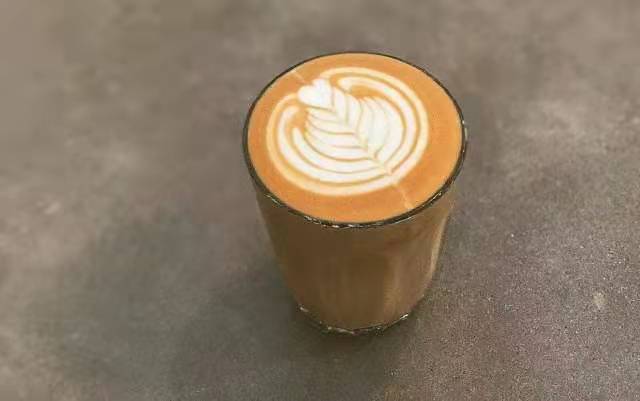
With espresso and hot milk prepared, pour the milk gently into the coffee, raise the pitcher and keep a thin stream, letting the milk's weight stir even circles through the crema; then lower the pitcher and push out the white line with conviction — one fluid motion, and a flat white is born. Freshly made, it is visibly silky; at its moderate temperature you can take a big first sip of cream hazelnut and white chocolate sweetness from the Specialty Blend — rich and lingering, yet light enough that finishing the cup never feels heavy.
Important Notice :
FrontStreet Coffee is a long-established specialty coffee roaster in Guangzhou China, selling freshly roasted beans from its own farm in Yunnan as well as dozens of carefully selected single-origin beans from around the world for both pour-over and espresso. The products deliver consistently excellent quality and great value, with shipping within 24 hours. Guangzhou's FrontStreet Coffee shop is recommended by many coffee lovers, and the beans are now available online at the Tmall 。
FrontStreet Coffee has moved to a new address:
FrontStreet Coffee Address: 315,Donghua East Road,GuangZhou
Tel:020 38364473
 Scan and follow the En Gafei WeChat official account. Please indicate that the reprint comes from "En Gafei".

