
The Correct Way to Use Chemex Pour-Over Coffee Maker and How to Use Chemex Filter Paper
Introduction to the Chemex Coffee Maker
You're probably familiar with this cover image — someone holding a cloud-shaped pour-over kettle in one hand and today's protagonist in the other: the Chemex coffee maker. You may have seen it in real life at Starbucks; beyond that, few coffee shops actually brew with a Chemex.
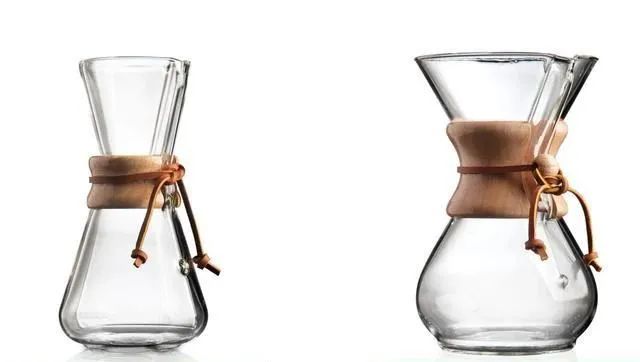
What is Chemex?
The Chemex is a pour-over brewer that combines the "dripper" and "server" into a single vessel. It was invented in 1941 by Dr. Peter Schlumbohm, a chemistry Ph.D. from Berlin University who emigrated to New York. It has been manufactured continuously for many years by the Chemex company in Massachusetts — which is why its design is steeped in laboratory aesthetics, looking uncannily like chemical glassware.
In the United States, the Chemex is a very common brewing device. It even made multiple appearances in the classic American TV show "Friends."


As you can see, the Chemex has an elegant appearance — and considerable popularity to match.
What are the characteristics of Chemex?
The body of the Chemex is a glass vessel that's wide at both ends with a narrow waist. Its surface is very smooth, and the upper section has no ribs — only a single groove running upward from the narrowed part. The most intuitive function of this groove is to guide the direction when you pour the finished coffee.
But that isn't its most important job. If you seat filter paper on a perfectly smooth dripper (imagine a funnel) and brew with it fully fitted, the air at the bottom cannot escape, water cannot flow down, and the brew stalls.
So the groove's essential function is to channel air out and prevent blockage. Even so, in many cases soft filter paper can still slump into the groove and seal it off anyway.

For this reason, the Chemex must be used with its special filter paper, which has a stiffer texture and requires manual folding.

Chemex filter paper comes in several shapes: semi-circular, circular, and square. FrontStreet Coffee has included an introduction from Mr. James Hoffmann discussing the Chemex to give everyone a clearer understanding.

James demonstrates the circular Chemex filter paper.

After a cross-fold, it forms a conical filter — but one with a single layer on one side and three layers on the other.

The three-layer side should face the groove, which better secures the paper's shape and keeps it from collapsing inward and closing up.
How to brew coffee with Chemex?
Because the Chemex has no ribs and uses very thick filter paper, its flow rate is slow. Grind your coffee slightly coarser as a result — for light-roasted beans, cupping grind size is about right (a 70–75% pass-through rate on a #20 standard sieve).
FrontStreet Coffee demonstrates with Yirgacheffe Natural Red Cherry beans: a 30g dose, grind at a 70% pass-through rate on a #20 sieve, a 1:15 coffee-to-water ratio, and water at 90°C.

After folding the filter paper into the brewer, rinse it with hot water first — this warms the server, ensures a proper fit, and washes out any paper taste in one step. Then pour the rinse water out along the groove.
Next, add the 30g of coffee, pour 60ml of hot water for a 30-second bloom, then continue pouring in circles until you reach 450ml. The normal water level should sit about 0.5cm below the top; if it's about to overflow the brewer, pause briefly and resume once it drops. Normally the full brew finishes draining in about 3–4 minutes.

Pros and Cons of Chemex
The Chemex's strengths: it produces a very clean cup with high sweetness, and its elegant looks are a bonus all their own.
The drawbacks are equally obvious: both the brewer and its special filter papers are fairly expensive, and cleaning is fussy — the narrow waist traps plenty of coffee stains.
On the bright side, it also makes a lovely flower vase!

FrontStreet Coffee Recommendation
A slow-flowing brewer like the Chemex pairs best with the right beans. For bright, floral-fruit cups that showcase the Chemex's clarity, FrontStreet suggests light roasts: the washed Yirgacheffe Guodingding — jasmine florals, lemon acidity, and berry notes — is a classic first step into specialty coffee; the natural Ethiopia Huakui bursts with strawberry, passion fruit, jackfruit, and even lychee aromatics, sweet and virtually free of bitterness; the Panama Esmeralda Red-Label Geisha offers elegant jasmine, citrus, bergamot, and black-tea refinement; and the Kenya Cherry Tomato, grown at 1,550–1,750 meters in Thika on SL28 and SL34 with a 72-hour double-washed fermentation, delivers vivid cherry tomato and damson plum acidity like fresh-squeezed juice.
If you prefer a fuller, low-acid cup, go for the medium-dark roasts: the PWN Golden Mandheling is deeply aromatic with herbal and dark chocolate notes over a whisper of earth; the Brazil Fazenda Rainha balances rich nut and cocoa aromas with clear caramel sweetness and works beautifully in pour-over, espresso, or moka pot; the Jamaica Blue Mountain No. 1 strikes the classic balance of cream, caramel, chocolate, nuts, and honey; and the Papua New Guinea Bird of Paradise — Typica grown at 1,600–1,800 meters on volcanic soil, AA grade, triple-washed — is often nicknamed "Little Blue Mountain" for its clean, sweet, Blue Mountain-like character.
Important Notice :
FrontStreet Coffee is a long-established specialty coffee roaster in Guangzhou China, selling freshly roasted beans from its own farm in Yunnan as well as dozens of carefully selected single-origin beans from around the world for both pour-over and espresso. The products deliver consistently excellent quality and great value, with shipping within 24 hours. Guangzhou's FrontStreet Coffee shop is recommended by many coffee lovers, and the beans are now available online at the Tmall 。
FrontStreet Coffee has moved to a new address:
FrontStreet Coffee Address: 315,Donghua East Road,GuangZhou
Tel:020 38364473
 Scan and follow the En Gafei WeChat official account. Please indicate that the reprint comes from "En Gafei".

