
What's the Difference Between Dirty Coffee and Latte, Which Tastes Better? Why Should You Take a Big Sip of Dirty Coffee on the First Taste?

Ordering at a coffee shop can feel like a pop quiz — Americano or pour-over? Latte or Dirty? The drinks look alike on the menu, so what actually separates them? FrontStreet Coffee breaks down the coffees you'll find at most cafés.
Common café coffees fall into three groups: the espresso-based family, the drip coffee family, and the cold brew coffee family.
The Espresso-Based Coffee Family
Espresso — Italian espresso — is a concentrated coffee extracted by forcing pressurized water through finely ground coffee. Everything in this family starts from espresso as the base; different ingredients in different proportions produce different drinks.

FrontStreet Coffee's daily house espresso is the Sunflower Warm Sunshine Espresso Blend — 30% natural Yirgacheffe Red Cherry beans plus 70% Honduras whiskey barrel-aged Sherry beans. The shot pours with a rich fermented wine aroma, berry sweetness and acidity, vanilla cream, and nutty caramel.
Typical double espresso parameters are 19–20g of grounds yielding 35–40g of liquid in 28–35 seconds; a single runs 11–12g of grounds for 20g of liquid in 18–23 seconds. Every machine and grinder behaves differently, though, so treat these numbers as a starting point and adjust to taste.

The main espresso variants are straight Espresso (the parameters above), Ristretto, and Single Origin Espresso / SOE. Ristretto is more concentrated than a regular shot (a shorter extraction ratio), while an SOE is pulled from beans of a single region or estate — a regular Espresso, by contrast, uses a blend from multiple origins.
The family's most familiar members: Americano, Latte, Cappuccino, Flat White, Dirty, and Mocha.
Americano (Water + Espresso)
FrontStreet Coffee's build: two regular espressos topped with hot or iced water at a 1:6 to 1:8 ratio.
Latte (Milk + Espresso)
FrontStreet Coffee's build: two regular espressos with steamed milk, iced milk, or iced milk with cubes added after frothing, at a 1:5 to 1:8 ratio.

Cappuccino (Hot only; dense thick foam + milk + espresso)
FrontStreet Coffee's build: two regular espressos with hot milk under thick, dense foam, at a 1:5 to 1:8 ratio.

Flat White (Hot only; thin foam + milk + ristretto)
FrontStreet Coffee's build: two ristrettos with hot milk under thin foam, at a 1:5 to 1:6 ratio. Compared with a latte, it's more concentrated with less milk — noticeably richer in the cup.

Dirty (Cold only; chilled glass + iced milk supporting two espressos)
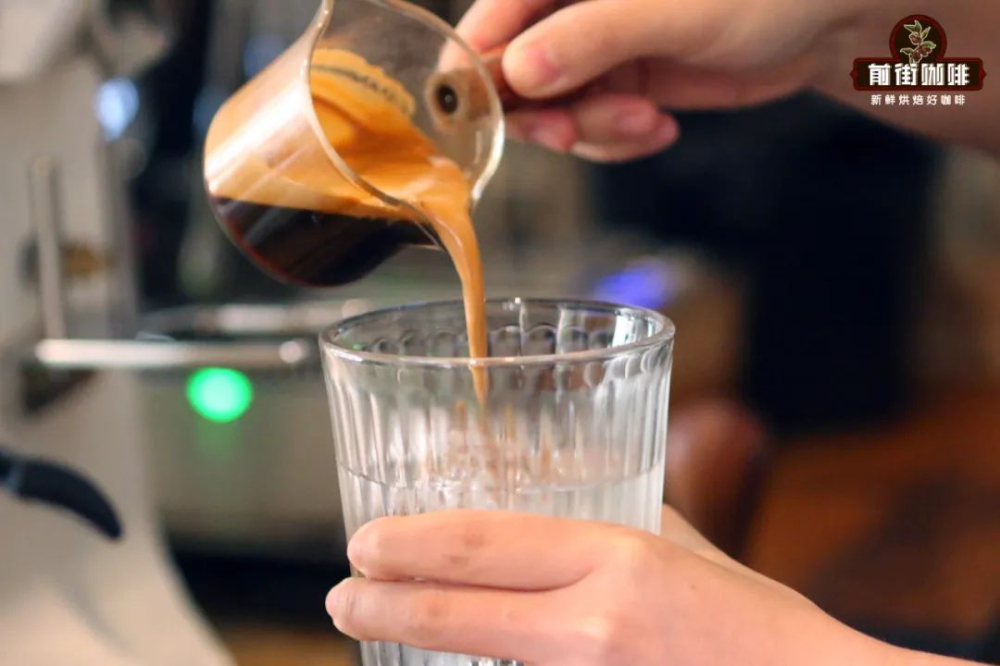
FrontStreet Coffee's build: a chilled glass with 160ml of iced milk, set directly under the group head so the espresso streams straight into the milk. Density does the rest — the espresso floats on top, painting a layered gradient. Unlike a latte, a Dirty is never stirred: you taste it in stages, the flavors and textures shifting as coffee and milk slowly merge with every sip. That's also why the first sip should be a big one — you get the hot espresso crema and the cold milk in one mouthful, the contrast that defines the drink.

Mocha (Chocolate sauce + milk + espresso)
FrontStreet Coffee's build: two regular espressos blended evenly with chocolate sauce, then steamed milk, iced milk, or iced milk with cubes added after frothing, at a 1:5 to 1:8 ratio.
FrontStreet Coffee Recommendation
Both lattes and Dirts live or die on the espresso underneath the milk. A milk-friendly bean needs enough body and sweetness to punch through without turning bitter, and FrontStreet Coffee's Sunflower Warm Sunshine Espresso Blend — 30% natural Yirgacheffe Red Cherry, 70% whiskey-barrel-aged Honduras Sherry — was built for exactly that: fermented wine aromatics, berry sweetness, vanilla cream, and nutty caramel that hold up beautifully in milk drinks.
If you'd rather build your own blend or pull an SOE at home, FrontStreet Coffee's natural Yirgacheffe Red Cherry alone brings berry juice and honeyed sweetness that make a gorgeous Dirty, and for a classic latte the washed Yirgacheffe daily bean offers white jasmine, bright citrus and lemon acidity, and a tea-like finish at a very approachable price.
Important Notice :
FrontStreet Coffee is a long-established specialty coffee roaster in Guangzhou China, selling freshly roasted beans from its own farm in Yunnan as well as dozens of carefully selected single-origin beans from around the world for both pour-over and espresso. The products deliver consistently excellent quality and great value, with shipping within 24 hours. Guangzhou's FrontStreet Coffee shop is recommended by many coffee lovers, and the beans are now available online at the Tmall 。
FrontStreet Coffee has moved to a new address:
FrontStreet Coffee Address: 315,Donghua East Road,GuangZhou
Tel:020 38364473
 Scan and follow the En Gafei WeChat official account. Please indicate that the reprint comes from "En Gafei".

