
Introduction to Panama's Premium Coffee Growing Regions: Did the Geisha Variety Originate from Panama?
The Rise of Geisha: Panama's Coffee Revolution
In the 1990s, Panamanian coffee farmers regarded the Geisha variety as little more than a hybrid that could improve their crops' resistance to leaf rust. Its flavor and bean size were nothing special. But at the 2004 Best of Panama competition, Hacienda La Esmeralda's winning entry turned out to be this unremarkable Geisha — and its exceptional citrus notes and white floral aromas sent shockwaves through the coffee market of the day.
Today, Panama's success in the coffee world is largely credited to the Geisha variety, which has drawn the special attention and pursuit of coffee professionals everywhere. How did Panama become an ideal specialty coffee origin? FrontStreet Coffee is here to share what makes Panamanian coffee special.
Panama's Ideal Coffee Growing Conditions
Panama sits at the southern tip of Central America, bordered by Colombia and Costa Rica. The Panama Canal, connecting the Atlantic and Pacific oceans within its borders, marks the dividing line between North and South America. The terrain is rolling and valley-crossed; apart from the coastal plains north and south, most of the country is mountainous. Thanks to its proximity to the equator, Panama has a tropical maritime climate — humid days, cool nights — with average annual temperatures of 23-27°C. The year splits into dry and rainy seasons, with annual rainfall between 1500-2500 millimeters.
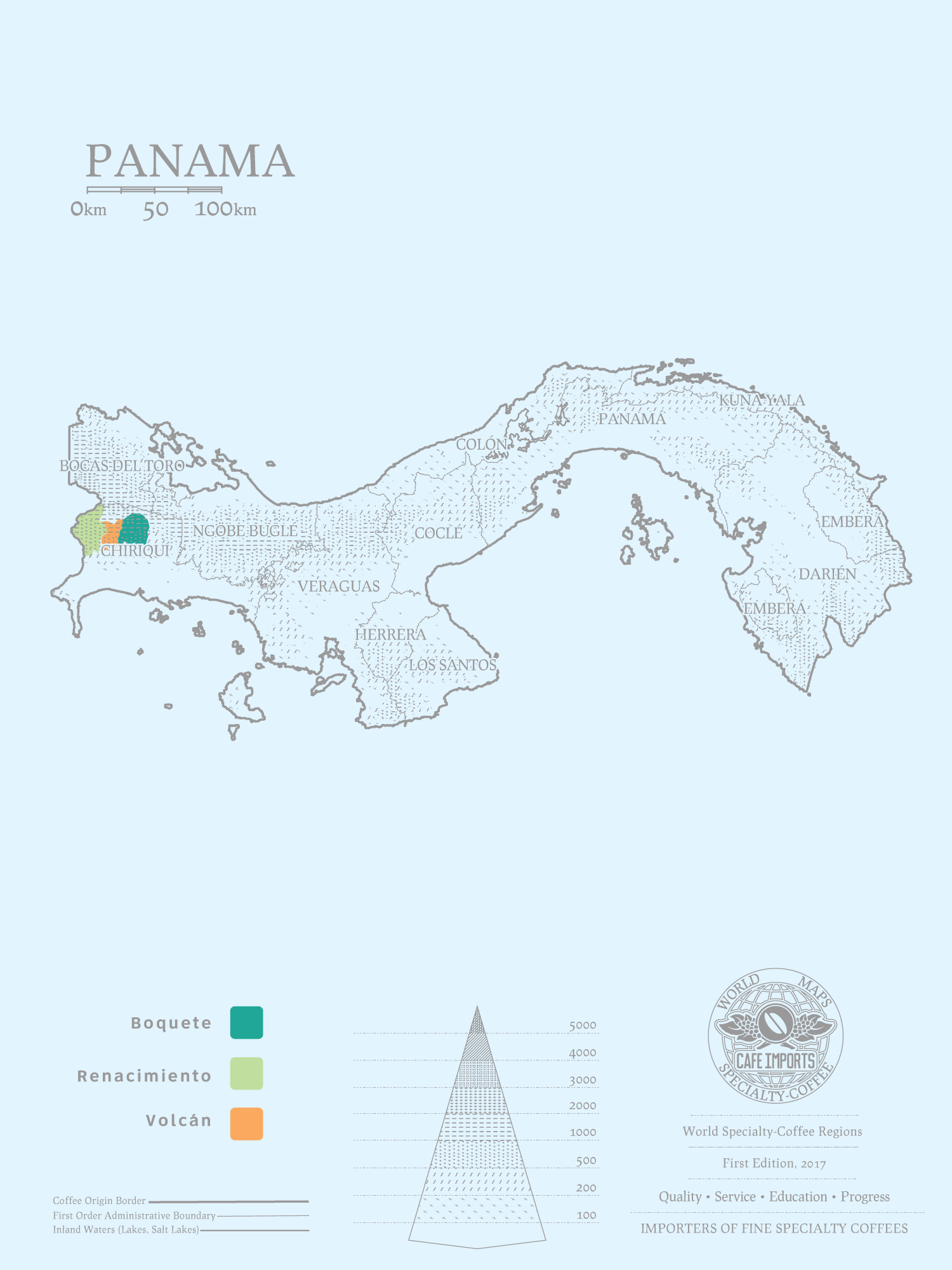
This superb climate attracted large numbers of European and American intellectuals to Panama, and coffee — essential to their daily life and work — began to develop there. The earliest plantations established in Boquete pioneered coffee cultivation in the country, though coffee of that era was little known and production limited. After Geisha was introduced from Ethiopia in the 1990s to fight coffee leaf rust, it was not until 2004 — when Hacienda La Esmeralda rose to fame with Geisha — that Panamanian coffee grew vertically in reputation and development.
Panama's Major Coffee Growing Regions
Boquet
The Boquete growing region lies between 1,400-1,900 meters, a town within Chiriquí province near the border with Costa Rica, in the shadow of the famous Barú Volcano. The microclimate and volcanic soil make Boquete exceptionally suited to coffee, and renowned estates such as Hacienda La Esmeralda and Elida Estate have planted here.
Volcan
When Panamanian coffee comes up, most people think first of Boquete — but in recent years, coffee from the Volcan region has been emerging in the specialty market. Quite a few Volcan estates have entered the Best of Panama competition and taken championships. Volcan generally receives less annual rainfall than Boquete, and its location on the western side of Barú Volcano gives its coffee more pronounced dried-fruit flavors, sweetness, and aroma than Boquet's.
The Volcan region is cultivated mainly at 2,000-3,000 meters. Early on, most of Volcan grew cash crops like fruits and vegetables, with only a few farmers raising coffee. Among those pioneers, the Hartmann family stands out as particularly well known in Panama.
RENACIMIENTO Coffee Growing Region
Renacimiento is a growing area within Chiriquí province, cultivated mainly between 1,100-1,500 meters, bordering Costa Rica. The region itself is relatively small, so it isn't counted among the major characteristic origins for Panamanian coffee beans.
FrontStreet Coffee Recommendation
Panama is where Geisha made its name, and Ethiopia is where it was born — every coffee lover should know, and taste, both. Panama's high altitude, microclimates, and soils gave Geisha its irresistible flavor, discovered by Hacienda La Esmeralda's owner in 2003 and sent to the Best of Panama competition, where an average cupping score of 94.6 shattered the BOP record and crowned it champion overnight. For the finest expression of that orange-honey character — fragrant florals over juicy fruit acidity with a tea-like sweet finish — choose the top-graded FrontStreet Hacienda La Esmeralda Red Label or Green Label Gesha, both dazzling when hand-poured.
For beginners who want a first taste of the legendary "Geisha flavor" without the price, FrontStreet Coffee recommends the entry-level Panama Boquete Gesha: it captures the classic orange-honey sweetness of high-quality Panamanian Geisha, with an oolong-tea feel, delicate fruit acidity, and distinct layers. Alternatively, the FrontStreet Strawberry Sugar blend pairs Costa Rican honey process with Panama Gesha, offering fine florals and sweet fruit in one bag — suited to pour-over, moka pot, espresso machine, or refreshing cold brew (steep 30g of beans, ground to fine sugar, in 360g of room-temperature water at 1:12 for 8 hours in the fridge, filter, then rest 3 more hours, for flavors of grape juice, rose, sweet orange, and fruit wine).
Ethiopia offers its own take: Gesha Village, a 475-hectare estate built 12 miles from the Gesha forest, grades its three Gesha varieties (Gori Gesha, Gesha 1931, Illubabor Forest) into Gold Label RARITIES (10% of production, refined natural, a favorite of competing baristas), Red Label GROWERS RESERVE (15%, SCA 88+), Green Label SINGLE-TERROIR, and CHAKA. For an approachable starting point, the medium-light roasted FrontStreet Granana Gesha keeps its pleasant white florals while highlighting orange, guava, and citrus, with a clearer finish — a perfect contrast to the Panamanian profile.
Important Notice :
FrontStreet Coffee is a long-established specialty coffee roaster in Guangzhou China, selling freshly roasted beans from its own farm in Yunnan as well as dozens of carefully selected single-origin beans from around the world for both pour-over and espresso. The products deliver consistently excellent quality and great value, with shipping within 24 hours. Guangzhou's FrontStreet Coffee shop is recommended by many coffee lovers, and the beans are now available online at the Tmall 。
FrontStreet Coffee has moved to a new address:
FrontStreet Coffee Address: 315,Donghua East Road,GuangZhou
Tel:020 38364473
 Scan and follow the En Gafei WeChat official account. Please indicate that the reprint comes from "En Gafei".

Recommended Pour-Over Coffee Beans for Beginners, Introduction to Pour-Over Coffee Process, and Basic Knowledge on How to Taste Pour-Over Coffee
