
How to Froth Milk for Latte? What's the Ideal Thickness for Espresso Foam? Beginner's Guide to Milk Frothing
Frothing milk is an unavoidable hurdle for many milk-coffee lovers. That's why FrontStreet Coffee even brought out a blackboard to walk you through, step by step, how to create smooth, delicate milk foam.

Why Froth Milk?
Originally, a latte was nothing more than heated milk mixed into coffee—no foam at all. Milk foam only began appearing around the mid-20th century, by which time espresso machines came fitted with steam heating wands, letting a single machine pull espresso and heat milk at the same time.
The catch is that a steam wand heats by injecting high-temperature vapor directly into the milk, and any air introduced along the way creates milk foam. People soon discovered that lattes with dense microfoam have better texture and hold their heat longer. The later rise of latte art pushed the study of frothing technique even further.

How Can Beginners Master Milk Frothing Techniques?
First, understand the principle. The machine heats milk by injecting steam through the wand's tip. When the nozzle is semi-submerged—half in milk, half exposed to air—it draws air into the milk, and milk proteins wrap around that air to form foam. When the nozzle is fully submerged, no new foam forms.
That leads to a key insight: "The amount (thickness) of milk foam depends on how much air you introduce—a phase called 'frothing.'" During air introduction there's a sharp "squeak~ squeak~~" sound, so many baristas use the duration of that squeaking as their gauge for how much air has gone in.

The foam created during frothing is coarse—full of large, unstable bubbles that pop quickly and wreck the texture. So a second phase, "texturizing," is needed. It's simple: submerge the wand tip deeper until the squeaking stops.
Now the force of the steam breaks the large bubbles down into many tiny ones. Fine microbubbles are stable, last longer, and feel silky. Both phases should be performed systematically—you need to "direct" the milk to move in one direction, concentrating the force rather than churning randomly. That's why we hold the milk pitcher at an angle to the steam wand to create a vortex.
Practical Demonstration
1. Optimal milk volume for frothing: Start with the right volume. FrontStreet Coffee suggests filling the pitcher to 40-60% of its capacity. Too little or too much milk makes the technique harder. Of course, also consider how much milk one drink actually needs to avoid waste. The pitcher FrontStreet Coffee uses holds 550ml, filled with 250ml of milk—just reaching the base of the spout.
2. Frothing position: Before starting, briefly open the steam wand to purge condensed water (then close it). Angle the wand at 45 degrees and use the spout to anchor its position. In this demonstration the vortex spins counterclockwise, with the wand placed to the right of the center of the liquid surface, in a semi-submerged state.
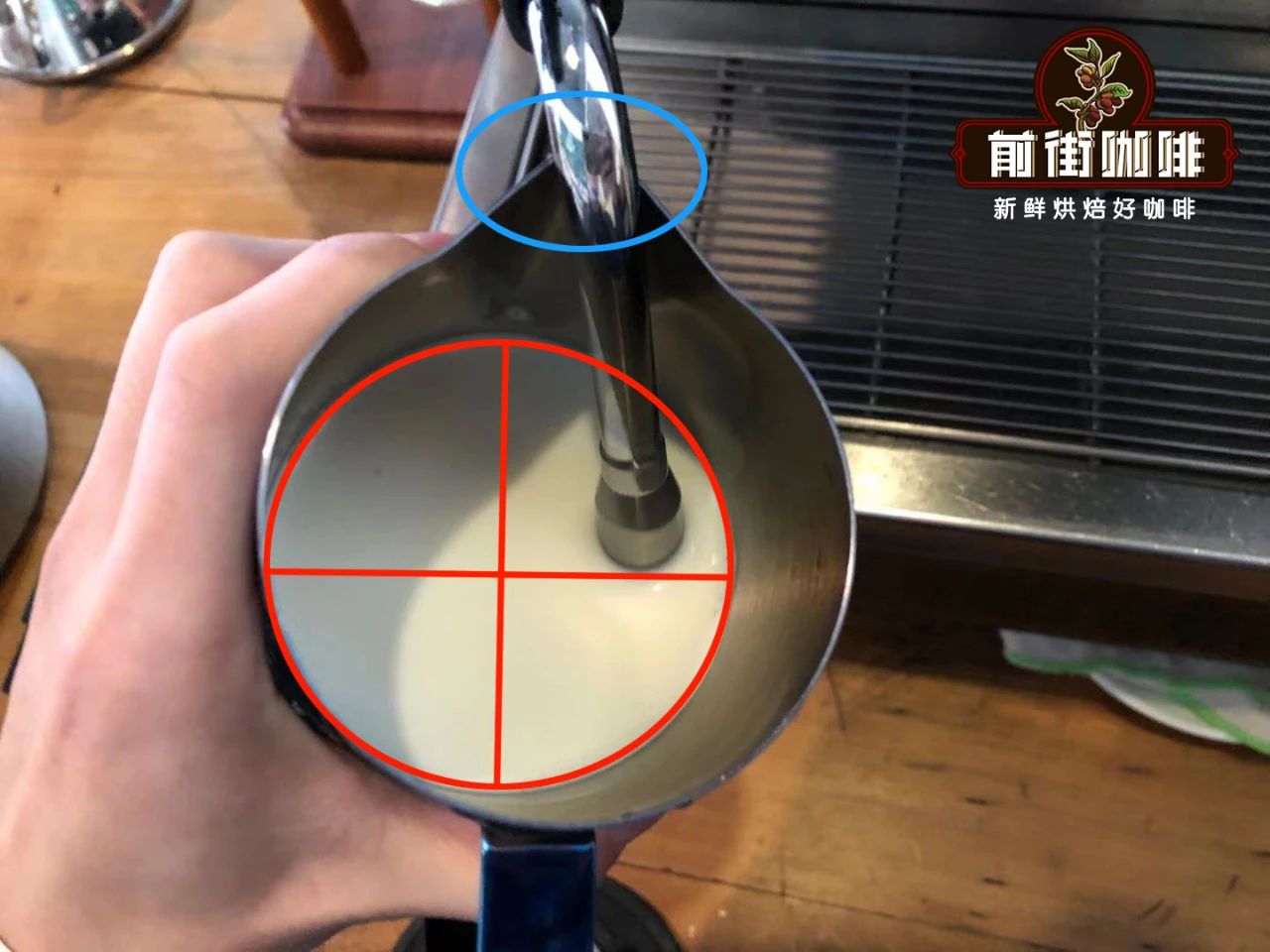
3. Frothing stage: Open the steam valve and you'll hear the "squeak—squeak" of the frothing stage. How long you froth depends on the foam thickness you want—longer frothing means thicker foam. To expand 5 parts milk to 6 parts (classic latte thickness) takes about 3 seconds. The milk should spin evenly into a vortex.
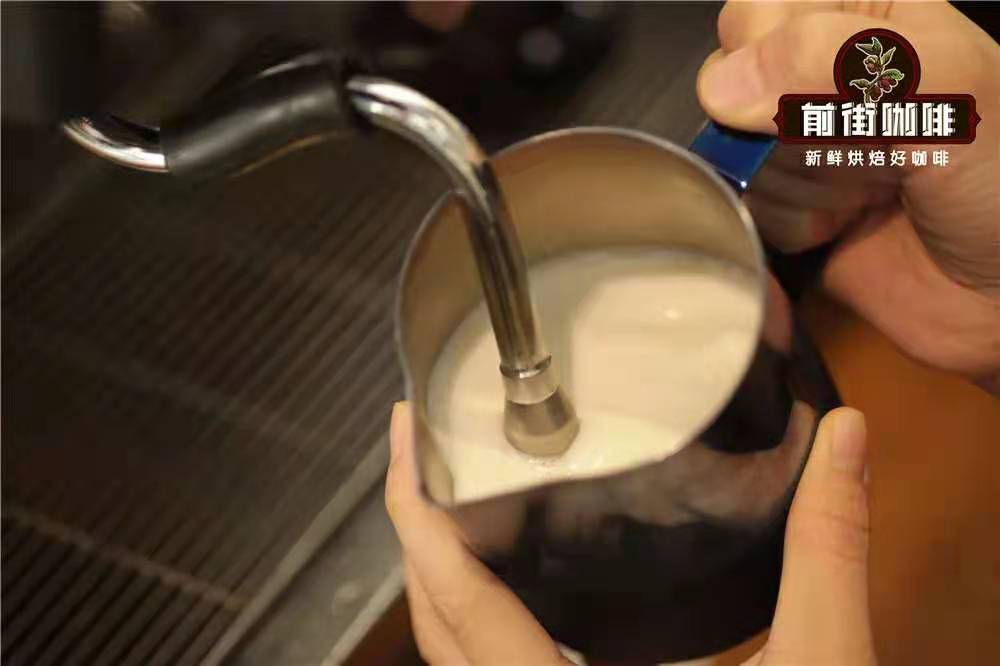
4. Texturizing stage: Now fully submerge the steam holes—heating only, no new foam. Don't bury the tip at the very bottom of the pitcher; keep it in the foam layer, which helps break coarse foam into fine. When do you stop? Watch the milk temperature—generally controlled between 55-65°C. Any hotter and the proteins begin to denature (heat-induced protein denaturation in food typically starts around 60°C).
5. Swirling and tapping: After steaming, the foam gradually separates from the milk. Give the pitcher a gentle swirl to fully integrate foam and milk. If 2-3 large bubbles remain, tap the pitcher on the counter to pop them—but this accelerates foam settling, so 1-2 taps are plenty.
Practice Tips from FrontStreet Coffee
From the process above, FrontStreet Coffee has distilled some practice methods for beginners:
When you first practice, use ice water. This isn't just to save milk—well, actually, it's mainly to save milk... When practicing with water, focus on two things. First, find a wand position that creates a good vortex. The air-introduction point described here is just one of countless approaches—every barista at FrontStreet Coffee uses a slightly different one, yet they all produce dense, silky microfoam. What works best for you is what counts.

Second, internalize the relationship between temperature and time. Frothing has two stages, and the total time—taking the milk from 7-11°C up to 55-65°C—is essentially fixed. So the skill is allocating that time between frothing and texturizing. Many beginners linger too long in the frothing stage, leaving too little time for texturizing, which produces coarse foam that collapses easily.
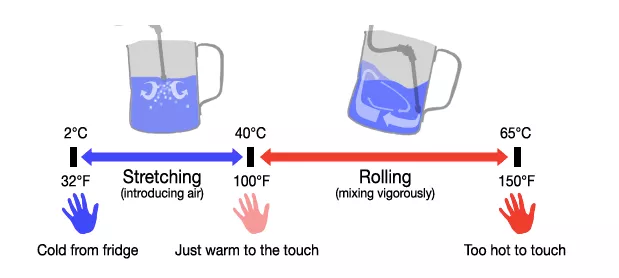
And if your timing is spot-on but the foam still isn't dense? The most common culprit is burying the steam wand too deep: the vortex forms at the bottom while the surface foam never gets texturized, even as the milk keeps heating. The ideal depth during texturizing is just deep enough to stop the squeaking.
FrontStreet Coffee Recommendation
Great latte art needs great espresso underneath, and FrontStreet Coffee has a bean for every stage of practice. The FrontStreet Coffee Classic Blend is a medium-dark, three-origin recipe inspired by the old-school "Mandheling-Brazil" combo, with a touch of Robusta for extra crema—expect clear notes of butter, toasted bread, and caramel biscuits, a strong, solid body, fine crema, and very stable extraction. It's the essential home coffee for beginners learning to pour.
If you prefer a nutty, aromatic profile, the FrontStreet Coffee Signature Blend pairs washed Colombian beans with pulped-natural Brazilians, showing nuts, dark chocolate, and caramel in espresso and releasing a soft cream, almond, and cocoa fragrance in lattes and flat whites—crema on par with café output, more than enough for latte-art practice, and equally suited to aspiring shop owners and home learners.
For those about to open a café, the FrontStreet Coffee Commercial Blend is built on the Signature recipe with a small addition of Robusta to deepen the dark-brown crema and add body—nuts, cocoa, and caramel in Americanos, lattes, and mochas alike, and latte art becomes effortless.
Important Notice :
FrontStreet Coffee is a long-established specialty coffee roaster in Guangzhou China, selling freshly roasted beans from its own farm in Yunnan as well as dozens of carefully selected single-origin beans from around the world for both pour-over and espresso. The products deliver consistently excellent quality and great value, with shipping within 24 hours. Guangzhou's FrontStreet Coffee shop is recommended by many coffee lovers, and the beans are now available online at the Tmall 。
FrontStreet Coffee has moved to a new address:
FrontStreet Coffee Address: 315,Donghua East Road,GuangZhou
Tel:020 38364473
 Scan and follow the En Gafei WeChat official account. Please indicate that the reprint comes from "En Gafei".

