
What's the Best Water for Brewing Coffee? Requirements for Coffee Water and How to Make Coffee Brewing Water Tutorial
Some things, once you have tasted them, change you for good. The first properly good pour-over is one of them: once you fall for that first cup, there is no going back to the instant-coffee era. Who could resist a coffee brimming with floral aromas and fruity sweetness?

Brew at home long enough and you inevitably learn every technique for making a great cup: good beans, precise grinding, careful ratios, water temperature, and pouring skills worthy of a barista. Seasoned brewers obsess over all of these. And yet — you have sourced good beans, dialed in your parameters, and your technique is steady, but the cup still does not taste like the one from the coffee shop. There is a deceptively ordinary variable that shapes the taste of coffee more than most people realize: the water!
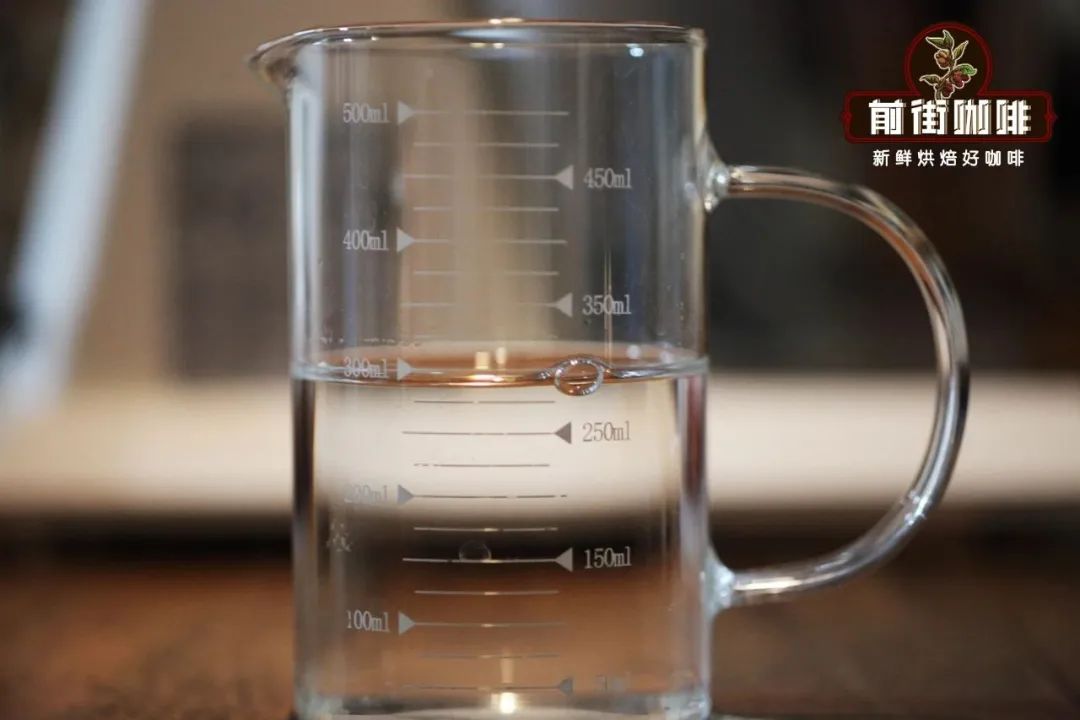
It is not just beginners. Even some longtime coffee enthusiasts have never paid much attention to water. In many people's minds, water is water — colorless, tasteless, and fine as long as it meets drinking standards. But coffee demands far stricter criteria. Next time a café serves you a great cup, ask the owner what water they use.
Water
Water looks colorless and tastes of nothing, but natural water is never completely pure. Seawater makes this most obvious: it carries high concentrations (above 1mg/kg) of sodium, potassium, calcium, magnesium, strontium, and other ions, and one sip tells you instantly that it is anything but pure.
River water, lake water, and even groundwater contain these same minerals, though in trace amounts that usually go unnoticed. Yet those trace minerals are precisely what influence how the flavor compounds extract during brewing.
Understanding Hard Water
Everyone has heard that hard water is bad for brewing coffee. But what is hard water? Simply put: the more dissolved impurities, the harder the water; the fewer, the softer. The chief culprits are calcium and magnesium ions.
The World Health Organization's "Guidelines for Drinking-water Quality" can be summarized like this: water with hardness below 200ppm counts as soft water, and above 200ppm as hard water. (ppm is a concentration unit — the mass of solute per million parts of total solution mass. Water quality is also commonly expressed in mg/L, and 1ppm ≈ 1mg/L.)
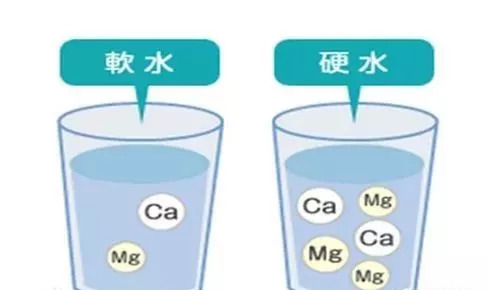
Excessive calcium and magnesium get in the way of flavor extraction. What is more, highly mineralized water simply does not taste good on its own: too much magnesium reads as bitter, too much calcium as faintly astringent — and a coffee brewed with such water inherits those flaws in both taste and mouthfeel.
Tap Water Considerations
The most readily available soft water is tap water. Most households today drink straight from the tap, filling the kettle and boiling before drinking, so using it for coffee seems reasonable. Take the tap water in Guangzhou as an example: its hardness sits around 150–180ppm, which by classification is definitely soft. Yet after just two kettles, a thin film of white powder clings to the inside walls, and within roughly three days a significant layer of scale has formed. Coffee brewed with tap water shows clearly weakened aroma, with astringency and bitter impurities standing out sharply. So most tap water is not suitable for brewing coffee as-is.
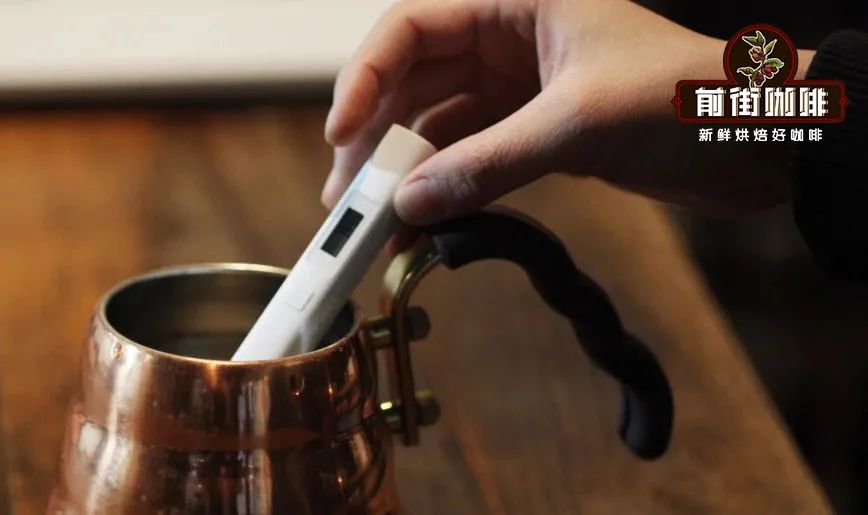
The fix is to install a filtration system matched to your local tap water. But a filter is not a set-and-forget solution: first play water-quality inspector and test whether the hardness has actually dropped, then replace the filter cartridges regularly to keep the water consistent.
Bottled Water for Coffee
If you want to be more refined, buy bottled water for brewing. Serious home brewers who understand how much water matters will happily "splurge" on it. When choosing, watch two things: mineral content and pH.
pH measures acidity and alkalinity. Coffee is naturally acidic, so if you brew with weakly alkaline water, it neutralizes part of that acidity, flattening the coffee's sour notes and dulling its overall flavor expression.
As for minerals: the content should not be too high, but it should not be zero either. Water with moderate calcium and magnesium does a better job of drawing out coffee's sweetness and fragrance. FrontStreet Coffee ran a comparison between purified water and mountain spring water — Yibao (0ppm) versus Nongfu Spring (37ppm) — and after five rounds concluded that the Nongfu Spring brew beat Yibao on both versatility and flavor.
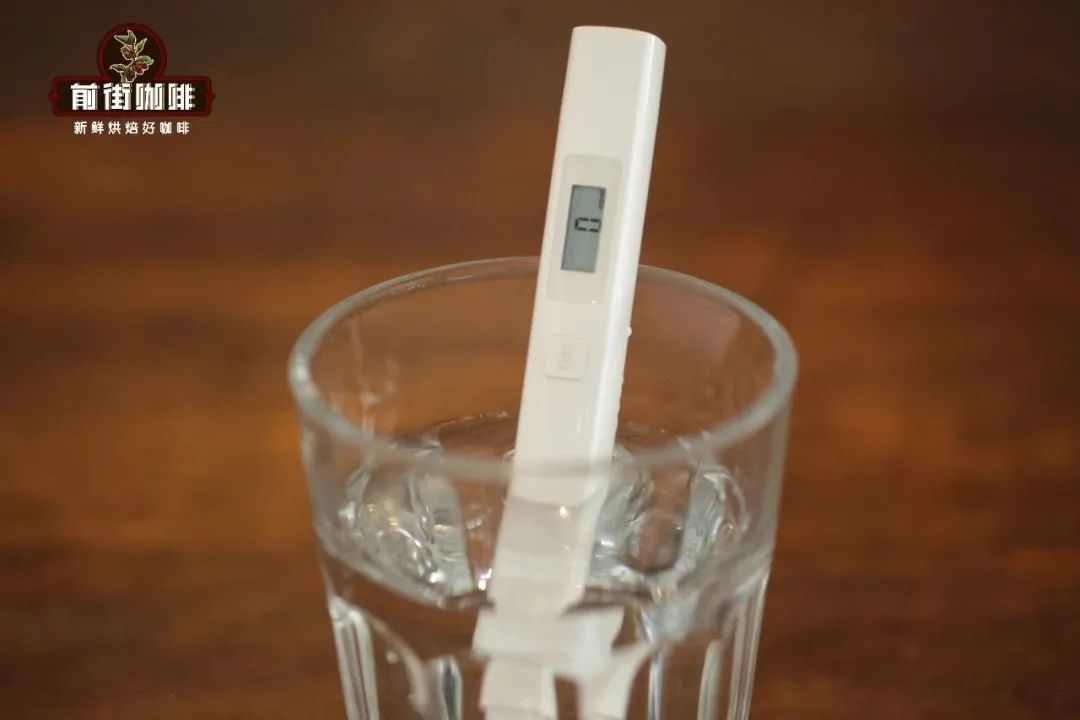
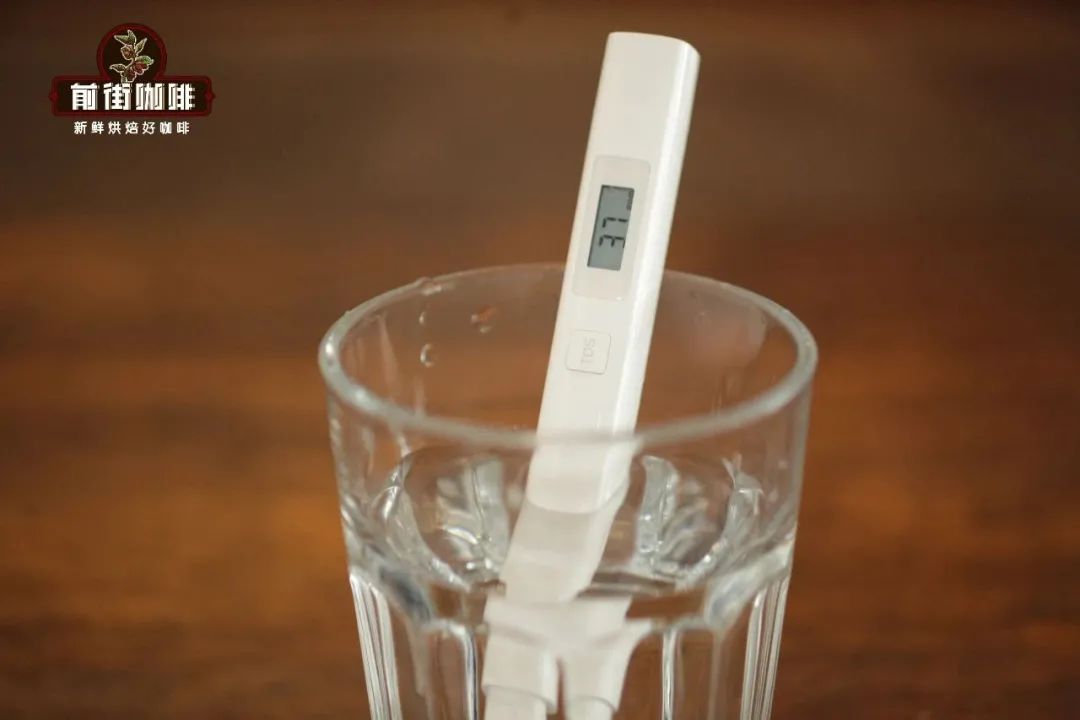
The experiment also exposed a quirk of purified water. With 2 minutes as the dividing line: brews shorter than 2 minutes came out watery, with hollow acidity — next to the same-time Nongfu Spring cup, it was practically coffee-flavored water. Past 2 minutes (2 minutes 10 seconds), the purified-water brew turned noticeably bitter, like an over-extracted cup, while the Nongfu Spring brew showed no such harshness and even finished with a sweet aftertaste. On aroma, purified water lost outright. "In the coffee world, if you don't know how to choose water, just use Nongfu Spring!" That is genuinely not an advertisement — it is simply what FrontStreet Coffee's own customers say when the topic comes up.
Professional Water Recipe
For a more professional approach, you can formulate your own brewing water. Anyone who follows brew competitions knows the drill: many competitors now state in their routines that they use custom-formulated water with specific ppm targets to spotlight particular flavors of a coffee...

It is less intimidating than it sounds. Get baking soda (NaHCO3), Epsom salt (MgSO4), and 3 bottles of 1L purified or distilled water, and you are ready to start.
- Dissolve 1.68g of baking soda in 1L of purified water A until fully dissolved, yielding a solution close to 1000ppm — this is your prepared "buffer solution," or HCO3-. Label it and set it aside. The buffer helps stabilize the solution's pH.
- Dissolve 2.45g of Epsom salt in 1L of purified water B until fully dissolved — this is the magnesium-ion "concentrate" (also close to 1000ppm). Label it and set it aside.
- Finally, to formulate the water: the recipe follows the water quality range proposed by the SCA, targeting total hardness of 120–130ppm. Combine 40ml of buffer solution, 80ml of "magnesium solution," and 880ml of deionized water (for ease of calculation, this makes 1L of formulated water) — and your brewing water is done.
You can also shift the ratio of buffer solution to magnesium solution to adjust the hardness of the finished water.
FrontStreet Coffee Recommendation
Beans that reward great water
Once your water is sorted, give it something worth extracting. The Hario V60 — redesigned in 2004 around its signature 60° cone angle and single large outlet — suits the bright, delicate flavors that good water highlights best. For light roasts, FrontStreet Coffee recommends the Yirgacheffe Guodingding (jasmine, citrus, green-tea finish), the natural-process Ethiopia Huakui (strawberry, passion fruit, jackfruit, lychee), the washed Kenya "Cherry Tomato" from Thika (SL28 and SL34 grown at 1550–1750 meters, with a 72-hour double-wash fermentation yielding cherry tomato, smoked plum, pear, and yellow-sugar flavors), and the Panama Esmeralda Red Label Geisha with its jasmine and bergamot elegance.
For medium-dark roasts
If you prefer a fuller, low-acid cup, the PWN Golden Mandheling (herbal, dark chocolate, a whisper of earth) and the Brazil Queen Estate (low acidity, nut and cocoa aromas with caramel sweetness) both shine, as does Jamaica Blue Mountain No. 1 — creamy, caramel, chocolate, nut, and honey in near-perfect balance — and the Papua New Guinea Paradise Bird from the Sigri estate, a Typica "little Blue Mountain" grown at 1600–1800 meters on volcanic soil, triple-wash fermented, AA-grade, clean and sweet with hardly any acidity.
A tip for the brew
Whichever bean you choose, remember that water quality interacts with extraction speed: softer, mineral-balanced water like the 37ppm spring water above is far more forgiving of long steeps than 0ppm purified water, so keep your total brew time in check and let the water carry the sweetness rather than the bitterness.
Important Notice :
FrontStreet Coffee is a long-established specialty coffee roaster in Guangzhou China, selling freshly roasted beans from its own farm in Yunnan as well as dozens of carefully selected single-origin beans from around the world for both pour-over and espresso. The products deliver consistently excellent quality and great value, with shipping within 24 hours. Guangzhou's FrontStreet Coffee shop is recommended by many coffee lovers, and the beans are now available online at the Tmall 。
FrontStreet Coffee has moved to a new address:
FrontStreet Coffee Address: 315,Donghua East Road,GuangZhou
Tel:020 38364473
 Scan and follow the En Gafei WeChat official account. Please indicate that the reprint comes from "En Gafei".

