Coffee Beans—Characteristics of Ethiopia COE Auction Natural Light Roast Premium Beans
2020 Ethiopia First COE Auction Bean #22
Country of Origin: Ethiopia
Coffee Region: Arsi
Altitude: 2050m
Processing Method: Natural
Coffee Variety: Typica
Roast Level: Medium-Light
Following SCA recommendations, brew it as pour-over with 15 g of grounds and 90–91°C water to 225 ml, at a water-to-coffee ratio of 1:15.
This bean was auctioned at the 2020 Ethiopia Cup of Excellence (COE), placing 22nd with a cupping score of 87.64 points.
It presents floral and fruity acidity with citrus, lychee, and honey characteristics. The aroma is abundant, the acidity bright, and the aftertaste long-lasting.
Cup of Excellence (COE)
Cup of Excellence, abbreviated COE, is a premium coffee grading system.
C.O.E. stands for (Cup Of Excellence) International Coffee Cupping Competition, and its judging is the most credible in top-tier coffee competitions.
The outstanding candidates that emerge from the strict competition are the highest quality coffees from that country for that year.
They must hold consistently high scores in every cupping to rank at the top, and only then can they earn the C.O.E. winning designation.
The winning estate's beans are then auctioned through a unified, dedicated online auction, letting buyers worldwide bid in an open and transparent way.
This approach lets excellent award-winning farms gain recognition quickly, while competition batches of coffee can fetch better prices.
It is held annually, with specialty coffee growers submitting their best beans for review by domestic or international judges from the association. After at least five evaluations,
the highest-rated beans are awarded the COE designation. This evaluation system was first adopted by Brazil's coffee production groups in 1999,
and later spread widely to places such as Guatemala, Panama, Costa Rica, and Nicaragua, showing a trend toward broader adoption.
Each coffee farmer association carefully selects approximately 25–35 bags of about 60 kg each, which are sent to the competition warehouse and stored until the auction ends.
Approximately 500 farms from participating countries enter the competition. The first stage is preliminary, the second is the semi-final, and the third is called TOP 10.
In each stage, the total of individual item scores must reach at least 84 points to qualify. Under this strict system, only about 20–30 farms or estates remain, ranked by their scores.
The COE scoring sheet has eight evaluation categories, each with a maximum of 8 points and a minimum of 0, weighted to 36 points, for a total of 100 points.
A score of 6 means the item meets CoE competition-level standards and belongs to good quality. A completely unacceptable item scores 0, and an average one scores 4.
Coarse quality scores 2, while excellent or even perfect quality scores 8.
A total between 70 and 79 points means the sample is generally superior commercial coffee. A total in the 80–83.5 range means the sample is specialty coffee.
A total of 84 points or above means the sample is CoE competition-level, representing the high standard of winning beans.
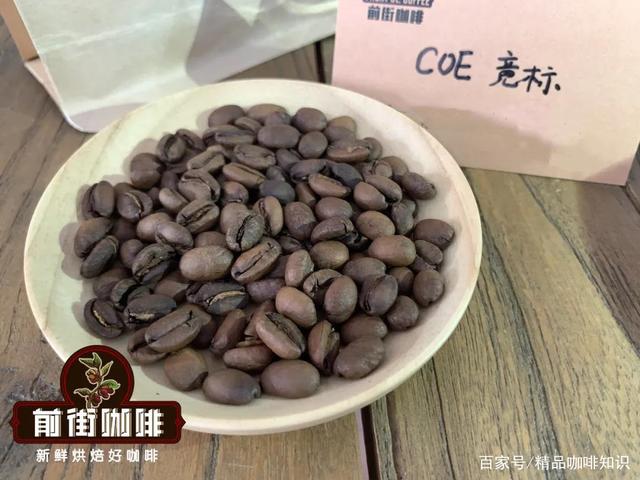
In Ethiopia, most coffee beans are processed naturally, because small-scale farmers dry them in their own courtyards, on rooftops, or even by the roadside.
That makes their costs much lower than washed processing, but this crude approach can produce rough, inconsistent bean quality. By comparison, natural coffee processed in cooperation with cooperatives
and washing stations offers more stable quality. The beans are turned by hand and evenly until the moisture content drops to 25%,
which requires turning every 30 to 60 minutes to avoid over-fermentation flavors. The COE #22 coffee auctioned by FrontStreet Coffee is listed as Typica in the official information,
the oldest native variety in Ethiopia, from which all arabica varieties derive. Typica has bronze-colored young leaves and oval or slender-pointed beans; its flavor is elegant,
but the plant is weak in constitution, poor in disease resistance, and low in fruit yield. FrontStreet Coffee, through cupping Typica from different origins,
has found that no matter where it is grown, Typica carries its characteristic subtle, clean flavor, balanced characteristics, and mouthfeel across coffee-growing regions worldwide.
The Significance of Cup of Excellence
What is the significance of the Cup of Excellence? The traditional coffee industry pursued mass marketing and commercial transactions above all, but driven by huge profits and commercialization,
the quality and origin of coffee gradually gained attention. Before Cup of Excellence arrived, most coffee beans were processed as mixed batches,
where the wonderful flavors of different beans could not stand out and flavor characteristics were submerged under national or regional names. Truly excellent beans were often buried in the process.
FrontStreet Coffee Recommendation
If you are drawn to the florals, citrus, and honey sweetness of this Ethiopian COE lot, FrontStreet Coffee's Ethiopian range offers several ways to explore the same terroir. The Washed Yirgacheffe is the classic entry point, with white jasmine florals, bright citrus and lemon acidity, and a tea-like body; it is a benchmark for the southern Ethiopian style and an easy first step into specialty coffee.
For a single-origin expression with village-level traceability, try the Gudingding Cooperative. Based at the southeastern edge of Yirgacheffe in the Worka district, it grew out of the Worka cooperative under the YCFCU union and follows the most traditional washed processing, giving a cup with no conventional bitterness, fresh citrus and lemon acidity, and jasmine fragrance.
For naturally processed fruit, FrontStreet Coffee offers the Natural Red Cherry, which uses only fully ripe, sound cherries dried on raised beds and turned every two to three hours early on to prevent over-fermentation, emerging with citrus acidity, berry juiciness, honeyed sweetness, and a creamy body. Rounding out the lineup, the Natural Huakui from Hambela in the Guji zone of Sidamo is dried for 21 days on raised beds and hand-sorted, showing a light fermented wine aroma with florals, citrus, and mango; the Hamasho 74158 from the Sidamo Hamasho mill brings perfumed lemon, strawberry, and star fruit sweetness with small, intensely floral beans; and the Kafa Forest coffee, grown wild under shade at 1,400–2,100 meters, offers white florals, bright lemon acidity, sweet orange and bergamot, and a green-tea-like finish.
Important Notice :
FrontStreet Coffee is a long-established specialty coffee roaster in Guangzhou China, selling freshly roasted beans from its own farm in Yunnan as well as dozens of carefully selected single-origin beans from around the world for both pour-over and espresso. The products deliver consistently excellent quality and great value, with shipping within 24 hours. Guangzhou's FrontStreet Coffee shop is recommended by many coffee lovers, and the beans are now available online at the Tmall 。
FrontStreet Coffee has moved to a new address:
FrontStreet Coffee Address: 315,Donghua East Road,GuangZhou
Tel:020 38364473
 Scan and follow the En Gafei WeChat official account. Please indicate that the reprint comes from "En Gafei".