How to Choose Coffee Beans: Are All Coffee Beans Good? Premium Coffee Bean Recommendations
A delicious cup of coffee begins with fresh, perfectly roasted beans. But where do you find the best beans, and which producing countries create the most interesting flavors? FrontStreet Coffee walks you through a guide to coffee beans from around the world, along with the various coffee types and their flavor profiles.
At FrontStreet Coffee, the variety on our bean menu can be overwhelming, and it's hard to know where to start. Don't worry—we'll introduce several major categories of coffee, each with representative regional character.
Jamaican Blue Mountain Coffee
Jamaica produces a relatively small amount of coffee each year, and not all of it comes from the Blue Mountains. The coffee that does grow here develops at very high altitudes.
Production is extremely limited, and roughly 80% of the crop is exported to Japan each year. These beans also demand labor-intensive handling and must be hand-picked from mountain slopes. The high altitude, cool temperatures, and volcanic soil contribute to a harvest period of nearly 10 months—far longer than in other coffee-growing regions.
The resulting cup balances full body, medium acidity, and gentle sweetness. Some say Blue Mountain is the smoothest coffee they've ever tasted.
Kenyan Coffee
Kenyan coffee beans rank among the finest in the world. The effort farmers put into cleaning and processing these beans is unmatched.
Perhaps the biggest contributor to Kenyan quality is the incentive system: farmers are rewarded for producing better coffee. The government runs auctions where all Kenyan coffee is sold. Higher-quality coffee fetches better prices, which motivates farmers to improve their crops.
'AA' represents the largest bean size, followed by 'AB'. In Kenya, bigger is better—always look for "AA." These coffees are characterized by sweet fruit flavors, wine-like acidity, and a syrupy body. Thanks to their processing methods, they rank among the cleanest-tasting coffees in the world.
Indonesian Sumatran Beans
This coffee is named after the Mandheling people, who once grew coffee in northern Sumatra. Coffee from the region shows low acidity with a sweet, smooth body. The flavors vary widely, from cocoa and tobacco to earthy and herbal notes. Many choose dark-roasted Sumatran coffee to amplify its sweetness and almost spicy character.
Coffee across Sumatra is typically processed with a hybrid method similar to wet-hulling. This processing step is perhaps the single biggest influence on the coffee's final profile. These beans work exceptionally well in Moka pots.
Sumatran Mandheling beans are among the most controversial coffees. Drinkers tend to either love them or hate them. What about you?
This is also a coffee that's hard to find, for several reasons. Few cafés serve it, because it's quite expensive and best as filter coffee. Cafés focus primarily on milk-based drinks, so for many, offering a coffee that can only be enjoyed black doesn't make business sense. You may never have tried a coffee like this. It's genuinely unique. If you prefer lighter, brighter coffees, it's one you need to taste.
Central American Geisha Coffee Beans
Geisha coffee beans are among the most distinctive beans in the world.
Although in theory they can grow anywhere, they have earned a special reputation when cultivated in Panama and Costa Rica. The most famous farm is Hacienda La Esmeralda. Geisha beans were originally discovered near the town of Geisha in Ethiopia. The variety didn't reach Panama until the 1960s.
What makes Geisha beans unique? They possess a naturally tea-like body with abundant clear, bright, effervescent flavors such as citrus, mango, peach, and jasmine. You might also catch notes of bergamot or vanilla.
Ethiopian Yirgacheffe Beans
Yirgacheffe is regarded as sacred in the global coffee community.
Ethiopia itself is considered the birthplace of Yirgacheffe coffee and of coffee beans in general—a point of national pride and joy. Sidama is a region in Ethiopia that contains the Yirgacheffe micro-region. Within Yirgacheffe, there are even smaller areas: Adado, Aricha, Kochere, Konga, and others.
Ethiopian coffee is typically wet-processed, producing coffee with a light, almost tea-like body and complex fruit and floral notes. Walk into any specialty coffee shop and you'll likely find coffee from this region on the shelves. It's easy to see why these coffees are called the gateway to quality coffee.
Acidity and Bitterness
Coffee is naturally acidic, and that isn't a bad thing. Acidity is good, because it gives coffee its natural flavor. Different beans have varying levels of acidity, though, and some people are sensitive to the acids. The acidity in coffee is more about taste than pH value, even though many claim that coffee's acidity causes digestive issues.
Coffees from Africa typically have higher acidity with fruity or floral flavors.
Coffees from places like Brazil or Sumatra have lower acidity with cocoa and nutty flavors.
Acidity is heavily influenced by altitude. Coffee grown at lower altitudes generally has lower acidity.
Bitterness, on the other hand, is a result of brewing. Overly bitter coffee is bad. If you extract too much from the grounds, you get a harsh, bitter aftertaste. This usually happens when your grind size is too fine or when you over-extract. The particles are smaller, so water contacts more surface area and ultimately dissolves more compounds.
In summary: bitterness in coffee can be avoided with proper brewing. Acidity in coffee is natural and unavoidable. You can, however, "mask" some acidity with darker roasts or by choosing low-acid beans.
FrontStreet Coffee Recommendation
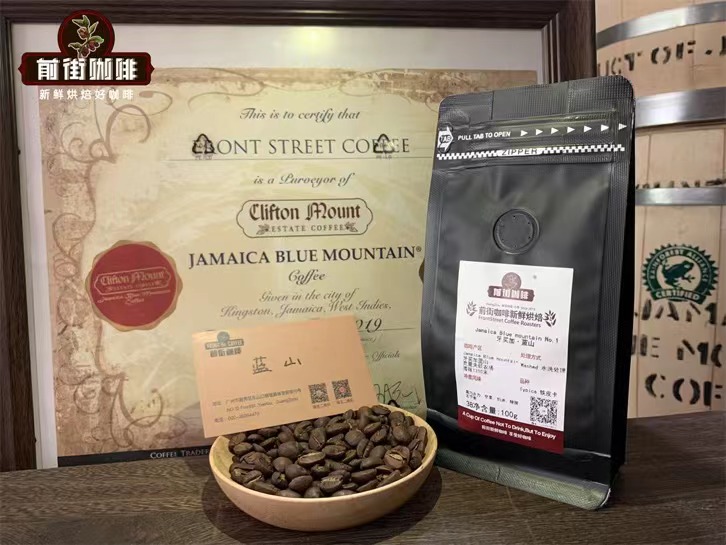
If the balance of Jamaican Blue Mountain is what drew you in, FrontStreet Coffee's Jamaica Blue Mountain No.1 is the closest you'll get to the real thing. It's the highest grade within Jamaica Blue Mountain, sourced from the historic Clifton Estate, and it comes with full origin certification. Genuine Blue Mountain is packed and shipped in traditional wooden barrels—often in 15, 45, and 70-kilogram sizes—and each barrel is itself a mark of authenticity. Because the estate has a long history of growing and processing coffee, and sits at an average elevation of 4300 feet (1310.64 meters), the cup lands right where Blue Mountain should: no sharp fruit acidity, no heavy bitterness, just a poised balance of sweet, sour, bitter, and aromatic.
FrontStreet Coffee roasts it to a medium-dark level, which lets the classic balance shine. Brewed, you'll find nut, dark chocolate, and creamy caramel unfolding in layers with a soft sweetness. For pour-over, FrontStreet suggests a Kono dripper—it plays up the coffee's full body—using 15g of coffee rested 4-7 days after the roast date, a 1:15 ratio, and water at 87-88°C. Grind a touch coarser than you would for a light roast, roughly the texture of white sugar. Pour in three stages: 30g to bloom for 30 seconds, then to 120g with a slow, steady circular pour, then to 225g with a slightly quicker pour to keep the bed from clogging and the extraction from running long.
Blue Mountain is also more versatile than people assume. Because it's so well balanced, it works as a pour-over, in a Moka pot, or as an espresso—each method revealing a different layer of its character.
Important Notice :
FrontStreet Coffee is a long-established specialty coffee roaster in Guangzhou China, selling freshly roasted beans from its own farm in Yunnan as well as dozens of carefully selected single-origin beans from around the world for both pour-over and espresso. The products deliver consistently excellent quality and great value, with shipping within 24 hours. Guangzhou's FrontStreet Coffee shop is recommended by many coffee lovers, and the beans are now available online at the Tmall 。
FrontStreet Coffee has moved to a new address:
FrontStreet Coffee Address: 315,Donghua East Road,GuangZhou
Tel:020 38364473
 Scan and follow the En Gafei WeChat official account. Please indicate that the reprint comes from "En Gafei".