World Specialty Coffee: 5 Things You Should Know About Brazilian Specialty Coffee
Brazilian coffee has a bad reputation. Quantity over quality, you might hear people say. But these beans have far more to offer than most people think. So here at FrontStreet Coffee, we want to share five things you should know about coffee from this country. A few of them may surprise you.
The World's Largest Producer
We are not talking about the size of the country here. Brazil's coffee production is massive. The country accounts for about one-third of global coffee production, making it by far the largest coffee producer and exporter. In 2015, the total reached 36.89 million 60-kilogram bags. Can you imagine how much coffee that is? Because of this scale, the country's production and market behavior ripple through international prices, which means a drought in Brazil can push global coffee prices up. This has led many coffee enthusiasts, though certainly not all, to believe that Brazil's focus on quantity makes producers forget about quality, and that in turn makes it harder for Brazilian producers to sell their beans.
Underestimated Flavor Profile
Most people go to Brazil to source beans for espresso blends. There is nothing wrong with that. Even so, the country produces specialty coffee time and time again.
More importantly, Brazil's single origins are not merely "good enough." They are high-quality, distinctive coffees. Brazilians typically deliver intense sweetness in the form of caramel and chocolate, a full body, and relatively low acidity.
That low acidity sometimes leads people to underestimate the quality of Brazilian cups, but take another sip and you will find this flavor profile is surprisingly good.
Diverse Coffee
As just mentioned, Brazilian coffee comes in a wide variety, without a doubt. With fourteen major coffee-producing regions spread across seven states, Brazil's beans are incredibly diverse. Look at the information on the coffee bag, and you might find coffee from Minas Gerais (Sul de Minas, Cerrado Mineiro, Chapada de Minas, Matas de Minas), São Paulo (Mogiana, Centro-Oeste), Espírito Santo (Montanhas do Espírito Santo, Conilon Capixaba), Bahia (Planalto da Bahia, Cerrado da Bahia and Atlantico Baiano), Paraná (Norte Pionerio do Paraná), Rondonia, and even Rio de Janeiro. With so many producing regions, you will find a wide range of traditional and experimental varieties under cultivation: Bourbon, Mundo Novo, Icatu, Catuai, Iapar, Catucai, and more.
Then there are the farms themselves, ranging from small family plots of less than 10 hectares to large estates of over 2000 hectares.
With such variety, you are sure to find a coffee you will love in Brazil.
Professional-Grade Naturals
Most Brazilian coffee is natural (unwashed) or natural pulped (semi-washed). Natural processing means the cherries are dried as they are after picking, without removing the skin or mucilage.
So why does this matter? Well, natural processing is difficult to do without damaging the beans, but it can add rich body, sweetness, smoothness, and complexity to the cup.
Brazil's climate, with scarce rainfall and long sunshine hours, is perfect for natural processing.
Complex Classification System
Compared with the classification systems of most producing countries, Brazil's is very detailed. Coffee is classified by hue and ranked by color and cupping. Beans are rated, from best to worst, as Strictly Soft, Soft, Softish, Hard, Riado, and Transparent.
FrontStreet Coffee Recommendation
To taste why Brazilian coffee deserves more credit, start with FrontStreet Coffee's Cerrado Red Bourbon, a classic half-washed (pulped natural) Brazilian single origin from the well-known Cerrado region. Roasted medium, it shows creamy peanut, toast, caramel, and hazelnut, with a round and smooth body, little acidity, and a light bitter note. It works for pour-over as well as moka pot, espresso SOE, siphon, and French press.
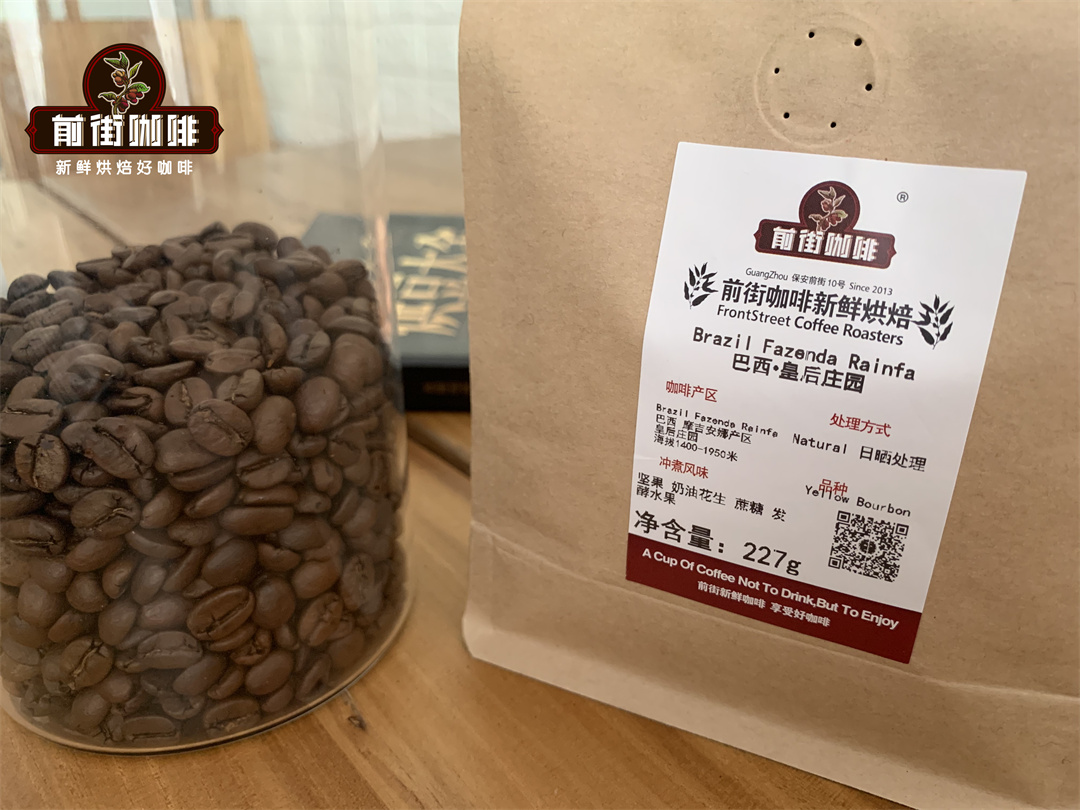
For the rare side of Brazil, try FrontStreet Coffee's Queen's Estate Yellow Bourbon from Mogiana, where fertile red volcanic soil builds a fuller aroma. Yellow Bourbon is a rare mutation of Red Bourbon with a cleaner fruit character, and it brings a sugarcane-like sweetness alongside fruit and chocolate notes. Brewed as pour-over, moka pot, or on a home espresso machine, it shows a clarity that other Brazilian regions rarely match.
Important Notice :
FrontStreet Coffee is a long-established specialty coffee roaster in Guangzhou China, selling freshly roasted beans from its own farm in Yunnan as well as dozens of carefully selected single-origin beans from around the world for both pour-over and espresso. The products deliver consistently excellent quality and great value, with shipping within 24 hours. Guangzhou's FrontStreet Coffee shop is recommended by many coffee lovers, and the beans are now available online at the Tmall 。
FrontStreet Coffee has moved to a new address:
FrontStreet Coffee Address: 315,Donghua East Road,GuangZhou
Tel:020 38364473
 Scan and follow the En Gafei WeChat official account. Please indicate that the reprint comes from "En Gafei".