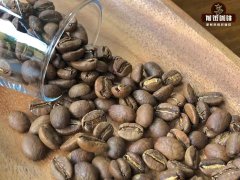
Honduras Best Coffee Beans Flavor and Taste Characteristics Description Honduras Local Coffee Bean Brands Ranking

FrontStreet Coffee organizes its bean catalog into three broad families by growing region: Asian, Latin American, and African coffees. Whether you visit our Guangzhou café or browse our online store, you'll see beans from all three on display. Today we'd like to introduce Lychee Lan, a Latin American bean with a striking wine-like aroma layered over rich nutty and chocolate flavors.
FrontStreet Coffee specializes in freshly roasted beans. A pour-over at our café costs 30 yuan, and freshly roasted whole beans are available to take home. Our retail bags are packed uniformly in one-jin portions so that every bag can be finished within the beans' peak flavor window. We're happy to grind beans to order — matched to whether you'll brew pour-over or espresso — but we recommend grinding as close to brew time as possible, since ground coffee loses its aromatics quickly.

FrontStreet Coffee: Honduras Moca Manor Lychee Lan Coffee Bean
Country: Honduras
Origin: Masaguara
Manor: Moca Manor
Altitude: 1500-1700m
Varieties: Caturra, Catuai
Processing: Fine washed + brandy barrel fermentation
Honduran Coffee Beans
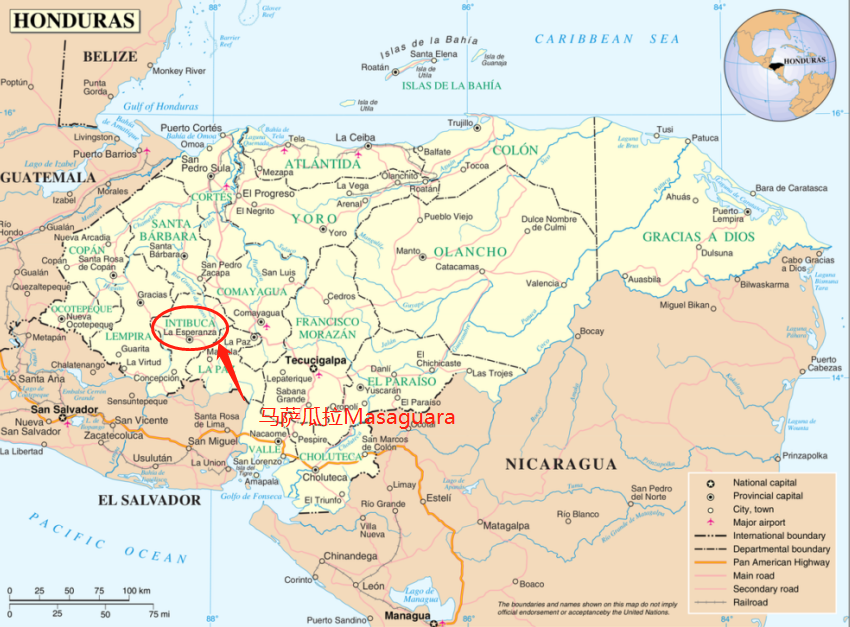
Honduras sits in northern Central America, bordered by the Caribbean Sea to the north and the Pacific's Gulf of Fonseca to the south, with Nicaragua and El Salvador to the east and south and Guatemala to the west. The landscape is dominated by mountains and highlands, and the tropical climate — mild temperatures and abundant rainfall — makes it ideal coffee country.

Honduras has 280,000 hectares under coffee, overwhelmingly farmed by smallholders — most farms are smaller than 3.5 hectares, yet together they account for sixty percent of the country's total coffee production.
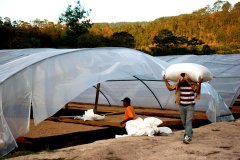
Over the past two decades, Honduran coffee has made enormous strides in processing and logistics. Because the growing regions are mountainous, cherries are picked by hand and carefully processed to preserve quality. The country harvests around three million bags a year, mostly specialty-grade lots, and now ranks among the world's top ten coffee exporters.

Honduran Coffee Regions
Honduras has six main coffee regions: Copán, El Paraíso, Comayagua, Opalaca, Montecillos, and Agalta. Beans are grown at an average altitude of 1000–1600m, with Bourbon, Caturra, Typica, Catuai, and Pacas as the leading varieties.

Honduran beans are relatively large, uniform in size, and even in color and sheen. To make hand-picking easier, farmers prune their trees to no more than 150 centimeters — taller trees would mean ladders, slower picking, and branches damaged by bending. Because cherries on the same branch ripen at different times, quality depends on selective manual harvesting, with pickers taking only the fully red fruit; a single branch may need several passes over several weeks to harvest completely.
Honduran coffee is known for a rich, mellow cup — neither astringent nor sharply acidic — with high body and aroma and a very distinct character. By varying roast level, FrontStreet Coffee can draw out several layers of flavor from these beans.

Masaguara
Lychee Lan comes from Masaguara, a municipality in Honduras's Intibucá department, south of the Jesús de Otoro valley and ringed by mountains and hills. Coffee growing is the engine of the local economy, while the valley below is devoted to staple grains and livestock. According to the scholar Alberto Membreño, the indigenous name Masaguara means "place of the deer."
Honduran Coffee Bean Varieties
Caturra is a natural Bourbon mutation discovered in Brazil in 1937. The trees are more compact than Bourbon, and although the lineage confers relatively weak disease resistance, yields are higher. Brazil's conditions never suited Caturra, so it was never planted at scale there — instead it spread across Central and South America, in Colombia, Costa Rica, Nicaragua, Honduras, and beyond. The general rule for Caturra: the higher the altitude, the better the quality — and the lower the yield.
In our roastery we can feel the difference directly. At light roast, Caturra shows prominent acidity and overall brightness, and with careful handling its sweetness comes through well — though the body is thinner than Bourbon's and the cup slightly less clean. Most Caturra bears red cherries; yellow Caturra exists only in tiny pockets, such as the rare yellow Caturra grown in Hawaii.
Catuai is a deliberate cross of Caturra and Mundo Novo. It shrugs off weather stress better than either parent — especially wind and rain. The trees are low-growing, and the fruit attaches so firmly that it resists shaking loose. Cherries come in both red and yellow forms.
Honduran Coffee Bean Processing
Barrel fermentation borrows directly from winemaking. In wine, oak's controlled oxidation stabilizes the wine's structure and layers in barrel aromas; it plays much the same role in coffee fermentation.
The barrel walls admit tiny amounts of air, gently oxidizing the beans inside. That measured oxygen inflow accelerates fermentation, softens tannins, and coaxes fresh fruit aromas toward richer, more complex mature wine notes. The wood's density keeps the barrel watertight and safe for storage, and its natural tannins seep into the green beans during rest, giving the finished coffee its layered, wine-lifted character.

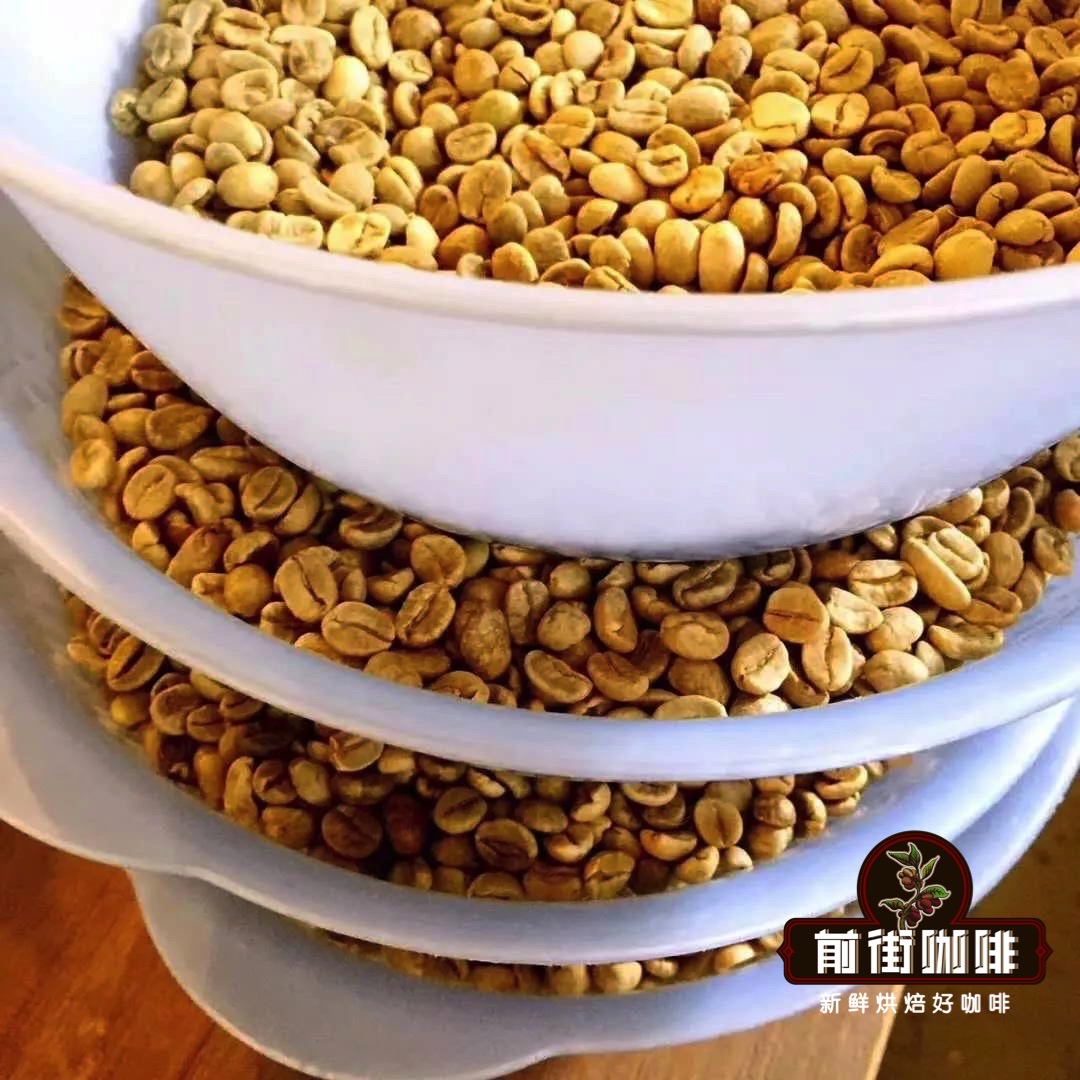
For this finely washed, brandy-barrel-fermented Lychee Lan lot, freshly picked cherries are first processed through fine washing, then the beans are sealed into brandy oak barrels for low-temperature fermentation of 30–40 days at roughly 15–20℃, where they absorb the barrel's flavors, and finally dried in the shade.
Brandy-barrel-processed beans carry soft lychee and honey sweetness wrapped in full-bodied brandy and oak aromatics.

Roasting Recommendations
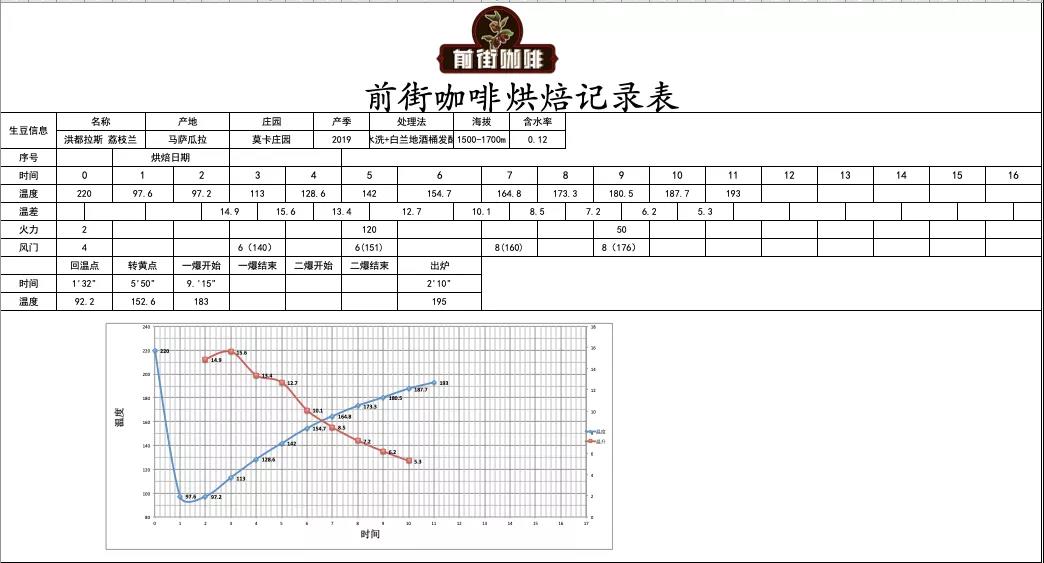
FrontStreet Coffee's version of this Honduran bean shows a pronounced creamy aroma. To showcase its character, our roaster built two roast curves for comparison.
[Curve 1] Entry temperature: 220℃, yellowing point: 6'30", 151.6℃, first crack: 9'53", 183℃, development after first crack 1'40", out at 196℃.
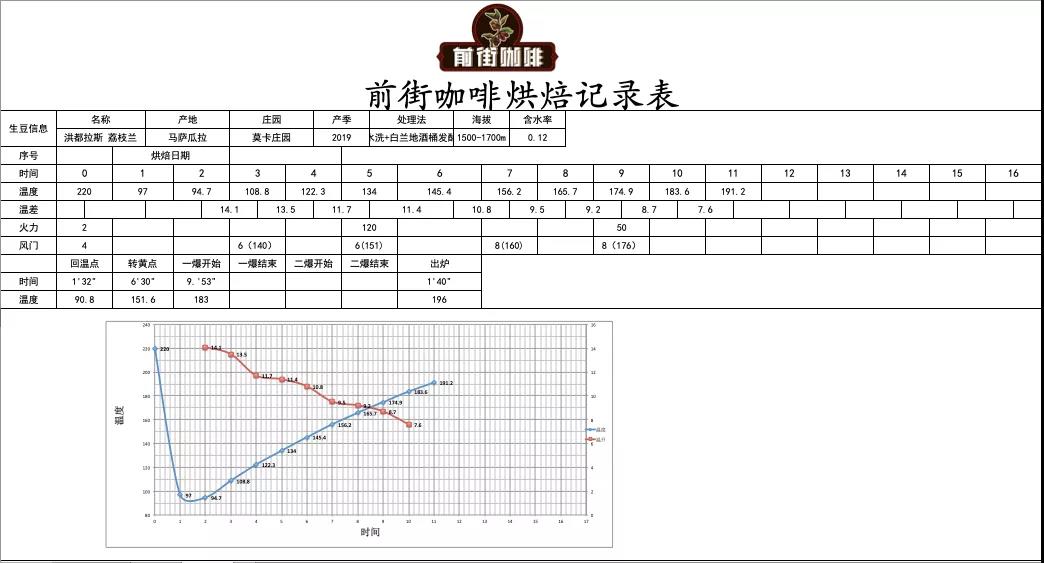
[Curve 2] Entry temperature: 220℃, yellowing point: 5'50", 152.6℃, first crack: 9'15", 183℃, development after first crack 2'10", out at 195℃.
Cupping Notes
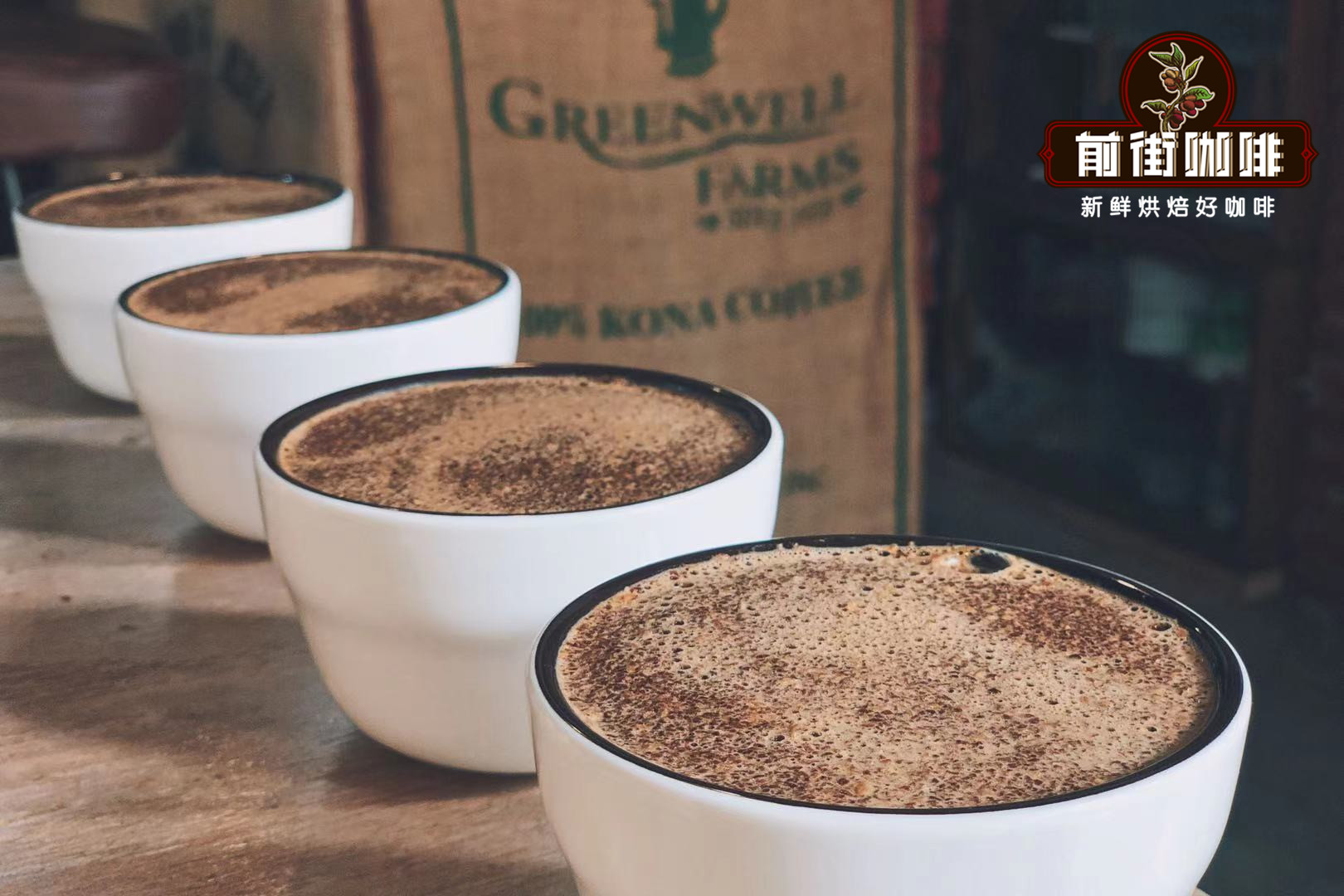
[Curve 1] Flavor: floral, berries, dark chocolate, honey, lychee. On the palate, berry acidity leads, with a subtle wine aroma emerging as the cup cools.
[Curve 2] Flavor: cream, dark chocolate, honey, lychee, brandy. Fuller-bodied with pronounced sweetness; as it cools, the wine character becomes increasingly prominent.
Brewing Notes
FrontStreet Coffee's brewing parameters: Hario V60 dripper, water temperature 90℃, 1:15 coffee-to-water ratio, grind size (fine sugar: 80% pass-through rate on China standard #20 sieve).
Brewing method: Multi-stage extraction. Bloom with 30g of water for 30 seconds, then pour in small circles to 125g for the first segment. When the water level drops and the coffee bed is nearly exposed, pour again to 225g and stop. Once the bed is nearly exposed again, remove the dripper (timing starts from the bloom). Total extraction time: 2'00".
FrontStreet Coffee kept parameters and technique as consistent as possible across both roast curves.

[Curve 1] On entry: berries, florals, honey. As it cools, brandy and cream emerge. Hot, the berry acidity is vivid but carries a green astringency.
[Curve 2] On entry: lychee, brandy, dark chocolate, cream. As it cools, wine flavor and dark chocolate take the lead. Full-bodied, with sweetness lingering in the aftertaste.
Comparing the two curves, FrontStreet Coffee found that while [Curve 1] offers decent sweetness and berry aroma, its fruit acidity dominates the entry, cleanliness suffers from astringency, and the aftertaste falls short — the wine character never fully develops, proving this bean is not suited to light, fast roasting.

[Curve 2], by contrast, outperforms on both wine flavor and sweetness: the flavors are distinct, the texture thick and smooth, and from first sip to finish, wine aroma and dark chocolate carry the cup with a thread of honey sweetness beneath.
Because [Curve 1] skewed toward fruit-acid flavors with green astringency and never let the bean's signature show, FrontStreet Coffee's roaster extended development in [Curve 2] to draw out more of the barrel character, making the bean's overall performance far more balanced.
FrontStreet Coffee Recommendation
If barrel-aged and wine-forward beans like Lychee Lan intrigue you, the Hario V60 is the dripper we'd reach for when brewing them — and for most floral, fruit-driven light roasts in general. The V60's 60-degree cone and single large outlet deliver a fast, controllable flow that coaxes out three-dimensional aromatics and lively acidity: the florals, fruit acidity, delicate sweetness, and tea-like finish that define the best specialty lots all come through with unusual clarity.
For a taste of what fast-flow conical brewing does best, start with FrontStreet Coffee's washed Yirgacheffe Worka (Guodingding) — soft citrus and berry acidity, white florals, and a green-tea sweetness, gentle enough for anyone new to specialty coffee. FrontStreet's Ethiopia Huakui pushes further into tropical territory with strawberry, passion fruit, jackfruit, and lychee aromatics and an almost juice-like sweetness, while the Panama Esmeralda Red-Label Geisha — jasmine, citrus, bergamot, and a black-tea finish — remains the benchmark for those chasing the ultimate floral cup.
Prefer the fuller-bodied, low-acid side? Slow things down with medium-dark roasts instead. FrontStreet's PWN Golden Mandheling brings herbal depth, dark chocolate, and a whisper of earthiness, and FrontStreet's Jamaica Blue Mountain No. 1 strikes that near-perfect balance of cream, caramel, chocolate, nuts, and honey that makes it one of the easiest premium coffees to love. Match the roast to the dripper's flow, and the V60 will flatter both ends of the spectrum.
Important Notice :
FrontStreet Coffee is a long-established specialty coffee roaster in Guangzhou China, selling freshly roasted beans from its own farm in Yunnan as well as dozens of carefully selected single-origin beans from around the world for both pour-over and espresso. The products deliver consistently excellent quality and great value, with shipping within 24 hours. Guangzhou's FrontStreet Coffee shop is recommended by many coffee lovers, and the beans are now available online at the Tmall 。
FrontStreet Coffee has moved to a new address:
FrontStreet Coffee Address: 315,Donghua East Road,GuangZhou
Tel:020 38364473
 Scan and follow the En Gafei WeChat official account. Please indicate that the reprint comes from "En Gafei".