El Salvador Coffee's Turbulent History: Fair Trade Impact and Black Honey Processing
The Turbulent History of Coffee in El Salvador
Coffee's turbulent history has left a profound mark on El Salvador's politics, economy, and development. No other country in the region has been so dependent on a single crop: the nation's fate rose and fell dramatically with the cycles of prosperity and depression brought by what Salvadorans call "el grano de oro" — the "golden bean." Yet the treatment of those whose fortunes rose in good times and endured through the bad was markedly different: the elites prospered, while small farmers and laborers were exploited almost constantly.
For many years, indigo had been El Salvador's most important export crop. In the 1880s, coffee surpassed indigo to become the primary export, seen as a path to progress and development. In practice, coffee created immense wealth for the landed elites and opportunity for those already in power.
In 1881 and 1882, the so-called Liberal Reforms were enacted, dramatically reshaping the country's land tenure system. The peasantry was forced to labor on harsh coffee, sugar, and cotton plantations, and nearly half of El Salvador's population was stripped of its land, with few farmers holding more than bare worker status.
In 1895, General Tomás Regalado won the presidency — a position that allowed him and his family to plant 6,000 hectares of coffee across six different provinces, expanding coffee's dominance and their own wealth in the years that followed.
In the 1920s and 1930s, coffee exports alone accounted for 90% of the country's total exports. The global economic depression of the 1930s pushed El Salvador to the brink, and the combination of entrenched plantation power and a desperate rural proletariat proved as unstable in the 1970s and 1980s as it had been fifty years earlier.
The coffee industry survived the Great Depression and even thrived. By introducing modern technology on plantations and sophisticated processing systems, El Salvador became one of the most advanced coffee-producing countries. By the 1970s it ranked as the world's fourth-largest coffee exporter — but neither the landed aristocracy nor the modernizing elites showed any interest in addressing the poverty and upheaval tied to the coffee trade. In the late 1980s, El Salvador's modernizing sectors hoped to expand their grip on the economy and diversify their assets. By the 1990s, 78% of coffee farms and 40% of the total coffee area were in the hands of small producers. Coffee trees also occupied most of the remaining forest land in what had become the second-most deforested country in the hemisphere, and coffee provided direct employment for 155,000 Salvadorans.
Fair Trade and Modern Coffee Culture
Despite the many challenges coffee farmers face today, those organized in fair trade cooperatives receive preferential prices along with technical assistance in production, marketing, and export. And as part of a global network of fair trade advocates and buyers, they can tap development projects and other support from governmental, non-governmental, and religious agencies.
The first fair trade café, "Foto Café," opened in San Salvador, selling only coffee from two fair trade cooperatives: El Pinal and Las Colinas. Photographs on the walls and pamphlets on the tables help Salvadorans understand the farmers' plight and the importance of fair trade coffee. The owners hope to begin influencing local purchasing decisions while also serving the growing number of foreign tourists visiting the country.
Fair trade has transformed the lives of these farmers and others in coffee cooperatives. The more fair trade coffee sold, the more opportunities for other farmers — and the greater the impact.
FrontStreet Coffee's El Salvador Coffee Selection
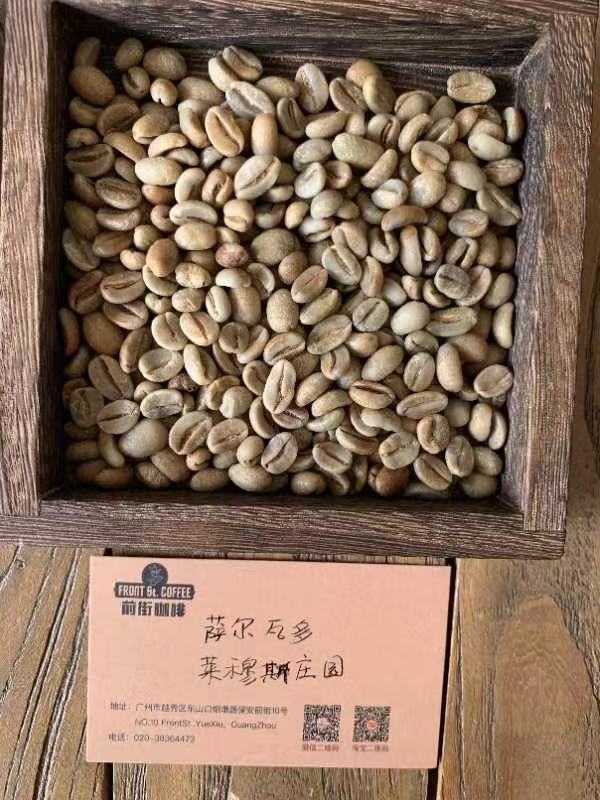
El Salvador has always been one of FrontStreet Coffee's favorite coffee-producing countries. Today, we'd like to introduce you to a coffee bean from El Salvador.
Country of Origin: El Salvador
Region: Apaneca-Llamatepec Mountain Range
Estate: Finca Lemos Bella Vista
Altitude: 1,250 meters
Variety: Bourbon
Processing Method: Black Honey Process
Grade: SHB (Strictly Hard Bean)
Harvest Season: 2020
FrontStreet Coffee roasts this bean to a cinnamon level. Thanks to the black honey process, the coffee shows remarkable sweetness and abundant aroma, with cupping notes of citrus, berries, grapes, and cocoa.
FrontStreet Coffee Recommendation
Honey processing began life as an adaptation of the semi-washed (pulled-natural) method, in which the cherry skin is removed before drying — shortening drying time while taming the off-flavors of uncontrolled fermentation. Costa Rica refined the idea by varying how much mucilage is retained and how long the beans dry, splitting the style into White, Yellow, Red, and Black Honey. Black Honey, as in this El Salvador lot, strips away almost none of the mucilage and dries for at least 2 weeks under coverings, with regular turning to prevent uneven fermentation — the most demanding of the honey styles, and the sweetest in the cup.
If you enjoy this lot, FrontStreet Coffee's raisin honey-processed "Mozart" pushes the method even further: cherries are pre-dried on raised beds for at least three days before pulping, with 100% of the mucilage retained — harder to manage even than Black Honey, and rewarded with rich hot-fruit sweetness, notes of osmanthus, pineapple, and raisin in pour-over, cold brew, or moka pot.
Important Notice :
FrontStreet Coffee is a long-established specialty coffee roaster in Guangzhou China, selling freshly roasted beans from its own farm in Yunnan as well as dozens of carefully selected single-origin beans from around the world for both pour-over and espresso. The products deliver consistently excellent quality and great value, with shipping within 24 hours. Guangzhou's FrontStreet Coffee shop is recommended by many coffee lovers, and the beans are now available online at the Tmall 。
FrontStreet Coffee has moved to a new address:
FrontStreet Coffee Address: 315,Donghua East Road,GuangZhou
Tel:020 38364473
 Scan and follow the En Gafei WeChat official account. Please indicate that the reprint comes from "En Gafei".