Guatemala Huehuetenango Washed Bourbon Coffee Flavor Characteristics and Guatemala's Eight Major Coffee Regions
In most cases, Guatemala runs on a well-functioning network of producers. Although infrastructure is generally lacking — there is no national postal service — the connections among coffee farmers are surprisingly good. Much of that is thanks to Anacafé (Asociación Nacional del Café), a trade organization that supports the country's growers.
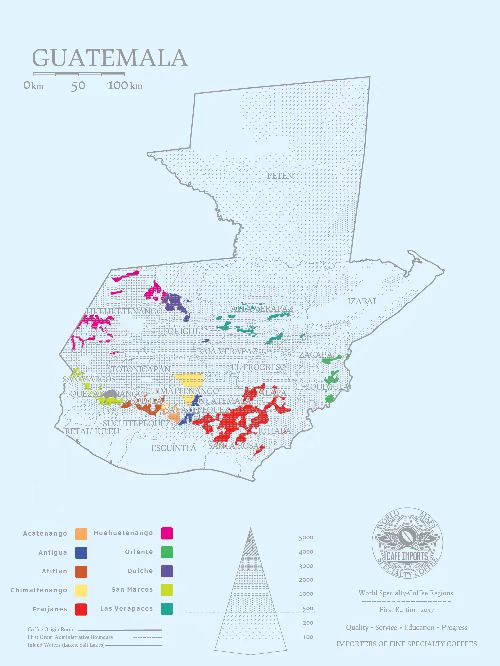
Anacafé has branded eight growing regions: Acatenango Valley, Antigua Coffee, Traditional Atitlán, Rainforest Cobán, Fraijanes Plateau, Huehuetenango Highlands, New Oriente, and San Marcos Volcano.
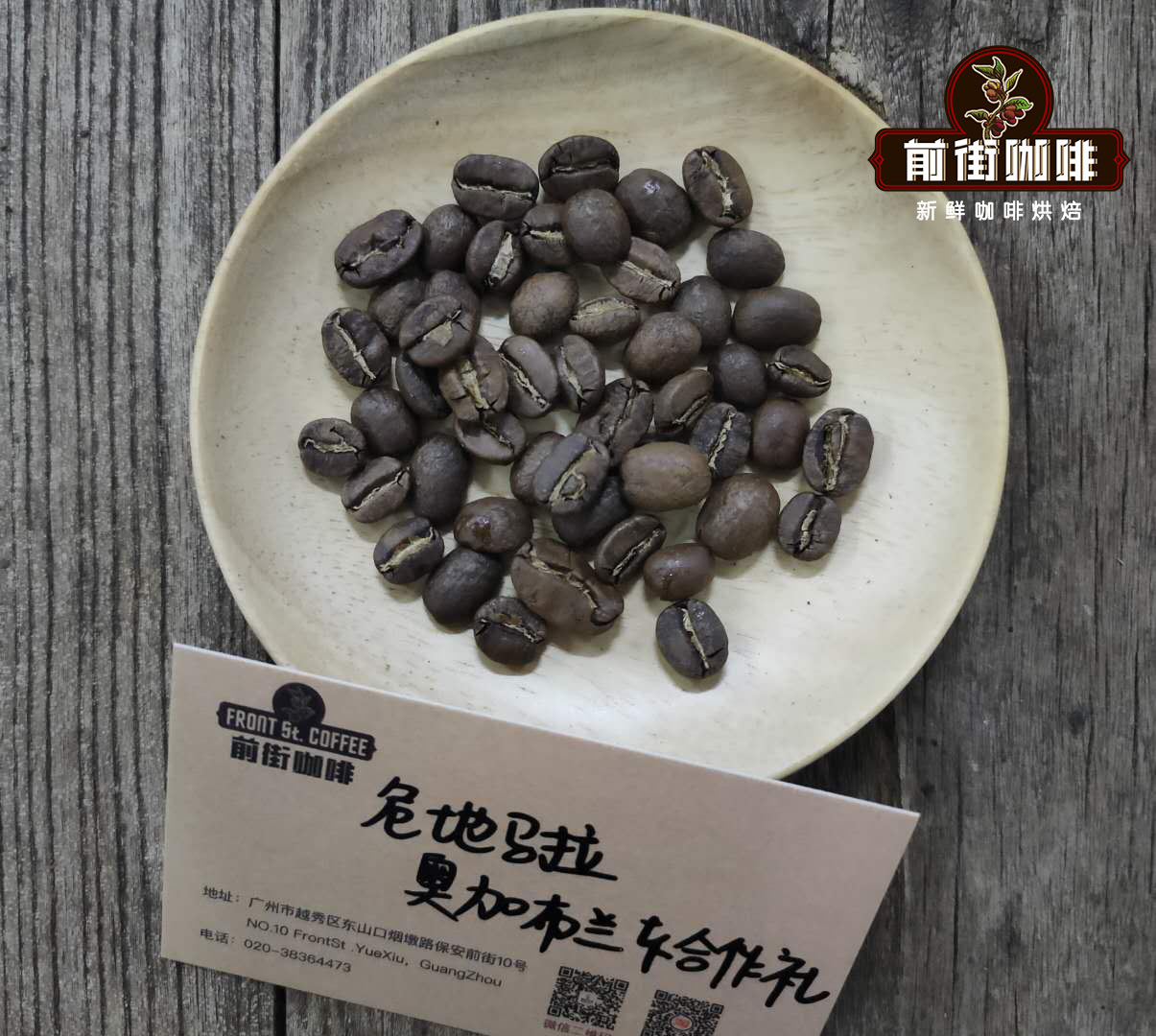
Most of FrontStreet Coffee's Guatemalan lots come from Huehuetenango. One example is this Guatemala Huehuetenango Agua Blanca Washed Bourbon Catuai, which FrontStreet roasts to a medium level to bring out flavors of berries, gentle fruit acidity, smoky notes, smoothness, and balance.
Acatenango Valley
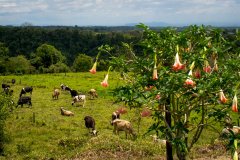
Crossing the Fuego and Acatenango volcanoes to the west of Antigua lies the Acatenango Valley, where coffee grows on steep slopes up to 2,000 meters under dense shade. Frequent eruptions from the nearby Fuego volcano continually enrich the coarse, sandy soil with minerals, while shade trees — Gravilea (Grevillea robusta), Cuje (Inga sp.), and Guachipilín (Diphysa americana) — regulate temperature and provide habitat for diverse flora and fauna.
Gentle breezes from the Pacific and clearly defined seasons make it possible to sun-dry coffee, with processing that follows long-standing family traditions.
The United Acatenango Coffee Growers Association was established in 2006 to define and promote the region's uniqueness, and in 2012 it obtained a designation of origin for the area's coffee. The geographical area of Café Acatenango covers 9,663 hectares, all within the Chimaltenango province.
Common varieties here include Caturra, Bourbon, and Catuaí. Coffee is traditionally hand-picked and sorted, fully washed, and sun-dried.
Average harvest season: December - mid-March
Atitlán
Of Guatemala's five volcanic coffee regions, Atitlán has the highest soil organic matter content. Ninety percent of Atitlán's certified coffee is grown along the slopes of the spectacular volcanoes that ring Lake Atitlán. The daily winds that stir the lake's cold waters — known locally as Xocomil — have a significant impact on the microclimate, and the region's highly developed artisanal traditions show in the skilled cultivation and processing carried out by its small producers.
Average harvest season: December - mid-March
Cobán
Annual precipitation here is about 3,500 millimeters, with rain falling regularly for nine to ten months of the year. The constant drizzle and mist — locally called chipichipi — means flowering is heavily staggered, with 8-9 flowering events per year. Because the flowering period is so extended, cherries mature unevenly, and up to 10 picking passes (spaced up to 14 days apart) are needed to ensure only the ripest fruit is selected.
The cool, rainy climate makes drying difficult in Cobán, so mechanical drying has become common. Even so, the region is home to some of Guatemala's most innovative and dedicated producers, many of whom have made great strides in experimenting with drying under difficult conditions and coaxing out some of the best coffee the country has to offer.
Average harvest season: December to March
Fraijanes Plateau
Volcanic pumice soil, very high altitude, abundant rainfall, variable humidity, and an active volcano all characterize this region. Pacaya, the most active of Guatemala's three erupting volcanoes, periodically dusts the plateau with small amounts of volcanic ash, enriching the soil with important minerals. The dry season brings abundant sunshine; although clouds, fog, and heavy dew are common in the early morning, they burn off quickly and the whole plateau dries out.
Average harvest season: December to February
Huehuetenango
Of the three non-volcanic regions, Huehuetenango is the highest and driest coffee-growing area. Dry, hot winds blowing in from Mexico's Tehuantepec plain protect the mountains from frost, allowing highland Huehue coffee to be cultivated up to 6,500 feet (2,000 meters). These altitudes, combined with a relatively predictable climate, produce exceptional specialty coffee.
Huehuetenango is extremely remote, so nearly all producers process their own coffee. Fortunately, the region has an almost limitless supply of rivers and streams, which means washing stations can be built practically anywhere.
Average harvest season: January to April
Nueva Oriente
In this region, coffee has been grown almost exclusively by smallholders since the 1950s. Today nearly every farm on the mountains is a coffee-production unit, and what was once one of Guatemala's poorest, most isolated corners is now vibrant and growing. Rainy and cloudy, Oriente sits in the pre-volcanic mountain range, and its metamorphic-rock soil is mineral-balanced — distinctly different from the volcanic soils found elsewhere in the country.
Average harvest season: December to March
San Marcos
The warmest of the eight regions, San Marcos also receives the most rain — up to 200 inches (5,000 millimeters). The seasonal rains arrive earlier here than anywhere else, and flowering comes first as well.
As in Guatemala's other remote areas, most San Marcos coffee is grown on farms with their own processing facilities. Because rainfall during harvest is so unpredictable, most coffee is pre-dried in the sun and then finished in Guardiolas (mechanical dryers).
Average harvest season: December to March
FrontStreet Coffee Recommendation
If this washed Bourbon-Catuai from Huehuetenango suits your palate, FrontStreet's Kenya "Little Tomato" is another washed specialty bean that belongs on your shortlist. Kenya is famous for pushing washed processing to its peak — the green coffee goes through a second full wash cycle: flotation and soaking, washing away the residual mucilage from the bean surface, soaking again, then drying and hulling for storage. That repeated rinsing and soaking gives the cup an extraordinarily juicy quality.
The result is a sweet-and-tart, mouthwatering profile with notes of cherry tomato, smoked plum, snow pear, black plum, and yellow sugar — a lively, fruit-forward cup that has made it a long-running favorite among coffee enthusiasts, and a fine companion to Guatemala's gentler, berry-toned style.
Important Notice :
FrontStreet Coffee is a long-established specialty coffee roaster in Guangzhou China, selling freshly roasted beans from its own farm in Yunnan as well as dozens of carefully selected single-origin beans from around the world for both pour-over and espresso. The products deliver consistently excellent quality and great value, with shipping within 24 hours. Guangzhou's FrontStreet Coffee shop is recommended by many coffee lovers, and the beans are now available online at the Tmall 。
FrontStreet Coffee has moved to a new address:
FrontStreet Coffee Address: 315,Donghua East Road,GuangZhou
Tel:020 38364473
 Scan and follow the En Gafei WeChat official account. Please indicate that the reprint comes from "En Gafei".