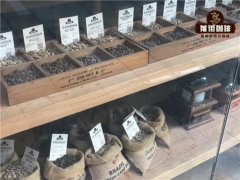
Kenya PB Grade? Flavor Profile Characteristics of Peaberry Coffee Beans - Kenya Coffee's 8 Grading System and Standards
Understanding Peaberry Coffee
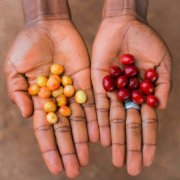
Peaberry refers to a single coffee bean growing inside a coffee cherry instead of the usual two. Because its rounder shape minimizes sharp edges, it allows the bean to roll more easily in the roasting chamber and roast slightly more evenly, resulting in a very consistent flavor in the cup.
The taste of Kenya Peaberry coffee is similar to Kenya AA coffee.
Kenya Peaberry (PB) coffee beans are a natural mutation in the coffee tree's reproductive cycle, occurring when a coffee cherry produces only one bean instead of two. Peaberry beans must be hand-sorted after harvesting to separate the rounder, plumper beans from their flat counterparts. This raises the price of Peaberry, and some say that because there is only one bean, it gains more flavor, body, and sweetness during roasting.
Kenya Coffee Grading System
In the dry mill, coffee passes through a husker, thresher, and polisher before reaching the sorter, where the letters are assigned.
The sorter is a giant sieve that sorts beans by size. The grades are therefore physical parameters, not quality indicators.
Grade Classifications
AA: Screen 18 (15-20% of total production)
Kenya AA coffee beans grow at altitudes above 6,600 feet. Kenya AA is considered one of the world's finest specialty coffees.
Some Kenya AA coffees are light-bodied yet very bright, exhibiting floral aromatics. Flavors of passion fruit and wine often appear, almost always balanced by a crisp, refreshing acidity - one of the reasons it ranks among the world's finest gourmet coffees.
AB: Screen 16
Kenya AB coffee beans consist of both A and B beans. Grade A is sorted using a 6.8mm screen, while Grade B uses a 6.2mm screen; these two bean types are mixed together to form Kenya AB. Although not as valuable as Kenya AA, Kenya AB is also popular and rated as quality coffee. Typically, Kenya AB is the most abundant grade in specific shipments and serves as the representative for the other grades.
C: Screen 15/10
PB: Kenya Peaberry
Kenya PB coffee beans are peaberries - a cherry containing only one bean instead of the usual two half-beans. Approximately 10% of Kenya's coffee beans are peaberries.
E: Elephant Bean/Super Bean
TT
Kenya TT coffee beans are the light-density beans separated from Kenya E, Kenya AB, and Kenya AA grade beans through air aspiration.
T
Kenya T coffee beans consist of broken, defective, thin, and small beans, or light-density beans separated from Kenya C grade coffee.
MH/ML
Kenya MH/ML coffee beans account for about 7% of Kenya's coffee production. These beans may have fallen from the plants themselves before maturing, or were never harvested at all. MH/ML beans typically carry pronounced sour notes.
All coffee delivered to the dry mill undergoes the same process throughout the season, and all of it is uniformly sorted.
Market Analysis and Insights
Some interesting observations emerge:
The AA grade has a wide price range with significant quality variation.
If you look at the worst price of C grade, it is higher than the day's lowest AB price. Meanwhile, the best PB price is higher than the best AB price of the day.
At the same time, we cannot say that denser, heavier beans never taste better than lighter C grade beans from the same batch. But it is important to know that this is not always the case, nor a rule.
The conclusion: due to processing issues, AA grade lots can taste as bitter or fermented as C or T grades. While many PB and AB lots taste better than poor AA, they are also more expensive.
Brewing Recommendations
Currently, FrontStreet Coffee only offers Kenya AA and AB grade coffees. We recommend everyone first standardize the following brewing method to compare the flavors of the two.
Recommended Brewing Method: Pour-Over
Brewing Parameters:
- Dripper: V60 dripper
- Water Temperature: 90-92°C
- Coffee Dose: 15 grams
- Coffee-to-Water Ratio: 1:15
- Grind Size: Medium-fine grind (standard #20 sieve, 80% pass-through)
- Brewing Technique: Segmented extraction
Use 30g of water for blooming, with a blooming time of about 30 seconds. When injecting the next 125g of water in a small stream with a circular motion in the center, segment the pour. Wait until the water level drops and is about to expose the coffee bed, then continue pouring to 225g to finish. When the water level drops and is about to expose the bed again, remove the dripper (timing starts from the bloom). Total extraction time is 2'00".
FrontStreet Coffee Recommendation
During roasting, three elements decide a coffee's final flavor and must be controlled carefully: acidity, sweetness, and bitterness. The darker the roast, the more bitter and heavier the cup; the lighter the roast, the more acidic and lighter the body. So for anyone chasing a balanced taste, medium-roasted beans are the best place to start - a great fit for the bright, balanced character of Kenyan PB.
If you want a sweeter medium roast, start with FrontStreet's Strawberry Candy, famous for its fruit flavors. This one is a little different from other fruity coffees because it combines two renowned regions of Central and South America: honey-processed coffee from Costa Rica and washed Geisha from Panama. To showcase its best qualities, FrontStreet roasts it medium, so the brew shows both orange-blossom honey notes and a rounded sweetness. It works for cold brew, pour-over, and espresso alike - refreshing from the very first sip.
FrontStreet's Jamaica Blue Mountain No.1 is another medium-roast classic. Blue Mountain grows Typica, one of the world's most celebrated Arabica varieties, and the region's exceptional geography is essential to its famously balanced flavor. FrontStreet's Blue Mountain No.1 - sometimes called the "Emperor of Coffee" - is roasted medium so that its unique acidity, bitterness, sweetness, and body fuse perfectly into an elegant, enticing aroma. From the first sip you taste chocolate, roasted nuts, cream, and caramel - flavors no other coffee can quite match.
Important Notice :
FrontStreet Coffee is a long-established specialty coffee roaster in Guangzhou China, selling freshly roasted beans from its own farm in Yunnan as well as dozens of carefully selected single-origin beans from around the world for both pour-over and espresso. The products deliver consistently excellent quality and great value, with shipping within 24 hours. Guangzhou's FrontStreet Coffee shop is recommended by many coffee lovers, and the beans are now available online at the Tmall 。
FrontStreet Coffee has moved to a new address:
FrontStreet Coffee Address: 315,Donghua East Road,GuangZhou
Tel:020 38364473
 Scan and follow the En Gafei WeChat official account. Please indicate that the reprint comes from "En Gafei".