Large Bean Coffee and Small Bean Coffee - Is Yunnan Small Bean Coffee a Small Bean Variety?
For professional coffee knowledge and more bean sharing, follow FrontStreet Coffee.
Coffee tree varieties are almost beyond counting, a bewildering diversity of genetics and flavors. Yet only a handful are actually cultivated for drinking. Coffee originally came from Africa - so what secrets do these trees hold? Let FrontStreet Coffee dig in.
In plant taxonomy, coffee belongs to the Rubiaceae family, with at least one hundred coffee species beneath it. Around eighty coffee tree species have been identified, but only three are cultivated for consumption: Arabica, Robusta, and Liberica.

Coffee beans are commonly sorted into three groups by seed size: small-seeded Arabica, medium-seeded Robusta, and large-seeded Liberica.
Large-seeded Coffee
Also known as the Liberica variety, it is an evergreen tree. The plant is tall, often exceeding 10 meters, with thick, hard branches that grow obliquely upward - its branches lignify faster than any other coffee. The leaves are elliptical or circular, with glossy, leathery surfaces, pointed tips, and no wavy edges. The fruits are large and oblong, with hard, thick skin and pulp and large, protruding navels. The variety has a deep taproot, is fairly drought-resistant, tolerates wind and cold moderately, tolerates strong light, but is the most susceptible of all to coffee leaf rust. Individual plants yield heavily, yet per-unit-area yields are low, and the flavor is intense and harsh.
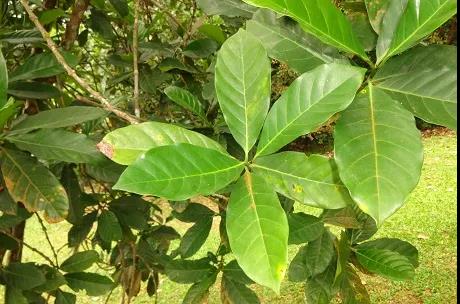
The large-seeded variety has elliptical or circular leaves.
Liberica was first discovered in Liberia, West Africa. Liberica trees grow taller than both Arabica and Robusta, and the species has strong disease resistance and environmental adaptability. Its leaves are larger than those of most coffee trees, and its fruit is much larger than a regular coffee bean - the thick skin makes removing skin and pulp difficult, which complicates post-harvest processing.
Most of the world's coffee trade is dominated by Arabica and Robusta; Liberica today accounts for only 1% of economically cultivated coffee production - a very small quantity, grown almost exclusively in Malaysia. Given its low commercial value, it is rarely discussed and hardly circulates in the market.
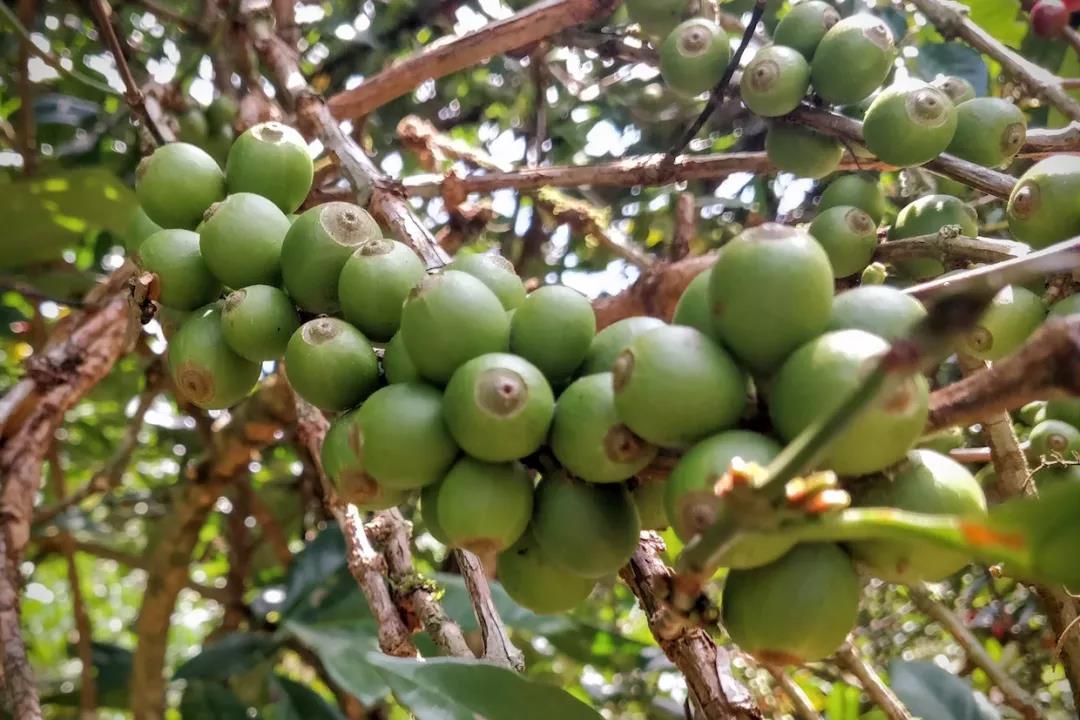
The large-seeded variety has large, oblong fruits.
Medium-seeded Coffee
This refers to the Canephora species, which accounts for less than 30% of world production but has few commercially cultivated sub-varieties - the most representative being Robusta. Robusta originated in central Congo, Africa.
Just as we often hear that Geisha belongs to the Arabica species, within Canephora only Robusta has been commercially cultivated and promoted, so Robusta has become almost synonymous with the Canephora lineage. Timor and Catimor, derived from natural hybrids of Robusta and Arabica, are now also widely cultivated and are classified under the broader Arabica category.

From a cultivation standpoint, Robusta trees tolerate heat, cold, drought, and humidity, with extremely high survival rates. They also carry high caffeine content (1.7%-3.0%) - roughly twice that of Arabica. Caffeine acts as the plant's natural pesticide, protecting Robusta from most insect damage. Individual plants are highly productive; the fruits are slightly rounder and smaller than Arabica cherries, and the beans are flat and round with a straight central crease.

Precisely because of Robusta's vigor - high yields, fast maturation, strong adaptability - it can be planted on low-altitude plains where mechanized, unified management and harvesting are possible. Cultivation costs are therefore lower, making it better suited to mass commercial production and naturally cheaper to sell. Hainan province in China, for example, grows predominantly Robusta.
Small-seeded Coffee
Arabica accounts for roughly 70% of world production. It is the most prestigious and best-known classification, originating in Ethiopia, and it is practically synonymous with "premium coffee" in the market.

When Ethiopians first discovered coffee, they chewed the leaves to stay alert and used the fruit as medicine. Later, through the research of Arab scholars, people took up roasting and drinking it, and Arabs spread it worldwide through trade in the sixteenth century, gradually shaping the popular beverage of today. Many specialty beans we know well - FrontStreet Coffee's Jamaica Blue Mountain, FrontStreet Coffee's Panama Geisha, FrontStreet Coffee's Yirgacheffe, and so on - all belong to the Arabica species.

Ethiopia is the largest coffee-producing country in Africa. There, coffee is not only an important source of income but is woven into the entire national culture and daily life. Beyond export sales, a large share of Ethiopian coffee is consumed domestically: rich or poor, every household keeps a coffee-making set, and drinking coffee is a highly ceremonial, important social activity.
In Ethiopia alone, Arabica has more than 2,500 sub-varieties. With its mild, elegant flavor and lower caffeine content - roughly 0.9%-1.5% of bean weight - Arabica commands higher commercial value and dominates the modern coffee industry, accounting for 60%-70% of global coffee production and sales.

However, to express diverse flavors, Arabica needs highland terrain - altitudes of 800-2,200 meters, free of frost. The higher the altitude, the greater the temperature swing between day and night, which slows cherry maturation and allows more flavor compounds and aromatics to accumulate. The microclimates of the various growing regions give Arabica diverse conditions and form each region's unique flavor profile. The trade-off: at higher altitudes coffee is more exposed to pests and weather, yields are lower, and maturation is slower. Quality Arabica demands heavier investment in manual care and hand harvesting, which raises production costs.
Is Yunnan Small-seed Actually a Small-seeded Variety?
Most coffee cultivated in Yunnan consists of Arabica and its derived, introduced, and cultivated varieties. By lineage, Arabica dominates, so the beans are collectively labeled "Arabica variety."

Arabica coffee is also called small-fruit coffee, or "small-seeded coffee." It originated as wild coffee in Africa and was later introduced to Europe through Arabia, hence the name. Arabica beans account for over 70% of world coffee production.
As the "representative face" of China's coffee industry, Yunnan coffee likewise belongs to the Arabica species. To distinguish it from the medium-seeded coffee grown in Hainan, farmers call it "small-seeded coffee" - and adding the place name gives us exactly "Yunnan Small-seeded Coffee."
FrontStreet Coffee Recommendation
Yunnan's small-seed coffee traces back to 1904, when the French missionary Tian Deneng brought coffee seeds - Typica - from Vietnam into Yunnan and planted the province's first coffee tree in Zhugula Village, Binchuan County. Thanks to Yunnan's favorable geography and climate, small-seed cultivation flourished. Coffee thrives in warmth - heat-tolerant but not cold-hardy, happiest with abundant light and an ideal growing temperature of 16-21°C - and Yunnan sits squarely on the coffee belt within 25 degrees north latitude, with most of its land above 1000 meters in altitude, fertile sloping soils, strong sunshine, abundant rain, and large day-night temperature differences.
Yunnan cultivation is concentrated in the province's southwest, across the four major producing areas of Baoshan, Dehong, Pu'er, and Lincang - and FrontStreet Coffee's everyday list carries two Yunnan specialty beans, one from each of Baoshan and Lincang. For an entry-level Chinese arabica, start with FrontStreet's Yunnan small-seed from Baoshan: washed processed and medium roasted, it offers gentle notes of nut and chocolate with a light plum acidity, presenting the region's terroir clearly at a friendly price. Baoshan's coffee history began in the mid-1950s, when the patriotic overseas Chinese Mr. Liang Jinshan introduced coffee; the frost-free climate and the unique dry-hot valley of Lujiangba - mild year-round but with big day-night swings and modest rainfall - give the coffee its distinctive sweet finish.
For a clearer, more defined Yunnan profile, step up to FrontStreet's 2013 Yunnan Natural Typica. FrontStreet built its own estate in 2013 and planted Typica - one of the oldest and purest arabica varieties - hoping to recover the region's original terroir character, since Typica was also the first variety ever planted in Yunnan. Only fully ripe, all-red cherries are used, natural (sun-dried) processed, then roasted medium: dark berry tones with caramel sweetness, chocolate, and a hint of dried apricot, followed by a black-tea finish.
And if you want Yunnan character in an espresso, FrontStreet's Dark Cocoa Blend combines Yunnan small-seed with Cerrado Brazil: Brazil contributes mixed-nut aromas and balance, while Yunnan supplies chocolate and citrus. Its Americano balances sweet, sour, and bitter with notes of nuts and brown sugar, and its latte shows the smooth texture of almond and cream - a barista favorite that is ideal for beginners.
Important Notice :
FrontStreet Coffee is a long-established specialty coffee roaster in Guangzhou China, selling freshly roasted beans from its own farm in Yunnan as well as dozens of carefully selected single-origin beans from around the world for both pour-over and espresso. The products deliver consistently excellent quality and great value, with shipping within 24 hours. Guangzhou's FrontStreet Coffee shop is recommended by many coffee lovers, and the beans are now available online at the Tmall 。
FrontStreet Coffee has moved to a new address:
FrontStreet Coffee Address: 315,Donghua East Road,GuangZhou
Tel:020 38364473
 Scan and follow the En Gafei WeChat official account. Please indicate that the reprint comes from "En Gafei".