Trends in China's Coffee Consumption Market: Are Emerging Coffee Brands on the Rise or Decline?
For professional coffee knowledge exchange and more coffee bean information, follow Coffee Workshop (WeChat official account: cafe_style).
The Rise of Coffee Culture in China
In recent years coffee culture has been gradually spreading through China, the number of enthusiasts and aficionados has been growing, and emerging coffee brands have been springing up like mushrooms after rain.
Looking at the coffee industry as a whole, the growth trend for coffee shops is in fact upward.
Market Potential and Consumption Patterns
China's domestic coffee consumption market still holds significant potential. Per capita coffee consumption remains low compared with developed countries: in 2018, mainland China's per capita coffee consumption was only 0.71% of Germany's and 1.6% of America's. The global coffee market is worth more than 12 trillion yuan, while China currently accounts for only about 700 billion yuan, a striking gap relative to its population. Income growth drives coffee consumption, and every 5% increase in national income leads to a 2%-3% increase in daily coffee consumption. As incomes rise and coffee habits take hold, the potential market space is enormous.
The term "emerging coffee brands" has become a relatively new talking point in recent years. Last year, industries across the board were hit by the COVID-19 pandemic, and many coffee shops suffered badly. Numerous owners faced operational crises and ultimately had to close.
According to data from Coffee Salon's "2021 Coffee Census" on coffee shop opening times, the proportion of shops opened within six months rose from 16.43% the previous year to 16.80%. The proportion of shops opened within the past year was 32.26% in 2019 and 30.26% in 2020. The data suggests that the rate of new shop openings in 2020 was not significantly affected by the pandemic.
In addition, according to the "White Paper on China's Fresh Ground Coffee Industry" released by Deloitte China and Mumian Capital, the number of coffee shops in China had passed 100,000 by the end of 2020.
Consumption Patterns and Market Evolution
Looking at coffee consumption by product type, related data shows instant coffee at 72%, ready-to-drink coffee at 10% and fresh ground coffee at 18%. Instant coffee therefore holds a crucial position across the category. Together with the impact of last year's pandemic, the category went through a major reshuffle. The pandemic encouraged home coffee consumption and instant coffee, and made the category more diverse: more drip bag coffee, cold brew coffee and creative coffee appeared on the market. Coffee has without doubt become one of the fastest-growing beverage categories in recent years, and consumption demand has been further met on that basis. As times move on, coffee itself improves too. Domestic emerging brands (such as Yongpu and Sandunban) have been working to restore instant coffee's reputation through better raw materials and technology.
During the 2020 pandemic, global coffee consumption also trended upward, mainly on the strength of online e-commerce. On one hand, the share of coffee shops offering delivery rose from 68.26% in 2019 to 74.25% in 2020. According to recent White Paper findings, in first-tier and new first-tier cities high-value brands built around "fast coffee" occasions and specialty brands built around "slow coffee" occasions are gradually gaining share. According to Shangguan data, Shanghai ranked highest among major Chinese cities for delivery coffee order volume in 2020.
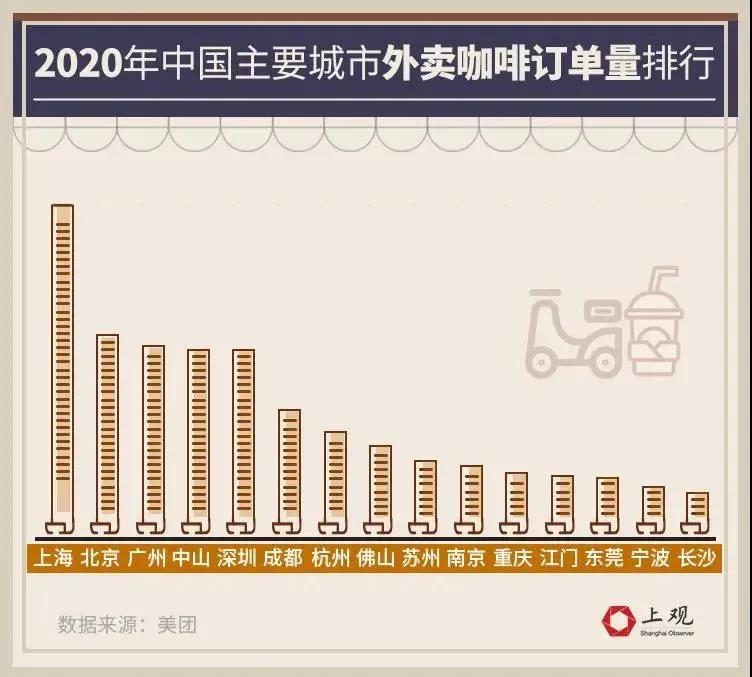
Image source: Shangguan data
On the other hand, Tmall's order volume growth rate for emerging coffee brands reached 300%, showing explosive growth in online consumption.
Future Outlook and Investment
As coffee culture keeps spreading and becoming more mainstream, the distance between coffee and ordinary consumers keeps shrinking. China's coffee consumption market has now reached about 100 billion yuan. According to a 2020 Dongxing Securities report, China's coffee consumption growth rate reached 15%, far above the global average of 2%, and is expected to reach 1 trillion yuan by 2025. The market holds unlimited potential, and China will become the world's largest coffee consumption market.
What is more, the huge potential of China's coffee market has attracted significant capital.
Take Canada's national coffee brand Tim Hortons as an example. Last May, Tim Hortons China announced an investment from Tencent in the tens of millions of yuan range. Since Tencent's investment, Tim Hortons has developed rapidly in the Chinese coffee market, calling it a "huge development opportunity." Then, on February 26 this year, Tim Hortons secured a second funding round led by Sequoia Capital China Fund, with increased investment from Tencent and participation from Zhongding Capital. That backing has filled Tim Hortons with confidence in the Chinese market: it plans to add 200 new stores in 2021 and to open 1,500 coffee shops nationwide in the coming years.
Last November 16th, McDonald's also announced a major investment aimed at the coffee market. McCafé, McDonald's coffee brand, officially said it will invest 2.5 billion yuan over the next three years to accelerate its layout in mainland China's coffee market. By 2023, more than 4,000 McCafés nationwide are expected to serve high-quality, cost-effective handmade coffee.
These are only two examples, and the list of brands with capital behind them is far longer. We have previously covered many specialty coffee financing events in 2020, such as Yongpu, Sandunban and Shicui. By incomplete count, there were more than ten coffee brand financing events that year.
Conclusion
In summary, the coffee industry is still growing. With 2021 now almost half over, the coffee market is set for another round of accelerated development in the period ahead.
For more specialty coffee beans, add FrontStreet Coffee on private WeChat, ID: kaixinguoguo0925.
FrontStreet Coffee Recommendation
As the market broadens, more drinkers are crossing over from instant coffee to whole beans, and the entry-level specialty range is where that usually begins. Ethiopia is the natural first stop: it is Africa's largest coffee producer and the widely recognised birthplace of coffee, with a huge number of varieties usually named after their region or cooperative, and Yirgacheffe and Sidamo are the two best known. FrontStreet Coffee's washed Gutingtin Cooperative is a typical Yirgacheffe, with jasmine florals, lemon acidity and berry notes, while its Sidamo Huakui uses a traditional natural process and leads with berry, floral, jackfruit, melon and honey — a good illustration of why Sidamo is famous for naturals, with bolder tropical fruit and fermented aromas.
Brazil is the second essential stop, since it produces more coffee than any other country. Much of that is commercial, but good specialty Brazilian coffee exists too. Exposure-style growing ripens the fruit quickly, so the beans are softer, the acidity gentle and the sweetness pronounced, with a fine, smooth, well-rounded cup. FrontStreet Coffee's Brazilian daily-drinker single origin comes from the well-known Cerrado region and focuses on being good and affordable, with the classic creamy, peanut and cocoa flavors at extraction; its Queen Estate is planted higher and uses the rare Yellow Bourbon, adding butter, sunflower seed, macadamia and almond notes on top of a sugarcane sweetness, sticky and smooth whether drunk black or with milk. Colombia is another country-name single origin worth knowing. Its mild climate and varied geography mean something is ripening all year, and Colombian coffee tends to be aromatic and rich; FrontStreet Coffee's daily-drinker Colombian comes from Huila, the country's best-known specialty region, where mountains surround the growing area above 1500 meters and the country's most important rivers meet, bringing abundant water. Huila coffee is typically floral and softly acidic, and FrontStreet also offers the Colombian Sidra and a Colombian Peaberry for drinkers who want to explore further.
For something different, Costa Rica is known for honey processing — drying the bean with mucilage still attached, which yields a notably sweet, clear cup — and FrontStreet Coffee's Blackberry uses black honey processing while its Mozart uses raisin honey processing, both showing raisin and blueberry sweetness with osmanthus and rose aromas; they work as pour-over, cold brew, americano or latte. China's own specialty output is concentrated in Yunnan, and FrontStreet Coffee's Yunnan Smallholder, from Baoshan and washed, offers the traditional nut and chocolate flavors in a soft, balanced cup, while the 2013 Yunnan Typica is an older Arabica variety planted at 1300 meters, cleaner in the cup and best at a medium roast, with hazelnut, dried apricot, black tea, caramel and ripe plum. Finally, for drinkers ready to spend a little more, Panama is famous for Geisha. The country's most celebrated estate produces citrus, berry and floral flavors with a balanced, silky body, like a fruit-and-flower tea with no bitterness at all, but for beginners it can feel extravagant, so a more accessible entry is FrontStreet Coffee's Boquete Geisha, from Panama's most representative specialty region, with pure varietal genetics and washed processing that shows the orange-blossom-honey character clearly.
Important Notice :
FrontStreet Coffee is a long-established specialty coffee roaster in Guangzhou China, selling freshly roasted beans from its own farm in Yunnan as well as dozens of carefully selected single-origin beans from around the world for both pour-over and espresso. The products deliver consistently excellent quality and great value, with shipping within 24 hours. Guangzhou's FrontStreet Coffee shop is recommended by many coffee lovers, and the beans are now available online at the Tmall 。
FrontStreet Coffee has moved to a new address:
FrontStreet Coffee Address: 315,Donghua East Road,GuangZhou
Tel:020 38364473
 Scan and follow the En Gafei WeChat official account. Please indicate that the reprint comes from "En Gafei".