What is the Pour-Over Coffee Powder-to-Water Ratio? Why is it 1:15?

For beginners, a common question is: how much water should be used for a cup of coffee? Why does FrontStreet Coffee use a 1:15 coffee-to-water ratio?
When tasting a cup of coffee, we naturally want it to have enough coffee flavor and to be pleasant to drink. Coffee that is too strong can be uncomfortable, while coffee that is too weak might as well be replaced with plain water. So the first reason to use an appropriate coffee-to-water ratio is to control the coffee's concentration.
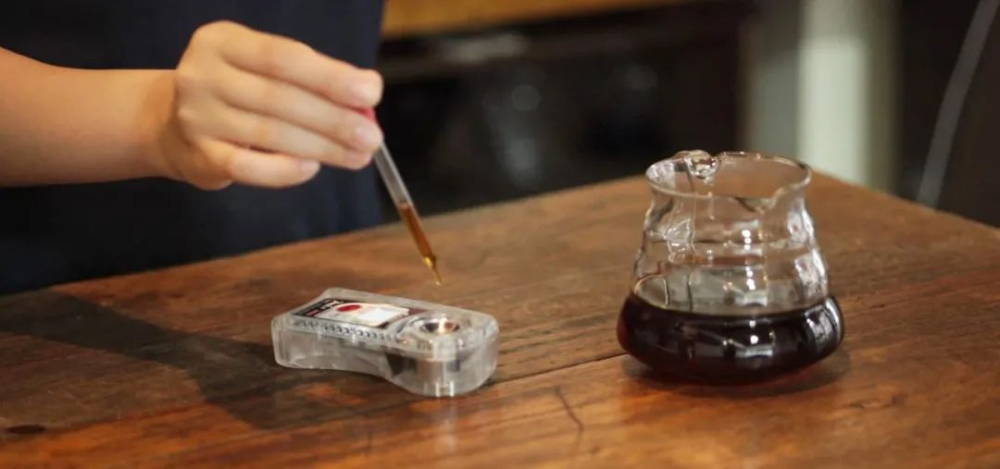
Concentration is the percentage of dissolved substances in a liquid. In a 200-gram coffee solution with a concentration of 1.3%, for example, the coffee contains 2.6 grams of dissolved substances. Those 2.6 grams are exactly what we extract from the coffee grounds by pouring water over them. The share of substances extracted from the grounds is called the extraction rate. Generally, an extraction rate between 18-22% is considered ideal. In the earlier example, using 15 grams of coffee grounds and extracting 2.6 grams of substances gives an extraction rate of 17.33%.
Pour-over coffee belongs to the drip category, in which water flows continuously through the coffee grounds and the liquid drips into the lower pot. For the coffee liquid, the more water you pour, the lower the concentration becomes, because the efficiency of dissolving substances is far higher early on than later. For the coffee grounds, the more water you pour, the higher the extraction rate becomes, though the rate of increase slows as extraction proceeds. To strike a balance between extraction rate and concentration, a scientific extraction ratio has been established.
Coffee-to-Water Ratio
First, let us understand two concepts in pour-over coffee:
Coffee-to-Water Ratio: the ratio of coffee grounds to water, directly indicating how much water is used to brew the coffee. For example, 1:15 means using 15 parts water to brew 1 part coffee grounds.

Coffee Grounds Absorption Rate: generally, the saturated water absorption of coffee grounds is about twice their own weight (there may be variations, but it is basically around 2 times). Therefore, the amount of coffee liquid we obtain will not equal the amount of water we use for brewing. Taking a 1:15 coffee-to-water ratio as an example, the grounds will absorb 2 parts of water, leaving us with 13 parts of coffee liquid.
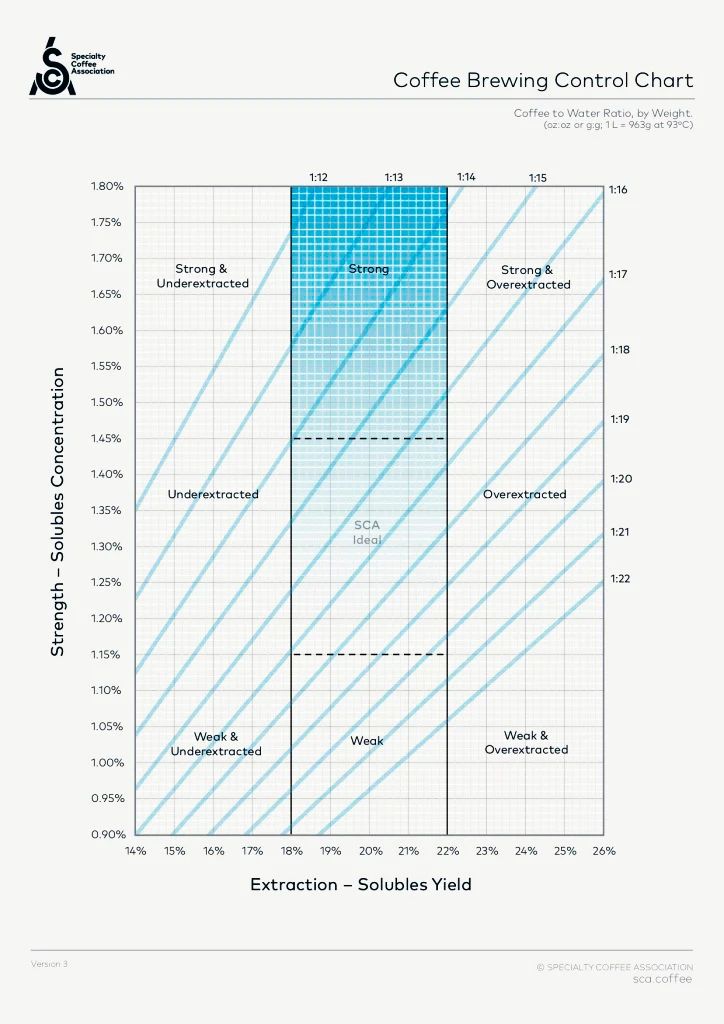
With those two concepts in hand, let us look at the SCA Golden Cup Extraction Chart. This chart combines the preferred flavor ranges of European and American coffee drinkers with the relationship between coffee concentration and extraction rate, and it serves as an excellent reference model.
SCA Golden Cup Theory
The SCA Golden Cup extraction range: extraction rate 18%-22%, concentration 1.15%-1.45%.
In Golden Cup theory, coffee within this range is called Golden Cup extraction, considered "delicious" by the system, though not necessarily matching everyone's sensory preferences.
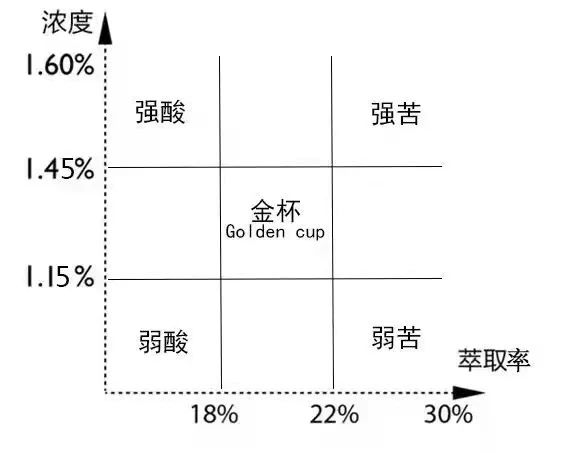
From the Golden Cup extraction chart we can determine the maximum and minimum coffee-to-water ratios: 1:20.9 (concentration 1.15%, extraction rate 22%) and 1:14.3 (concentration 1.45%, extraction rate 18%). We observe that the 1:17 ratio passes through the largest area of the Golden Cup range, making it the easiest to land in the Golden Cup zone, followed by 1:16 and 1:18. Conversely, a 1:15 ratio is quite difficult to achieve within the Golden Cup range.
Why Choose 1:15?
Based on the Golden Cup extraction chart, then, the ideal brewing ratio would be 1:16-18, and 1:15 would not be recommended. But when we run practical experiments, we find that although increasing the ratio to 1:18 might fall within the Golden Cup range for both extraction rate and concentration, it easily extracts unpleasant flavors (in that process, concentration is easy to maintain, but extraction rate is hard to guarantee). Actual production ratios are therefore reduced accordingly, adopting a 1:15 coffee-to-water ratio.

FrontStreet Coffee has run many brewing experiments with light roast coffee and found that a 1:15 ratio typically yields a concentration between 1.35-1.42%, corresponding to an extraction rate of 17.79%-18.73%. Although this barely meets the Golden Cup standard, sensory testing showed that the flavors were very appropriate, without the sharp acidity or astringency associated with under-extraction. This ratio suits most coffee beans and represents a conservative, stable coffee-to-water ratio compared with larger ratios, which more easily lead to over-extraction or bitterness.
Although 1.35%-1.42% counts as high concentration in Golden Cup extraction, we should remember that the concentration range SCA provides reflects the tastes of American and European consumers; it does not represent the concentration preferences of people worldwide.
Is the Golden Cup Theory Incorrect?
Actually, it is not incorrect. Besides the coffee-to-water ratio, many other factors affect coffee extraction. For example, the cupping ratio we use is 18.18% (11g coffee, 200g water), which is in fact the ratio most easily achieved within the Golden Cup range used by the SCAA, SCA's predecessor. That premise, however, applies to immersion extraction.
Pour-over coffee, by contrast, belongs to drip extraction, where the flow of water agitates the coffee grounds and thereby raises extraction efficiency, which is why reducing the coffee-to-water ratio is also justified.
Does the Final Segment Necessarily Mean Bitterness?
A couple of days ago, some customers came to the shop for pour-over coffee. As the brew entered its final stage, one friend suddenly began urging us to remove the filter cone quickly to stop the flow, claiming this would avoid negative flavors from the final segment. FrontStreet Coffee has run comparison experiments following the normal 1:15 coffee-to-water ratio. Tasting the liquid from the final segment at the point of stopping the flow, we found no bitter or astringent flavors or other negative tastes. Blindly relying on "stopping the flow" actually loses some flavor compounds, resulting in coffee without an aftertaste.

Usually, if coffee brewed following the original framework still tastes off, either there is a problem with the beans or there is a deviation in the extraction parameters. Many high-quality beans from renowned regions are of top grade locally and do not easily develop negative flavors, so they need no flow-stopping measures.
The reason champion competitors can stop the flow "effortlessly" is that they have accumulated countless brews with the same bean, allowing them to apply the technique so skillfully in competition. For ordinary people like us, stopping the flow is mainly a rescue method. Removing the filter cone before the coffee has finished flowing in fact introduces uncertainty: one brew might taste good, but the next might not reproduce the same flavor.
FrontStreet Coffee Recommendation
A 1:15 ratio rewards beans that show their aromatics clearly, and light-roast pour-over coffees are the best place to see it. FrontStreet's Yirgacheffe Gedingding is a natural choice, one of the very first specialty coffees many drinkers try. Gedingding sits at the southeastern edge of Yirgacheffe in the Woka area and was originally part of the Woka cooperative under the Yirgacheffe Coffee Farmers' Cooperative Union, later emerging as a single-origin lot as demand for traceability grew. It uses the most traditional washed processing, which is why it is often called Yirgacheffe's last pure land: bright citrus and berry notes with florals and a green-tea-like sweetness, and an acidity that stays soft and bright rather than sharp, making it very easy to accept.
If you want more fruit in the cup, FrontStreet's Kenya Little Tomato is a Kenya specialty washed bean built around vivid cherry tomato and dark plum acidity with a full, juicy body, the go-to for drinkers who love bright fruit and complexity. It comes from Kenya's Thika region at 1550-1750 meters, uses the classic SL28 and SL34 varieties on plump, round beans, and undergoes Kenya's signature 72-hour double washed fermentation to draw out the fruit while keeping the cup clean and pure; roasted light to preserve the lively acidity, it shows dried cherry tomato and florals in the dry aroma, a clear cherry tomato and dark plum flavor on the palate, prominent sweetness mid-cup with snow pear and black plum, and a clean, long finish of yellow-sugar sweetness and a hint of green tea.
Anyone who prefers tropical fruit should also look at FrontStreet's Ethiopia Huakui, from the Hambella area of Guji in Sidamo, where a 200-hectare farm uses traditional natural processing. The ripe cherries are spread on raised beds for 21 days, turned constantly for even drying and hand-sorted every three to five days, then hulled and given a final sort. Because the fruit stays on through drying, a medium-light roast gives a light fermented wine aroma with florals, citrus, and mango, plus honey sweetness, cocoa, and a little spice, a thick body, and a persistent finish.
Important Notice :
FrontStreet Coffee is a long-established specialty coffee roaster in Guangzhou China, selling freshly roasted beans from its own farm in Yunnan as well as dozens of carefully selected single-origin beans from around the world for both pour-over and espresso. The products deliver consistently excellent quality and great value, with shipping within 24 hours. Guangzhou's FrontStreet Coffee shop is recommended by many coffee lovers, and the beans are now available online at the Tmall 。
FrontStreet Coffee has moved to a new address:
FrontStreet Coffee Address: 315,Donghua East Road,GuangZhou
Tel:020 38364473
 Scan and follow the En Gafei WeChat official account. Please indicate that the reprint comes from "En Gafei".