Nestlé Coffee's Future Development Strategy: Nestlé Coffee to Double Its "Sustainable Development" Expenditure
Nestlé Doubles Down on "Sustainable Development" Spending
According to Bloomberg, Nestlé is stepping up its sustainability spending for the Nescafé brand.
Nestlé plans to invest more than 700 million Swiss francs ($787 million) over the coming decade. The money will fund responsibly sourcing all of Nestlé's coffee, tracing supplies back to farmer groups by 2025, and achieving 100% responsibly sourced coffee across the category.
Nestlé is also moving to 100% recyclable packaging, and the company says it will reach net-zero carbon emissions by 2050.
By comparison, that commitment is more than double what the company spent on sustainability over the past 10 years.
On December 3, 2020, Nestlé had already announced plans to invest 3.2 billion Swiss francs (about $358 million) over five years to shrink its climate impact. Roughly 1.2 billion Swiss francs of that will go toward developing regenerative agriculture in its supply chain and reaching 100% renewable electricity within five years. The company also intends to plant 20 million trees a year in its raw-material sourcing regions over the next decade.
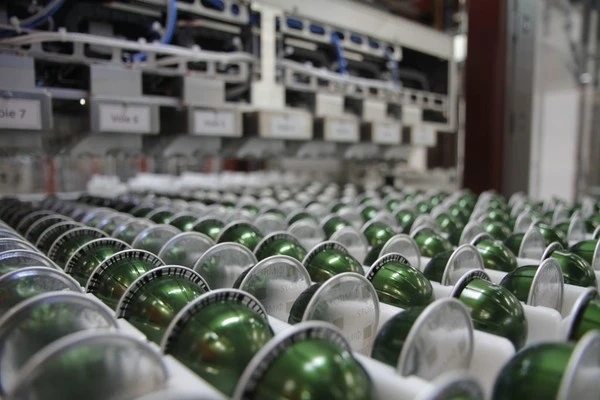
Earlier, Nestlé revealed plans to further expand its three Nespresso capsule production sites in Switzerland. On July 8, 2020, Nestlé Nespresso invested 160 million Swiss francs (about 1.192 billion yuan) to build a factory at its production center in Romont, Switzerland, with the first new production line expected to be fully operational by June 2022.
In August of that year, Nespresso also teamed up with illustrator Pencil Bryan to release five limited-edition coffees.
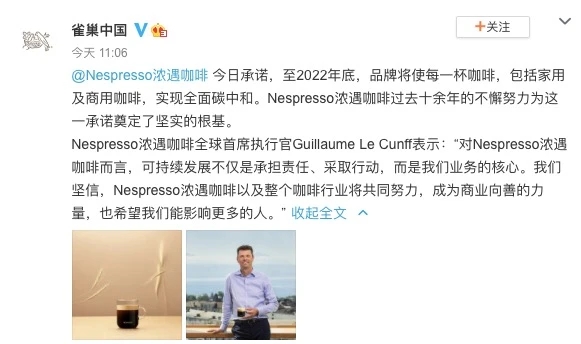
For its nearer-term goals, Nestlé aims to be carbon neutral by the end of 2022. Nestlé China stated on its official Weibo account that the brand would make every cup of coffee—home and commercial alike—completely carbon neutral.
Founded in 1866, Nestlé is the world's largest food manufacturer. In coffee, its main markets sit in the mid-to-low end of instant and ready-to-drink products. It first launched instant coffee in 1989 and became popular with the slogan "It tastes great." Today it owns three major coffee brands: Nescafé, Nespresso, and Starbucks.
The history of Nescafé reaches back to the 1930s, when it was created to help solve the problem of excess coffee inventory. After decades of development it has become one of the world's best-known coffee producers. In 1986, Nestlé launched four NESPRESSO coffee capsules—the name fusing "Nes" (short for Nestlé) with "presso" (espresso)—which quickly conquered the global market. Nespresso is a subsidiary of the Swiss Nestlé company, headquartered in Lausanne, Switzerland. It officially entered the Chinese market in 2007, and since then its business has centered on promoting coffee culture and delivering excellent coffee experiences. On October 10, 2019, Nestlé announced on its official website that Nespresso had officially adopted a new Chinese name. Nespresso remains committed to innovation and research in coffee.
Nestlé operates 11 production centers and 4 R&D centers in Switzerland and has invested an average of 300 million Swiss francs annually in Swiss infrastructure and operations over the past decade. Over the years Nescafé has rolled out numerous coffee products, including Starbucks instant coffee, the Nespresso Yunnan Limited Edition, Nestlé ready-to-drink tea, the light-meal brand nesQino, and "Feel CAFE" drip bags. At the end of 2019, Nescafé also launched a "Pour-Over Master" drip coffee in China.
In recent years, the Nescafé coffee business has delivered considerable success and become one of the company's fastest-growing segments. Against that backdrop, Nestlé has accelerated its footprint across the coffee market—and this major investment looks like a bet on the category's continued rapid growth.
Image source: Internet
FrontStreet Coffee Recommendation
Espresso beans generally come in two flavors of choice: the blends most cafés reach for first, or a single origin chosen to taste one place—what we call SOE. Blends are built by roasters and baristas who combine beans from different origins for a more balanced cup: if one bean is silky but shy on aroma, another aromatic bean fills the gap. The point of blending is simply to make the coffee better.
For traditional-style americanos and lattes, the FrontStreet Coffee classic blend or commercial blend is the play—both build on old-school Italian recipes with a touch of Robusta added, so the extraction yields butter, nuts, spice, dark chocolate, and toast aromas, with a wild, thick body and a bursting golden crema that makes latte art easy. If nut-driven espresso is more your speed—almond, walnut, and the like—go for the FrontStreet Coffee premium blend or black cocoa blend, both heavy on Brazilian beans for comfortable bittersweetness and a creamed-peanut aroma that glides across the palate. FrontStreet Coffee's Premium Blend carries Colombian nut, chocolate, and caramel notes with just the right acidity; FrontStreet Coffee's Black Cocoa Blend adds the ripe-plum acidity of Yunnan small-bean coffee and smells of creamy chocolate as you grind—balanced, versatile, and at home in lattes, americanos, and specialty coffee drinks alike, a shop owner's best partner.
And for SOE, where the goal is showcasing origin character and full traceability, the FrontStreet Coffee natural Floral Champion (Huakui) SOE is a standout: grown in Guji's Hambella at elevations up to 2300 meters and processed as a natural to lift more sweetness, then roasted medium to keep its elegant florals while caramelizing just enough—an americano or latte built on it shows cream, cocoa, berry, light florals, and black tea. For a sweeter pour, the black honey Costa Rica Blackberry SOE brings cranberry cookie, raisin, and nut flavors with milk.
Important Notice :
FrontStreet Coffee is a long-established specialty coffee roaster in Guangzhou China, selling freshly roasted beans from its own farm in Yunnan as well as dozens of carefully selected single-origin beans from around the world for both pour-over and espresso. The products deliver consistently excellent quality and great value, with shipping within 24 hours. Guangzhou's FrontStreet Coffee shop is recommended by many coffee lovers, and the beans are now available online at the Tmall 。
FrontStreet Coffee has moved to a new address:
FrontStreet Coffee Address: 315,Donghua East Road,GuangZhou
Tel:020 38364473
 Scan and follow the En Gafei WeChat official account. Please indicate that the reprint comes from "En Gafei".