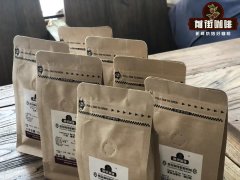
Papua New Guinea Bird of Paradise Estate Coffee Beans - The Flavor Profile of the "Little Blue Mountain" Bird of Paradise Coffee Beans

Papua New Guinea is a country both familiar and unfamiliar to coffee enthusiasts. Many have heard of Papua New Guinea coffee, but few have actually tried it. Those who have often describe it as having a feel similar to "Blue Mountain." To investigate why Papua New Guinea coffee is called Little Blue Mountain, FrontStreet Coffee specifically sourced and launched this Papua New Guinea coffee to explore it together with customers.
Papua New Guinea
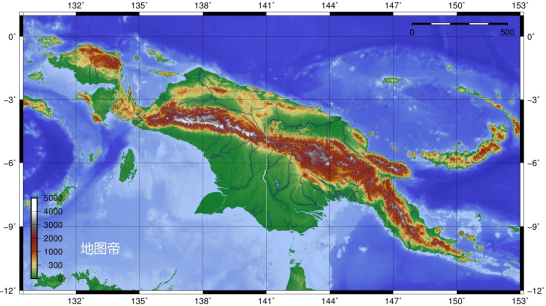
Papua New Guinea lies east of Indonesia, with a typical island climate situated between the equator and 10 degrees south latitude. It has tropical rainforests, volcanic rock, and highland terrain, with elevations ranging from 1200-2500m. The regional taste of Papua New Guinea coffee differs markedly from the spicy, herbal, deep flavors of Indonesian beans, instead showing brightness, sweet-sour notes, and floral-fruity aromas closer to South American flavors. FrontStreet Coffee believes it is called Little Blue Mountain because Papua New Guinea shares similar island-climate characteristics, high altitude, and volcanic soil. In addition, its coffee-bean spread route originated from Jamaica to Papua New Guinea, hence the name Little Blue Mountain, though the flavor offers a different experience. FrontStreet Coffee's Jamaica Blue Mountain offers a very mellow coffee flavor, while FrontStreet Coffee's Papua New Guinea Little Blue Mountain presents a mellow flavor with a hint of fruit acidity.
Coffee Cultivation History in Papua New Guinea
In 1931, Typica was introduced from Jamaica to Papua New Guinea. At that time Britain had occupied Jamaica for nearly 300 years, and Jamaica's most representative coffee was the Typica variety Blue Mountain coffee. Since Australia had friendly relations with Britain, it was logical for Papua New Guinea to introduce Typica. FrontStreet Coffee uses the name Little Blue Mountain to introduce Papua New Guinea coffee to customers, as the historical reasons provide solid evidence, and the name "Little Blue Mountain" is indeed far more memorable than Papua New Guinea.
In 1950, Bourbon coffee beans were introduced from Kenya. Coincidentally, Kenya was also a British colony at the time. Government encouragement for open cultivation led to significant growth in the coffee industry during the 1970s-80s.
In 1961, after World War II, the western part of New Guinea island, formerly belonging to the Netherlands, declared independence as "West Papua," but within months it was invaded militarily by Indonesia, which had also gained independence. Indonesia established Irian Jaya Province there. After 2003 it was further divided into the Papua and West Papua provinces. Then in 1962, Mundo Novo and Caturra were introduced from Brazil, leading to a great leap forward in Papua New Guinea bean quality.
Papua New Guinea Coffee Industry: From Adversity to Diversity
According to reports translated by Financial Network, in the last century the member countries of the International Coffee Organization (ICO) implemented a quota system for coffee exports. To obtain sufficient coffee, Australia had to purchase large quantities of Papua New Guinea coffee beans, as the territory was still under Australian administration at the time.
In 1975, when Papua New Guinea declared independence, and after the ICO abandoned the quota system in the 1980s, Australian coffee importers preferred to source coffee from around the world. From then on, Papua New Guinea's coffee industry began a difficult struggle.

Particularly over the past decade, Papua New Guinea's coffee production has decreased by 22%, from approximately 1 million 60kg bags in 2009 to 800,000 bags today. This decline is largely due to aging coffee trees. For more than 30 years since the 1980s, almost no one in Papua New Guinea chose to replace old trees, nor did anyone guide farmers on how to replant. Fortunately, in a continuous support program funded by the World Bank and the International Fund for Agricultural Development (begun in April 2010), more than seven million coffee trees have been replanted or restored. According to the World Bank, many coffee farmers who participated in the first round of replanting have already seen increased yields.
Although Papua New Guinea has soil conditions, rainfall, weather, and climate that could be described as perfect for making delicious coffee, it has always been a challenge to consistently produce large quantities of high-quality coffee, mainly because more than 85% of coffee is produced by small farmers. Unlike other coffee-producing countries with many independent farmers working small plots, international buyers find it difficult to purchase consistently high-quality beans in Papua New Guinea.

The inconsistency in quality stems from difficulties in passing on coffee-cultivation knowledge, as Papua New Guinea has as many as 10,000 scattered tribes speaking more than 800 different languages, making it hard for professional coffee knowledge to spread effectively. In addition, tribal complexity has created land-ownership issues. Coffee plots often remain uncultivated due to land transfers or disputes over ownership. Beyond a lack of knowledge and resources, small farmers also lack motivation to persist with coffee because they rely more on subsistence agriculture, and the return on planting coffee is too low for them. For farmers in Papua New Guinea, the vast majority of their cultivation time goes to food crops, with coffee ranking only second.
The "Papua New Guinea Coffee Market Study," published in 2019, pointed out that extensive government regulations and requirements actually complicate an already difficult business environment. The report states that reducing government intervention and giving more support to the country's coffee industry would make it more productive: 1. expand agricultural extension services and best-practice training; 2. conduct scientific research on agricultural and economic issues to inform new national programs and policies; 3. support private enterprises that promote business operations domestically and internationally. The research identified three key areas of work to change the industry: supporting women's participation in coffee; promoting business growth, domestic consumption, and international trade; and promoting quality from seed to cup.

FrontStreet Coffee · Papua New Guinea · Bird of Paradise
Origin: Papua New Guinea
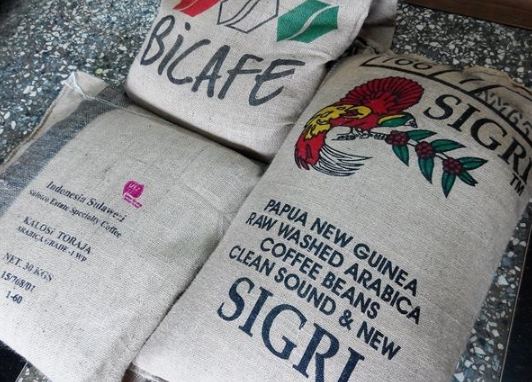
Estate: Sigri Bird of Paradise Estate
Altitude: 1600-1800m
Processing: Washed
Variety: Typica
Grade: AA
Sigri Bird of Paradise Estate
Papua New Guineans regard the beautiful bird of paradise as a bird of freedom and happiness, a "gift from the spirits." The Sigri Bird of Paradise Estate Typica beans, like bird migration, traveled a long distance from Jamaica Blue Mountain to Papua New Guinea for cultivation, carrying the same lineage as Jamaica Blue Mountain. This Blue Mountain lineage is also why Papua New Guinea Bird of Paradise beans draw attention today. FrontStreet Coffee selects each bean hoping for its unique characteristics, not wanting different beans with the same flavor, which is why FrontStreet Coffee spends significant time on bean selection, adjusting roasting parameters, and other steps. A bean may have similarities with others, but it must also have distinguishing features.
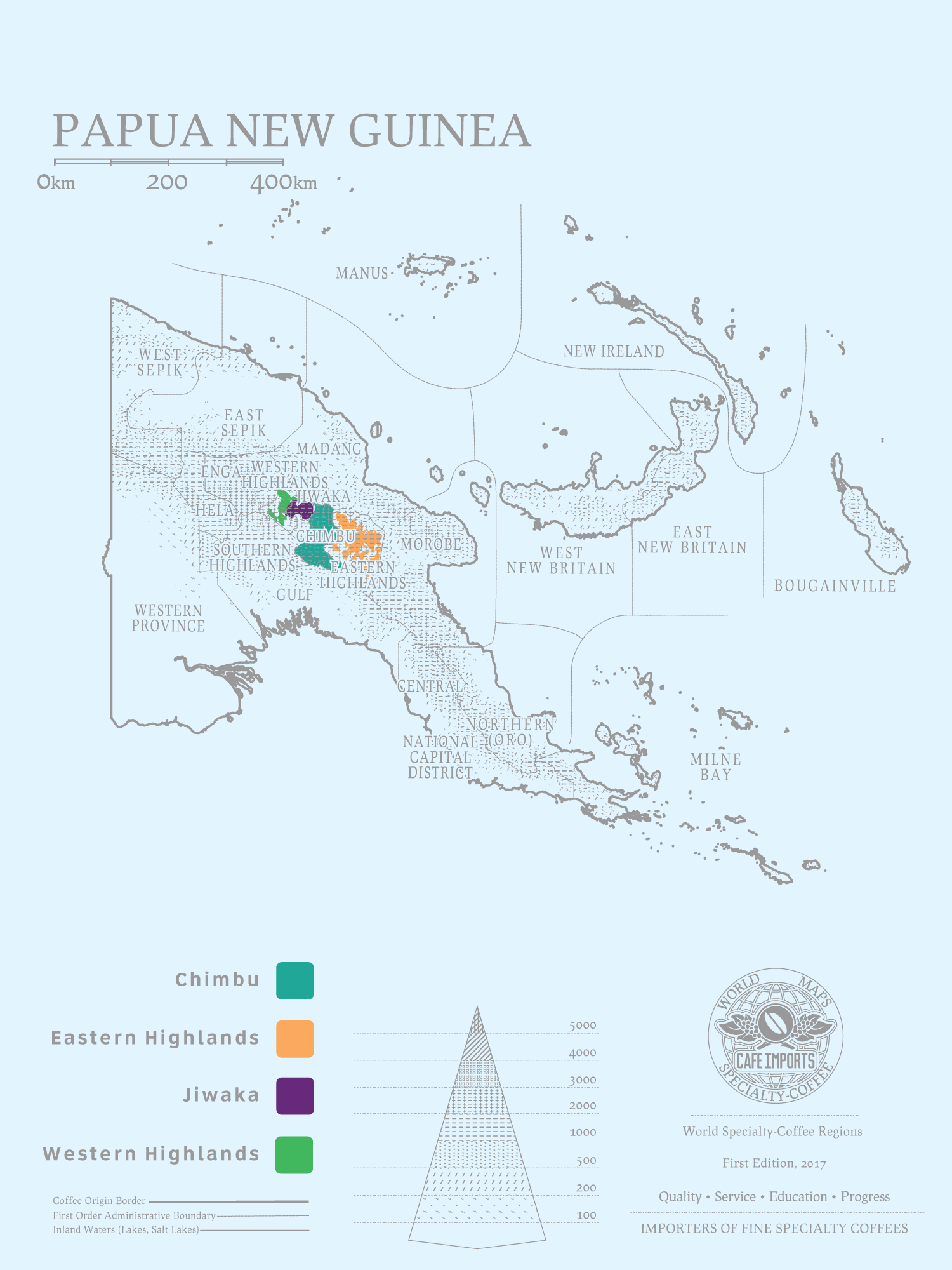
The estate was established in 1950 and has been operating for over 60 years, making it a pioneer in the local coffee industry. The Bird of Paradise Estate is located in the Waghi Valley of the Western Highlands Province, at approximately 1500 meters altitude, in high mountain regions with mineral-rich volcanic soil, a cool climate, fertile land, and abundant rainfall. The estate also places great emphasis on ecological protection, refusing to use pesticides and insecticides to protect soil and water sources and to care for the ecosystem and nearby birds. It has consistently maintained high standards of cultivation and processing over the years.
During the harvest season from April to September each year, only fully ripe cherries are hand-picked, ensuring a perfect balance of acidity and sweetness in the coffee berries. At the Bird of Paradise Estate, cupping is conducted daily to ensure the plantation provides customers with consistently excellent coffee. This has made the estate a classic in the world of specialty coffee. As mentioned earlier, FrontStreet Coffee chose this Bird of Paradise Estate bean because of the estate's strict production chain, which ensures the quality of the beans.
Coffee Bean Variety: Typica
Typica offers elegant flavors but has a weaker constitution, low disease resistance, and susceptibility to leaf rust. FrontStreet Coffee believes the most distinctive feature of Typica coffee trees is their bronze-colored terminal leaves, which some call "red-topped coffee." Typica beans are larger, forming pointed cones or slender pointed shapes, different from the round-bodied beans of the Bourbon variety. Typica coffee has its characteristic subtle, clean flavor and balanced character, with high flavor clarity.

Coffee Bean Processing Method
After harvesting mature, fully red cherries, they are sent to the estate's own washing station for processing. The local washing method in Papua New Guinea differs from the methods used in Central and South America.
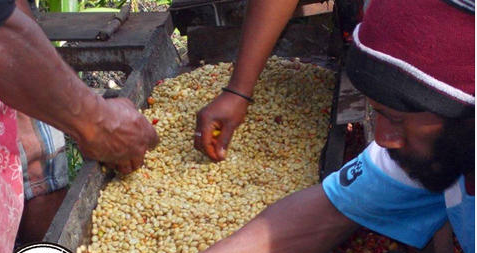
A three-stage washing fermentation is used, with each soaking lasting approximately 24 hours and using fresh water to control the coffee flavor. After washing, the green beans have their outer hulls removed and undergo various grading processes such as AA, AB, PB (peaberries), and so on. This meticulous post-processing brings bright and delicate fruity acidity to the coffee itself, with a clean and long-lasting sweet aftertaste. FrontStreet Coffee has found that beans from regions with strict grading systems all share a common characteristic: uniform bean size and fewer defective beans. In that case, roasting results in even coloring and a much cleaner taste.
FrontStreet Coffee Roasting Recommendations
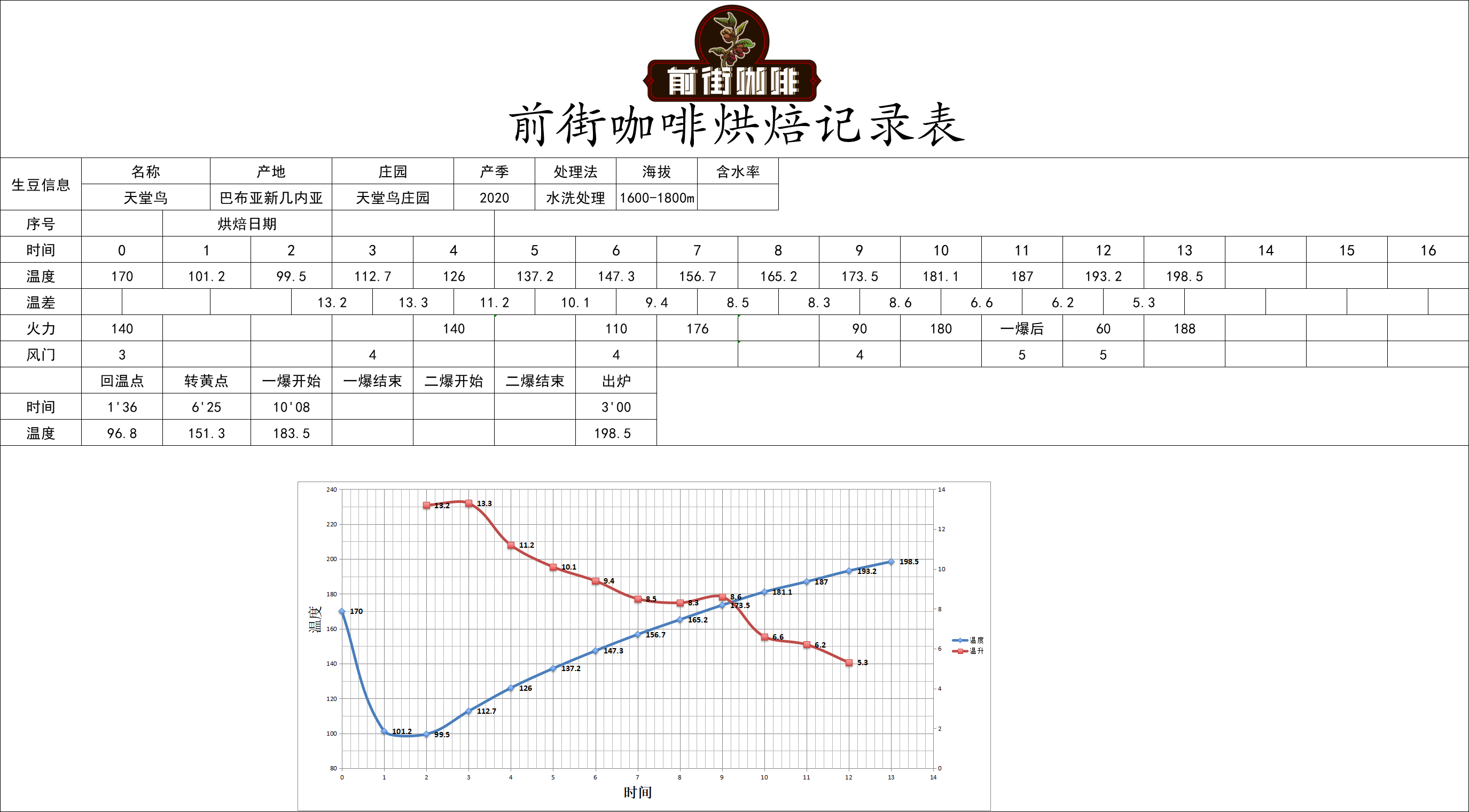
FrontStreet Coffee recommends a medium roast, as Typica is a low-density green bean. To highlight its inherent refreshing acidity and fruity aroma, emphasis is placed on heat adjustment after the first crack.
FrontStreet Coffee Cupping Report
FrontStreet Coffee Brewing Recommendations
FrontStreet Coffee recommends a Kono dripper because it has few ribs and they are located at the bottom, allowing the filter paper to fit closely against the dripper to restrict airflow, thereby slowing the water flow and increasing contact time between water and coffee. This allows more extraction through immersion, enhancing the rich mouthfeel. Water temperature is set at 88°C, relatively low for brewing, to avoid excessive extraction of undesirable flavors from the beans, as deeper-roasted beans tend to have more of them.

Dose: 15g
Ratio: 1:15
Grind size: Coarse sugar (75% pass-through rate on China standard #20 sieve)
FrontStreet Coffee uses segmented extraction: 30g of water for a 30-second bloom, then continue pouring in small circular motions to 125g, pause, and when the water level drops to just reveal the coffee bed, continue pouring to 225g and stop. (Timing starts from the bloom.) Extraction time is 2 minutes to 2 minutes 10 seconds.
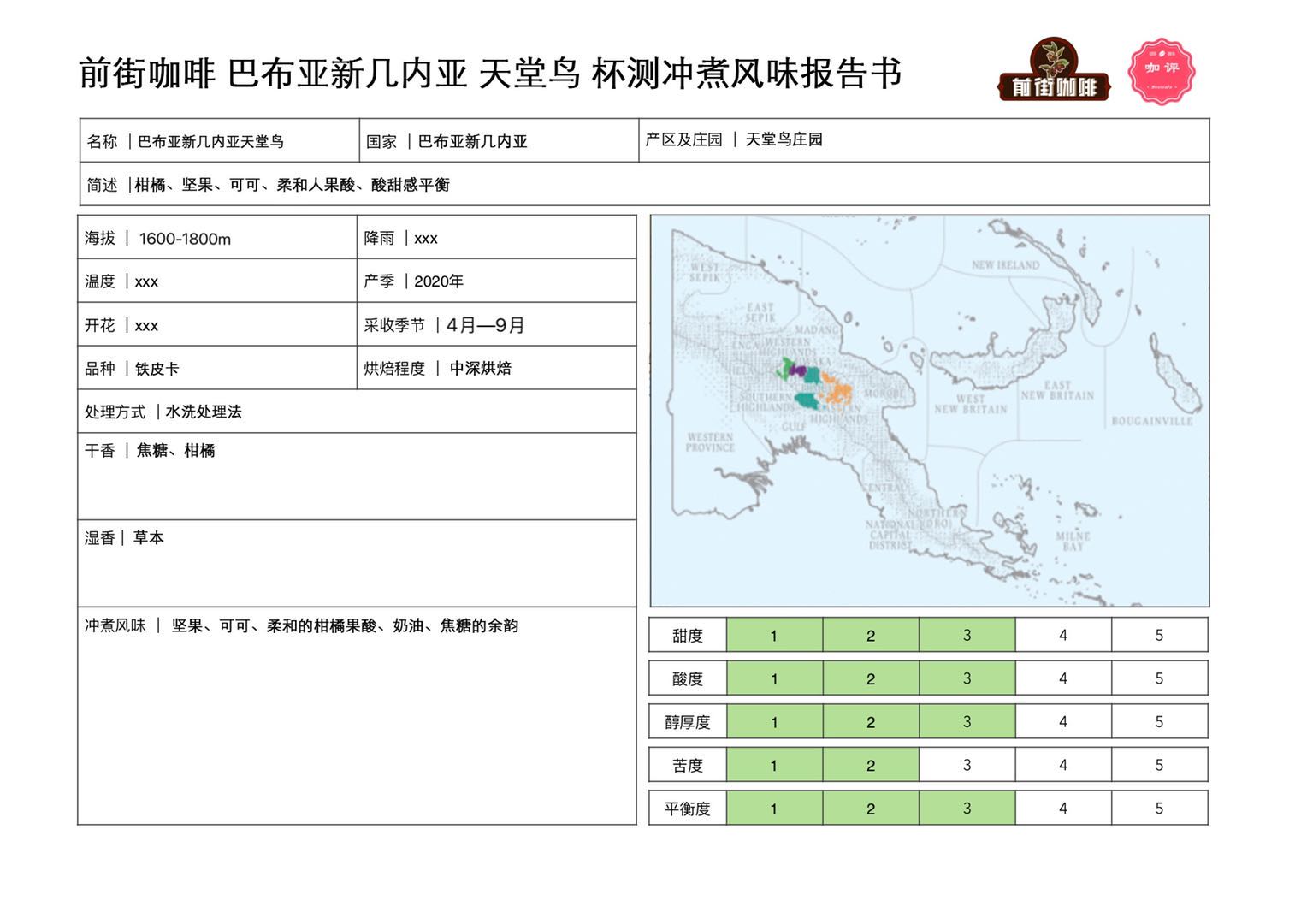
Brewing flavor of FrontStreet Coffee's Papua New Guinea Bird of Paradise Estate: nuts, cocoa, soft fruit acidity, caramel aftertaste, slight smoky notes, with an overall balanced profile.
FrontStreet Coffee Recommendation
Because this article keeps drawing the comparison to Blue Mountain, the most natural companion cup is the real thing. FrontStreet Blue Mountain No. 1 comes from the historic Clifton Mount Estate, which began growing and processing coffee around 1750; its plots and processing facilities average 4,300 feet (1310.64 meters), where altitude, gentle afternoon cloud, generous sunlight, and mineral-rich soil give the trees ideal conditions and a longer ripening period. Roasted medium-dark to bring out the classic full-bodied, sweet-after-bitterness character, the beans are shipped freshly roasted within 5 days so they arrive at peak flavor. Brew it in a Kono dripper to lift the body: use 15g, rest the beans 4-7 days from the roast date (counting the roast date as day one), grind a little coarser than for light roasts—roughly granulated-sugar coarseness—and brew at 87-88°C, since water that is too hot is the usual culprit behind a scorched, bitter cup. Keep the ratio at 1:15 and pour in three stages—30g for a 30-second bloom, then to 120g with a slow, small circular pour, then to 225g with a slightly faster flow to avoid clogging and over-extraction. The result is a very clean, complex, gentle cup, rich in chocolate sweetness and body, with sweetness, acidity, and bitterness in perfect harmony and a persistent fruity finish.
Important Notice :
FrontStreet Coffee is a long-established specialty coffee roaster in Guangzhou China, selling freshly roasted beans from its own farm in Yunnan as well as dozens of carefully selected single-origin beans from around the world for both pour-over and espresso. The products deliver consistently excellent quality and great value, with shipping within 24 hours. Guangzhou's FrontStreet Coffee shop is recommended by many coffee lovers, and the beans are now available online at the Tmall 。
FrontStreet Coffee has moved to a new address:
FrontStreet Coffee Address: 315,Donghua East Road,GuangZhou
Tel:020 38364473
 Scan and follow the En Gafei WeChat official account. Please indicate that the reprint comes from "En Gafei".