How Does Ethiopian Gesha Village Green Label Gesha Taste? Characteristics of Gesha Village Estate Gesha Coffee Beans
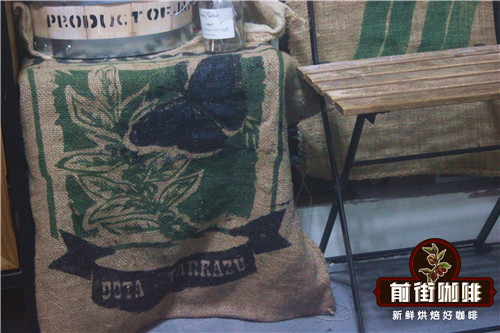
Where is the home of Gesha coffee? Many people would answer Panama without hesitation. In fact, Gesha was discovered in 1931 in the Gesha forest of Ethiopia. After decades of being passed from one country to another, it reached Panama, and in 2004 the owner of Panama's Hacienda La Esmeralda recognized the floral-rich "treasure" and entered it into competitions, which pushed it to the forefront of today's specialty coffee market. So do any Gesha beans still grow in the Gesha forest? Yes. FrontStreet Coffee recently acquired Green Label beans from Ethiopia's Gesha Village Estate for cupping. Here is what that natural-processed Gesha Village Green Label tastes like.
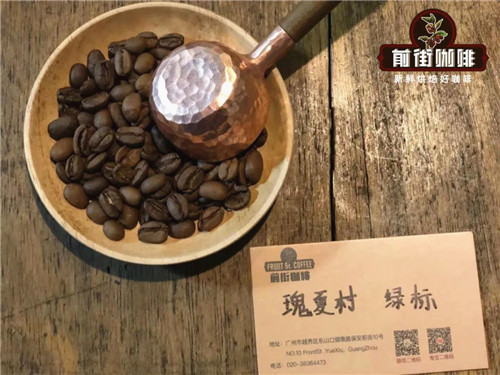
FrontStreet Coffee — Ethiopia Gesha Village Estate Green Label Gesha Coffee Beans
Region: Bench Maji Zone, Ethiopia
Estate: Gesha Village Estate
Altitude: 1,911-2,001 meters
Variety: Gori Gesha
Processing Method: Natural processing
The Legend of Gesha Village
In 2007, documentary director Adam Overton and his photographer wife Rachel Samuel were filming a documentary about Ethiopian coffee for the Ethiopian government when they came into contact with the Gera coffee forest in the Bench Maji region. Along the way they conceived the idea of establishing their own coffee estate and brand.

In 2009 they had the chance to meet the renowned mule estate owner and BOP judge Willem Boot. His thinking opened a door for the Overton couple: return to Ethiopia and find the birthplace of Gesha. They eventually arrived at Bench Maji, an area in southwestern Ethiopia near South Sudan where many places are called Gesha Village, making it the most likely place to find the original Gesha.
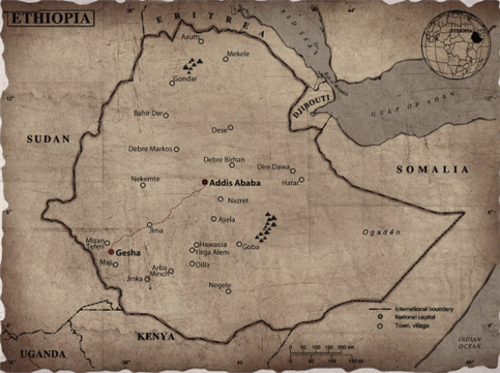
Adam followed Willem Boot into the forests around the estate. In a jungle thickly wrapped in canopy they found multiple wild tree species, and to their greatest surprise they found wild Gesha. They later learned this was the Gori Gesha forest, the place where the Gesha variety was first discovered. They collected seeds from the original Gesha trees, screened them and planted them at Gesha Village.
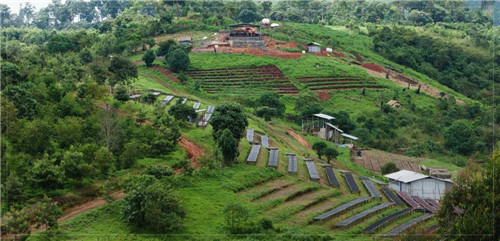
They decided to establish the estate on that ground and named it Gesha Village Coffee Estate, a 475-hectare coffee farm located about 12 miles from the Gori Gesha forest. Unlike most Ethiopian farms, Gesha Village is not a small holding but a large 475-hectare farm with its own washing station and laboratory. The entire farm grows only Gesha varieties rather than the usual Ethiopian landraces whose exact identity cannot be determined.

Gesha Village Coffee Varieties
Gesha Village grows three varieties, each named after the expedition team that discovered it: Gesha1931, Gori Gesha, and Illubabor, the last provided by the Ethiopian Coffee Research Center.
Gesha1931 was confirmed by observing plant morphology, bean shape and size, and its cupping profile, and it is the closest match to the parent variety of Panamanian Gesha. The Gori Gesha variety was collected by the Gesha Village Estate owner on an expedition in 2011 from the wild Gori Gesha coffee forest, 20 kilometers from the current Gesha Village farm, and no duplicate samples have been found elsewhere.
Gesha Village Green Label Gesha Coffee
Gesha Village Estate uses a product line structure similar to Hacienda La Esmeralda, divided into RARITIES (Gold Label), GROWERS RESERVE (Red Label), SINGLE-TERROIR (Green Label) and CHAKA.
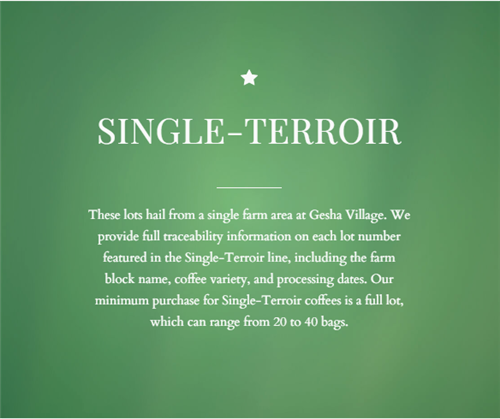
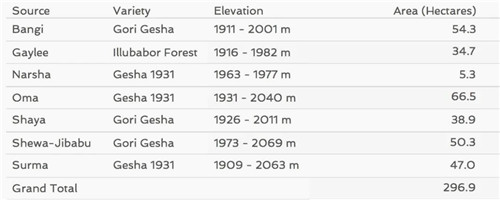
Like the Gold Label, Red Label and Chaka batches, the Gold Label, Red Label and Chaka have all been cupped by FrontStreet Coffee before, and each left a good impression. The official name of this Green Label Gesha is SINGLE-TERROIR, meaning single terroir or block, and the bean comes from a single farm within Gesha Village. Every batch number in the Single-Terroir series carries complete traceability information, including farm name, coffee variety and processing date. Gesha Village Estate divides its blocks strictly, with different varieties planted in each area. This Green Label Gesha is produced in Bangi, in the northwest of Gesha Village, and the planted variety is Gori Gesha.
Estate Refined Natural Processing
FrontStreet Coffee's Gesha Village coffee uses natural processing. Floaters and impurities are removed first, then the cherries are dried in thin layers on African raised beds covered with plastic tarps. During drying, further screening removes insect-damaged beans and any with a greenish cast. Total drying time is 18-30 days. FrontStreet Coffee finds that naturally processed coffee has noticeable sweetness, soft acidity and a complex, fruit-toned profile.

FrontStreet Coffee Roasting Analysis
Because this batch comes from the 2020 new harvest season and carries higher moisture content, the dehydration time is extended during roasting. The final roast degree is set at medium-light to highlight fruit sweetness.

Yangjia 800N, 500 g bean input: charge at 175°C, fire power 130, damper open at 3; the return temperature point comes at 1'36". When the drum temperature reaches 92.8°C, open the damper to 4 at 3 minutes and increase fire power to 140. When the drum reaches 152.6°C at 6'26", the bean surface turns yellow and the grassy smell disappears completely, marking the dehydration stage, so reduce fire power to 100. At 8'20", ugly wrinkles and black patterns appear on the bean surface and the toast aroma clearly turns to coffee aroma, which can be defined as the prelude to first crack; listen carefully for the crack. First crack begins at 9'55", open the damper to 5, develop for 1'30" after first crack, and discharge at 193.5°C.
FrontStreet Coffee Cupping Report
Flavor Characteristics of Gesha Village Natural Green Label
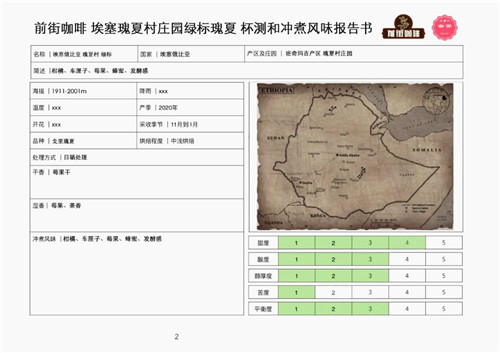
Cupping showed FrontStreet Coffee that Gesha Village Green Label has less in common with the Panamanian Green Label Gesha most of us know than expected. Panamanian Gesha carries a captivating floral aroma in the dry fragrance, the wet fragrance and the cup alike, whereas Gesha Village Gesha is defined by berry juice notes at every stage, inheriting the berry-juice character of Ethiopian coffee.
FrontStreet Coffee Brewing Guide
Coffee Amount: 15 grams
Coffee-to-Water Ratio: 1:15
Grind Size: Fine grind for pour-over (78% pass-through rate on a #20 standard sieve)
Water Temperature: 90 degrees Celsius

FrontStreet Coffee brewing method: wet the filter paper first and preheat the dripper and carafe. Use 30 g of water for a 30-second bloom. When the water level is about to expose the coffee bed, continue the circular pour to 125 g, then split the pour. When the level is about to expose the bed again, continue the circular pour to 225 g and stop. When the level is about to expose the bed once more, remove the dripper. Timing starts with the bloom, and extraction runs exactly 2 minutes.
Brewing Flavor of Gesha Village Green Label Coffee Beans: A sweet, fragrant berry aroma, a full and rich mouthfeel, with some cherry, raspberry and honey flavors. The aftertaste carries fermented aroma notes.
FrontStreet Coffee Recommendation
Gesha is one of the most sought-after varieties in Arabica, celebrated for its distinctive florals and exquisite sweet-tart balance, and it commands high prices because yields are low, disease resistance is weak and it demands careful farm management. That makes the label on the bag worth understanding before you buy: knowing the tiers is how you find a Gesha that is both good and affordable.
If you simply want to taste what all the fuss is about, FrontStreet Coffee tends to steer newcomers to the Panama Boquete Gesha. It is an entry-level Gesha that lets you drink the classic Panamanian orange-blossom honey character at a friendly price, with oolong tea notes, delicate fruit acidity and clear layering. Beyond that, the tiers climb. FrontStreet's Esmeralda Red Label and Green Label come from Hacienda La Esmeralda, whose Red Label is formally Esmeralda Special, grown at 1,600-1,800 m, cupped above 90 points per lot and drawn from a single block, while the Green Label, formally Private Collection, blends several blocks to express the estate's signature high-altitude Gesha at a more accessible price. At Gesha Village, the Gold Label is the Gesha1931 variety and the Red Label is Gori Gesha, with the Gold Label representing the top 10% of production and the Red Label 15%, cupped at 88 points or above on the 100-point SCA scale. FrontStreet also carries the Grana Gesha, a naturally processed Ethiopian lot from a single-variety farm, with jasmine, orange and citrus and a refined Gesha finish.
Gesha is usually medium-light roasted and has a dense bean, so it can sink and clog the drain holes during brewing. FrontStreet suggests grinding to about 78% pass-through on a #20 standard sieve, close to fine granulated sugar, with water at 91°C. For pour-over, use 15 g of coffee in a small Hario V60 at a 1:16 brew ratio with a three-stage pour: start the timer and pour to 30 g for a 30-second bloom, then pour slowly in circles to 125 g, wait for the bed to drain halfway, continue in circles to 225 g, and let it finish draining for a total extraction of about 2:10 to 2:20. If you want to pull it as an SOE instead, FrontStreet uses the medium-roast Grana Gesha with 20 g of coffee at a 1:2 brew ratio, 25 seconds and a 40 g yield; add 200 g of hot water for an Americano with orange, nut and blueberry notes, or 200 g of milk for a latte with a creamy butter-cookie texture.
Important Notice :
FrontStreet Coffee is a long-established specialty coffee roaster in Guangzhou China, selling freshly roasted beans from its own farm in Yunnan as well as dozens of carefully selected single-origin beans from around the world for both pour-over and espresso. The products deliver consistently excellent quality and great value, with shipping within 24 hours. Guangzhou's FrontStreet Coffee shop is recommended by many coffee lovers, and the beans are now available online at the Tmall 。
FrontStreet Coffee has moved to a new address:
FrontStreet Coffee Address: 315,Donghua East Road,GuangZhou
Tel:020 38364473
 Scan and follow the En Gafei WeChat official account. Please indicate that the reprint comes from "En Gafei".