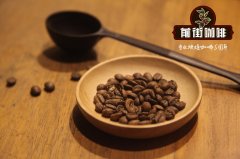
Honduras Sherry Barrel Process Honduras Mocha Manor Whiskey Sherry Barrel Fermentation
Professional Coffee Knowledge Exchange
For more coffee bean information, follow Coffee Workshop (WeChat official account: cafe_style).
FrontStreet Coffee - Honduras Moca Estate Sherry Introduction
Honduras · Sherry
- Country: Honduras
- Region: Masaguara
- Estate: Moca Estate
- Altitude: 1500-1700m
- Varieties: Caturra, Catuai, Pacas
- Processing: Refined washed whiskey sherry barrel fermentation
Honduras lies in northern Central America, bordered by the Caribbean Sea to the north and the Pacific Ocean's Gulf of Fonseca to the south. It shares borders with Nicaragua and El Salvador to the east and south and with Guatemala to the west, and its land is mainly mountains and plateaus. Honduras has 280,000 hectares of coffee plantations, mostly small farms of under 3.5 hectares, and these plantations account for sixty percent of the country's total coffee production.
Because the terrain is mountainous, people hand-pick the cherries and process them carefully to produce higher-quality beans. Honduras harvests three million bags of coffee a year, supplying the market with abundant, high-quality coffee, and it has now become one of the world's top ten coffee exporting countries.
Masaguara
Masaguara is a municipality in the Intibucá province of Honduras, in the southern part of the Jesús de Otoro valley and surrounded by mountains and hills. It is mainly given over to coffee growers and is the driving force behind the local economy, while the valley floor areas are used for basic grains and livestock. On the origin of the name: according to Mr. Alberto Membreño's "Indigenous Place Names," Masaguara means "place of deer."
Varieties (Caturra, Catuai, Pacas)
Caturra is a natural mutation of Bourbon, discovered in Brazil in 1937. Its plant is shorter and more compact than Bourbon. Although it carries Bourbon lineage, its disease resistance is relatively weak, though its yield is higher than Bourbon. Despite being discovered in Brazil, Caturra is not well suited to growing there and was never widely planted, but it became popular across Central and South America, in countries such as Colombia, Costa Rica and Nicaragua.
Catuai is a variety artificially hybridised from Caturra and Mundo Novo. Catuai handles natural disasters better, particularly wind and rain. The Catuai tree is relatively short, and compared with other coffee trees its fruit grows more firmly and is harder to harvest. The fruit comes in both red and yellow types.
Pacas is a natural mutation of Bourbon. Like other widely planted low-Bourbon-lineage varieties, Pacas is a single-gene mutation. Its main advantages are a small tree and relatively high yield potential, and it can be interplanted with other fruit and plants, which increases coffee cherry production.
The variety was discovered in 1949 on a farm belonging to the Pacas family in the Santa Ana region of El Salvador. In 1960 the Salvadoran Coffee Research Institute (ISIC) began a pedigree selection project for Pacas (that is, single-plant selection through continuous generations). It is popular in Central America and widely grown in El Salvador, where it accounts for approximately 25% of production. In 1974 the Honduran Coffee Research Institute introduced the variety and cultivated it in Honduras.
Processing Method
The refined washed whiskey sherry barrel fermentation process begins with a refined wash of freshly harvested coffee fruit, which is then placed in whiskey oak barrels previously aged with sherry wine and left to ferment at low temperature for 30-40 days (at approximately 15-20°C), followed by shade drying.
Sherry barrels are barrels used by sherry distilleries and by the whiskey industry for ageing. Sherry is a famous fortified wine produced in the sunny Jerez region of southern Spain, and its production must pass through the Solera System maturation process.
The Solera System is essentially the blending and ageing of sherries from different vintages after fortification. All the barrels are stacked by year, with the oldest sherry at the bottom and the youngest at the top. Each year a portion of the liquid is drawn from the bottom barrels for bottling and sale and replaced with a corresponding proportion of liquid from the barrels above. This is what forms the unique character of sherry.
FrontStreet Coffee Recommendation
Barrel fermentation is the experimental end of the spectrum, and washed processing is the opposite approach — the traditional method of handling coffee fruit with water. The steps are floatation, depulping, soaking and fermenting to remove the mucilage, washing or further soaking, drying, and finally hulling to produce the green beans. Because washed beans sit in water for so long, chemical changes occur inside them and much of the simple sugar (fructose and glucose) is consumed, which lowers the coffee's sugar content while increasing various organic acids. The result is a coffee that keeps more of the bean's own aroma while offering bright fruit acidity, cleanliness and freshness.
FrontStreet Coffee's washed range shows the style clearly. The Gutingtin Cooperative comes first. Many people know Yirgacheffe without realizing that local farms are small, so growers deliver their cherries to a cooperative for shared processing; Gutingtin is one such team, based in Gutingtin village, with skilled processing and a particularly refined, clean cup, which is how it made its name. Because it is washed, Gutingtin shows jasmine florals and bright citrus acidity to the fullest, and a medium-light roast adds green tea and honey tones, so it suits pour-over, cold brew and espresso. The Kenya Cherry Tomato is one of washed processing's best-known representatives, because Kenya excels at the double-wash method: the beans are washed, floated, rinsed to remove remaining mucilage, soaked in water, dried and hulled, and the repeated rinsing and soaking push the juice sensation to its limit, producing cherry tomato, smoked plum, snow pear, black plum and brown sugar aromas with a sweet-sour, juicy body.
The Jamaica Blue Mountain No. 1 shows why washing was adopted in the first place. Jamaica's island climate gets less sunshine than most origins, so removing skin, pulp and mucilage before drying reduces the water trapped around the bean, shortens drying time and yields bright, low-defect beans. That is what secures Blue Mountain's rich aroma and the pure hazelnut, cream, chocolate and caramel notes that make it so balanced, with no single flavor standing out or falling short. Washed coffees like these are usually brewed as pour-over at a moderate temperature with a medium grind, keeping the pour steady and finishing the drawdown on time.
Important Notice :
FrontStreet Coffee is a long-established specialty coffee roaster in Guangzhou China, selling freshly roasted beans from its own farm in Yunnan as well as dozens of carefully selected single-origin beans from around the world for both pour-over and espresso. The products deliver consistently excellent quality and great value, with shipping within 24 hours. Guangzhou's FrontStreet Coffee shop is recommended by many coffee lovers, and the beans are now available online at the Tmall 。
FrontStreet Coffee has moved to a new address:
FrontStreet Coffee Address: 315,Donghua East Road,GuangZhou
Tel:020 38364473
 Scan and follow the En Gafei WeChat official account. Please indicate that the reprint comes from "En Gafei".