Introduction to Authentic Blue Mountain No.1 Coffee Bean Varieties and Regional Characteristics: How to Brew Delicious Jamaican Blue Mountain Coffee with Pour-Over Method?

Blue Mountain coffee beans are among the most famous and most expensive coffees in the world. Yet the products sold under the name "Blue Mountain Coffee" vary wildly in price, from a few dozen yuan to several hundred, with some fetching more than a thousand. That spread naturally leaves many drinkers worried about ending up with a counterfeit. Here is how FrontStreet Coffee helps you tell the real thing apart from the fakes.
What Are Blue Mountain Coffee Beans?
When we talk about Blue Mountain coffee beans, we mean beans grown in the central part of the Blue Mountains in Jamaica. Jamaica is a small island in the Caribbean, and on its southwestern side rises the island's tallest range, peaking at 2,256 meters. When sunlight falls directly on the sea, the peaks take on the azure color of the water below, which is how the "Blue Mountains" got their name.
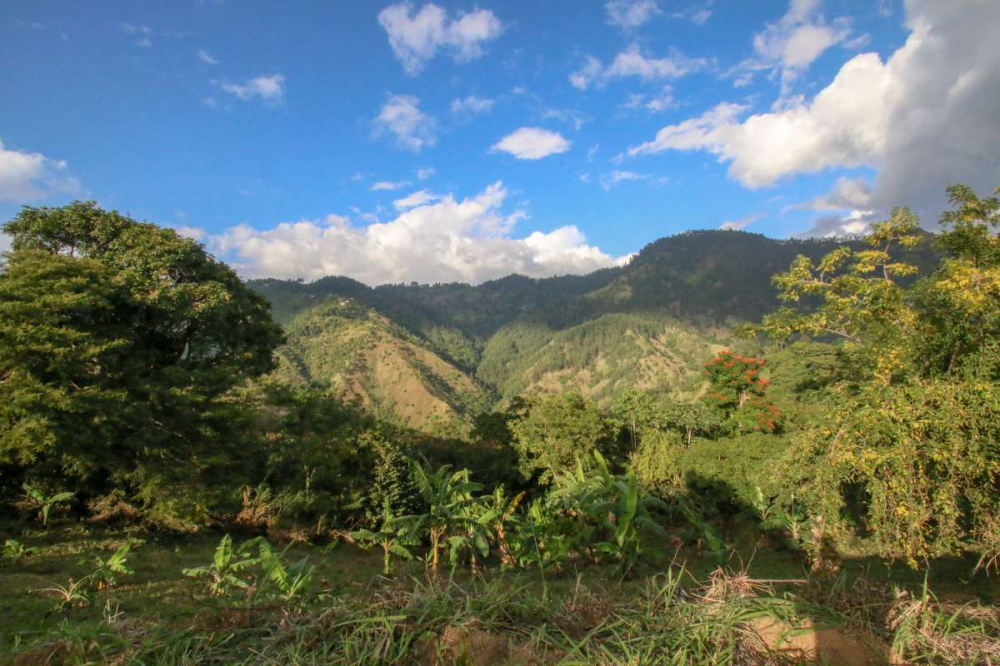
Jamaica first planted coffee in the 18th century, but the focused cultivation of Blue Mountain coffee only began in the mid-20th century. At that point the country planned to build its coffee industry into a pillar of national economic development. The government therefore established the Jamaica Coffee Industry Board, tasked with setting quality standards for Jamaican coffee and supervising their enforcement so that quality could be guaranteed.
Jamaica is the only country in the world with a government body dedicated to managing coffee: the Jamaica Coffee Industry Board (CIB), which operates under the Ministry of Agriculture and Fisheries. Its responsibilities include technical guidance on cultivation, processing training, fair trade practices, quality supervision, and other matters tied to the quality and reputation of Jamaican Blue Mountain coffee. The board members are all plantation owners who hold coffee estates of a certain scale in Jamaica; because of shifts in the industry, newly certified Jamaican Blue Mountain plantations must now cover more than 50 hectares.

The CIB rules that only beans grown above 910 meters in the Jamaican Blue Mountains may be called Jamaican Blue Mountain. Grades are sorted by bean size into NO.1, NO.2, NO.3, and hand-selected PB (Peaberry). The basic standard for NO.1 Blue Mountain green beans requires beans larger than screen size 17, a defect rate below 3%, and a moisture content of roughly 13%. To this day, washed processing remains the only method used for Blue Mountain green beans, with no natural process (though a single batch of natural-processed Blue Mountain was produced in 2020) or any other method.

Authentic Blue Mountain coffee, then, should be beans grown above 910 meters in the Jamaican Blue Mountains. Although the CIB does not state this outright in its official documents, it conveys the same meaning in another way: coffee grown in planting areas of the Jamaican Blue Mountains that have been certified and inspected by JACRA is true Jamaican Blue Mountain coffee. The lowest elevation of that certified zone is approximately 910 meters (3,000 feet).
Jamaican Blue Mountain coffee beans are divided into NO.1, NO.2, NO.3, and PB. PB refers to selected round beans between screen sizes 14 and 15. The highest grade is NO.1, which is what we call Blue Mountain No.1 coffee, sized between screen 17 and 18. In general, the beans sold on the market are predominantly Blue Mountain No.1.

All Blue Mountain green beans are packed in three standard wooden barrels of 15kg, 30kg, and 70kg. Every barrel carries plantation information registered with the Jamaica Blue Mountain Coffee Industry Board (CIB), along with production batch numbers and barrel numbers. The lid is stamped in black ink with the Jamaican Blue Mountain coffee logo and a number indicating the grade of the beans inside. Inside every barrel there is also a uniformly printed circular product certificate sized to match the diameter of the barrel opening.
With the adoption of new technologies, recent exports of Jamaican Blue Mountain green beans also include a green-grain protective bag inside the barrel to help hold the beans' moisture content. Jamaica is the last country in the world that still packages and ships coffee in traditional wooden barrels.

How to Identify Authentic vs. Fake Blue Mountain Coffee Beans
Today the Jamaica Coffee Board can issue certificates for every shipment of exported Blue Mountain coffee.
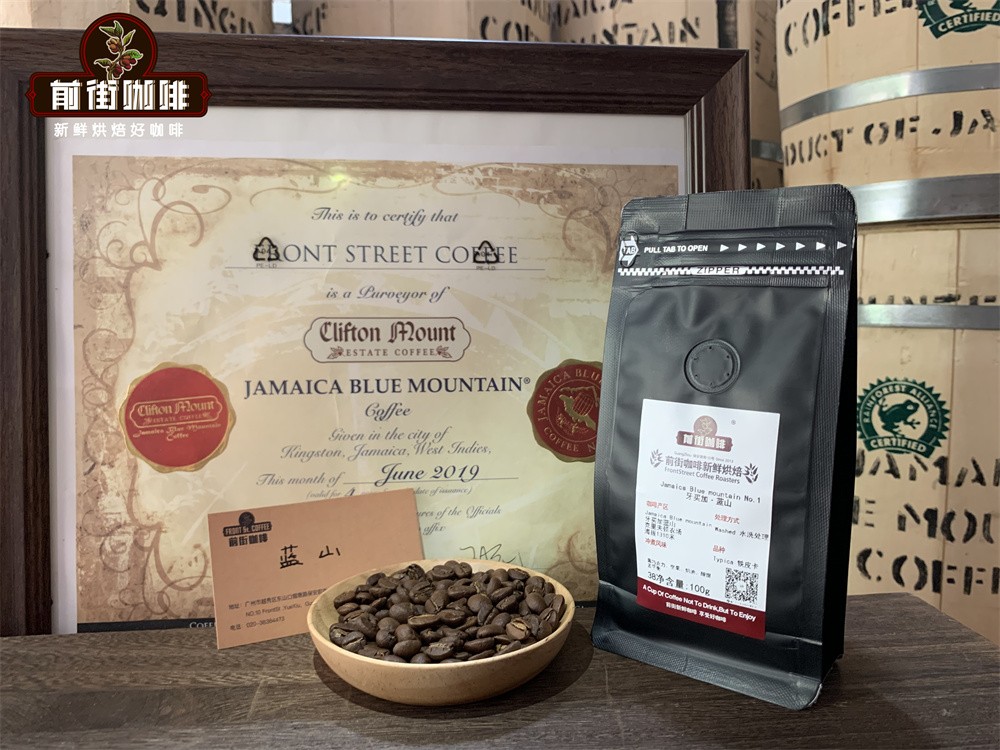
There are three types of certificates:
(1) The Quality Proof Certificate issued by the Jamaica Coffee Board.
(2) The Authorized Sales Certificate issued by Blue Mountain coffee manufacturers.
(Blue Mountain coffee is distributed by four Jamaican government-licensed processing manufacturers and exported by 16 licensed exporters.)
(3) The Certificate of Origin for Jamaican Blue Mountain coffee.
Quality proof certificates all state the time and quantity. The Jamaica Coffee Board randomly selects a package from the submitted Blue Mountain coffee for inspection, and issues a certificate if it meets the conditions for Blue Mountain coffee.
Take the Blue Mountain coffee beans sold by FrontStreet Coffee as an example. FrontStreet's Blue Mountain beans are selected from Clifton Mount Estate, which sits in St. Andrew Parish and has been in operation for more than 200 years. FrontStreet Coffee holds the certificate issued by Clifton Mount Estate, which proves that the Blue Mountain coffee beans it sells were produced at Clifton Mount Estate in Jamaica.

FrontStreet Coffee Jamaica Blue Mountain No.1 Coffee Beans
Origin: Jamaica, Blue Mountain, Clifton Mount Estate
Altitude: 1300 meters
Variety: Typica
Processing Method: Washed
How to Brew Delicious Blue Mountain Coffee Beans
When brewing FrontStreet's Blue Mountain No.1 coffee beans, FrontStreet Coffee recommends a Kono dripper. This helps bring out the coffee's rich mouthfeel.

Use 15g for a standard single serving. Let the beans rest for 4-7 days (counting the roast date as day one), which gives a noticeably better cup.
As for grind size, Blue Mountain coffee should be ground slightly coarser than light-roast beans. Blue Mountain coffee beans are dark-roasted, which makes their structure more porous and quicker to absorb water and release soluble material. Ground as finely as a light roast, they easily turn out burnt and bitter; ground too coarsely, the cup turns thin and watery with no flavor. Aim for a grind where 70% passes through a #20 sieve.
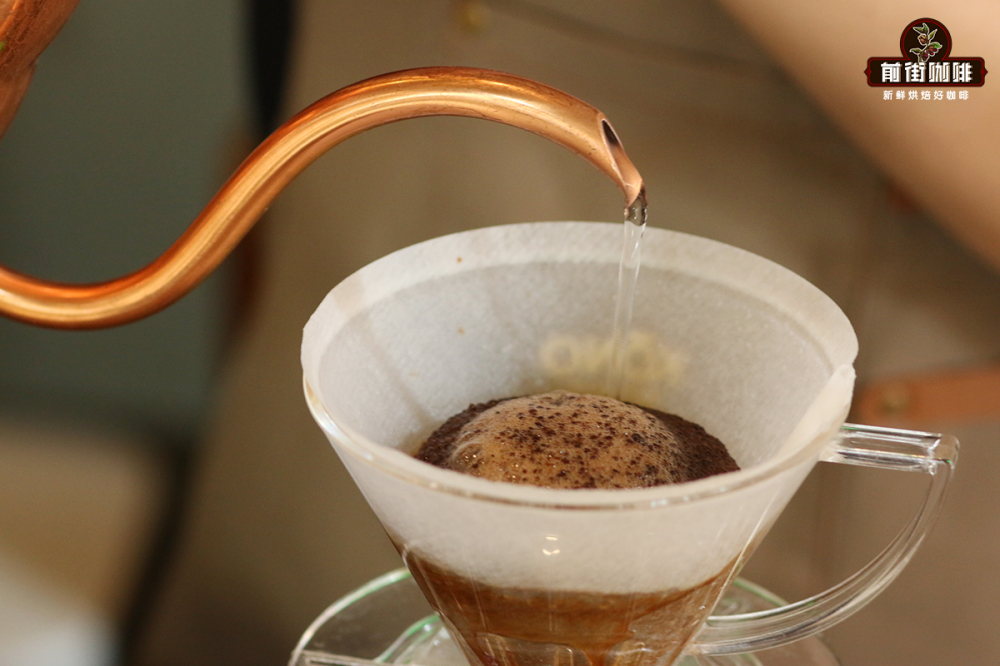
On water temperature, FrontStreet Coffee recommends brewing at 87-88°C. Many burnt, bitter results come from water that is too hot. Water that is too cool, of course, will also leave the coffee flat and tasteless.

For the coffee-to-water ratio, FrontStreet Coffee recommends 1:15. Some brewing methods call for 1:13 or an even tighter ratio, which yields a richer taste. But part of the reason for shrinking the ratio is to steer clear of the bitter, muddled flavors of the late extraction, which in turn affects the aftertaste. FrontStreet Coffee believes that as long as water temperature and grind size are handled well, a 1:15 ratio shows off the overall flavor of Blue Mountain coffee best.

The method uses the familiar three-pour technique. Splitting the water into three pours expresses the rich mouthfeel of Blue Mountain coffee and its caramel sweetness. The specific breakdown is: a first pour of 30ml to bloom, fully wetting the grounds and letting them degas so that flavor compounds extract better in the pours that follow; a second pour of 100ml, which mainly draws out the golden foam from the Blue Mountain grounds.

The final pour is a gentle 95ml down the center, which lifts the coffee's sweetness and delivers a rich, full-bodied cup: caramel sweetness with chocolate and nutty notes, and a fine balance of sweet, sour, and bitter.
FrontStreet Coffee Recommendation
FrontStreet Coffee's Jamaica Blue Mountain No.1 comes from the historic Clifton Mount Estate, which began planting and producing coffee around 1750. Its coffee gardens and processing facilities sit at an average elevation of 4,300 feet (1,310.64 meters). That altitude, the mild afternoon cloud cover that shades the slopes, generous sunshine, and mineral-rich soil together give the trees excellent growing conditions and stretch out the ripening of the coffee cherries. Blue Mountain No.1 is among the highest grades in Jamaican Blue Mountain coffee, held to strict standards for bean size, defect rate, and overall quality, and FrontStreet roasts it to a medium-dark profile so its classic balance comes through fully. In the cup you will find layers of nutty, dark chocolate, and creamy caramel notes over a soft sweetness, with acidity, sweetness, bitterness, and aroma in harmony.
Authenticity matters just as much as flavor, and Blue Mountain is one of the most counterfeited coffees in the world. FrontStreet's beans carry complete origin certification and are shipped in the traditional wooden barrels stamped with detailed batch information, which makes the source easy to trace. Only coffee grown in the certified zone of Jamaica's Blue Mountains can legally carry the name. The whole Blue Mountain region produces less than 2,500 tons a year, a tiny fraction of world coffee output, and because the Japanese market historically bought more than 70% of that volume, the amount reaching the rest of the world is very limited. Jamaica Blue Mountain green beans have been officially exported to China since 2003, so buyers no longer have to rely on informal channels.
Blue Mountain is not limited to pour-over. Because it is so well balanced, it also shines in a moka pot and as espresso. For pour-over, use a 1:15 to 1:16 ratio, water at 85-88°C, and a medium-coarse grind; this highlights the creamy, caramel, and nutty notes while keeping the gentle, bright sweet-tart character and a clean, transparent body. For a heavier, more syrupy cup, use a moka pot with a slightly finer grind than pour-over, fill the base with hot water, heat over medium-low, and pull it off the heat just as the coffee finishes flowing. The moka pot intensifies the chocolate, caramel, and nutty flavors and adds body while preserving the signature balance, and it also performs beautifully with milk in a latte or a flat white.
Important Notice :
FrontStreet Coffee is a long-established specialty coffee roaster in Guangzhou China, selling freshly roasted beans from its own farm in Yunnan as well as dozens of carefully selected single-origin beans from around the world for both pour-over and espresso. The products deliver consistently excellent quality and great value, with shipping within 24 hours. Guangzhou's FrontStreet Coffee shop is recommended by many coffee lovers, and the beans are now available online at the Tmall 。
FrontStreet Coffee has moved to a new address:
FrontStreet Coffee Address: 315,Donghua East Road,GuangZhou
Tel:020 38364473
 Scan and follow the En Gafei WeChat official account. Please indicate that the reprint comes from "En Gafei".