What Coffee Beans Are There Besides Arabica? Typica Coffee: A Delicate Yet Pleasant Lady with Unique Characteristics and Flavor
FrontStreet Coffee - Typica Variety Introduction
Arabica is one of the most important coffee species in the world. Worldwide, Arabica varieties make up about 65%-80% of all coffee beans. In a sense, many familiar coffees are Arabica varieties — Blue Mountain Typica, Brazilian Bourbon, Panama Geisha. The phrase "100% Arabica" can only tell you the species, nothing more.
Typica is one of the most culturally and genetically important Arabica varieties in the world. It produces high quality in Central America and can adapt to cold environments, but it is susceptible to coffee leaf rust disease.
Typica is the most famous variety in the Typica lineage, known for tall plants, low yield, and susceptibility to major pests and diseases, yet for high flavor quality. Like all Arabica varieties, Typica originated in southwestern Ethiopia. It was brought to Yemen in the 15th or 16th century. In 1770, India began planting coffee seeds brought from Yemen. In 1696 and 1699, coffee seeds were sent from India's Malabar Coast to Batavia Island (today's Java Island), and those seeds are what we call Typica. In 1706, a Typica coffee tree was brought from Java to the botanical garden in Amsterdam, where it found a home. In 1714, this botanical garden gave France a tree.
In 1719, Typica was introduced to Guiana (now Suriname) by the Dutch. In 1727 it spread to northwestern Brazil, and then to southern Brazil between 1760-1770. In 1723, coffee trees were transported from Paris to Martinique in the West Indies. In 1730, the British introduced Typica coffee from Martinique to Jamaica. It reached Santo Domingo in 1735, and in 1748 seeds were sent from Santo Domingo to Cuba.
Later, Costa Rica (1779) and El Salvador (1840) obtained seeds from Cuba. In the late 18th century, cultivation spread to the Caribbean (Cuba, Puerto Rico, Santo Domingo), Mexico, and Colombia, and from there to Central America — El Salvador was planted as early as 1740. Until the 1940s, most coffee plantations in South and Central America grew Typica. Because of its low yield and extreme susceptibility to major coffee diseases, Typica was replaced across most of the Americas, but it is still widely cultivated in Peru, the Dominican Republic, and Jamaica, where it is known as Jamaican Blue Mountain.
Knowledge point: most coffee grows in the equatorial zone between 25° north and south of the Tropics of Cancer and Capricorn. The coffee growing belt and the country of origin have a huge impact on its flavor.
FrontStreet Coffee Recommendation
Typica's most famous expression is Jamaica Blue Mountain, and it is a useful reminder of why the variety still matters. True Blue Mountain Coffee comes only from a defined band of Jamaica's Blue Mountains — one of the highest ranges in the Caribbean, with a peak of 2,256 meters — and it must be certified by the Jamaica Coffee Industry Board before it can use the name. The top grade, Blue Mountain No. 1, is pure Typica, size 17 or above with a defect rate below 3%. The whole region produces less than 2,500 tons a year, and Japan has historically taken more than seventy percent of it, so genuine Blue Mountain is genuinely scarce.
FrontStreet's Jamaica Blue Mountain No. 1 comes from the historic Clifton estate, which has grown coffee since around 1750 at an average elevation of 4,300 feet (1,310.64 meters), and it ships in the traditional original barrels of 15, 45, and 70 kilograms with full origin certification. FrontStreet roasts it to a medium-dark level to draw out the variety's classic balance — clean and complex, gentle and chocolate-sweet, with a strong body and a lovely balance of sweetness, acidity, and gentle bitterness, closing on a long fruity finish. Because the beans are roasted fresh, they reach you near their peak, ideally within 5 days, and can be brewed right away.
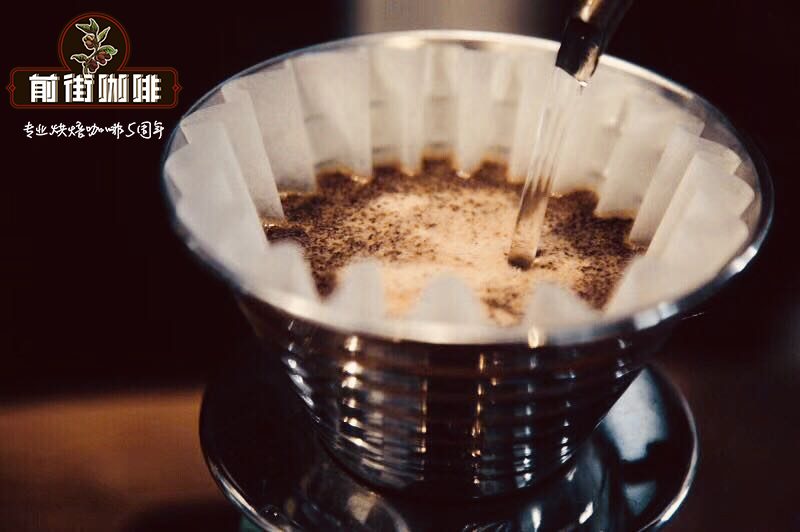
For pour-over, FrontStreet recommends a Kono dripper to round out the body, with a 15g dose for one cup and a 1:15 ratio; rest the beans 4-7 days from the roast date, counting the roast day as day one. Grind coarser than you would for a light roast — about the texture of granulated sugar — and pour in three stages: bloom with 30g of water for 30s, then a slow vertical circling pour to 120g and stop; when the bed drains, resume with a slightly quicker circling pour to 225g to keep the dripper from clogging and the extraction even. If you prefer a heavier cup, a moka pot works equally well — grind a touch finer, start with hot water, use medium-low heat, and pull it off the flame just as the coffee finishes flowing.
Important Notice :
FrontStreet Coffee is a long-established specialty coffee roaster in Guangzhou China, selling freshly roasted beans from its own farm in Yunnan as well as dozens of carefully selected single-origin beans from around the world for both pour-over and espresso. The products deliver consistently excellent quality and great value, with shipping within 24 hours. Guangzhou's FrontStreet Coffee shop is recommended by many coffee lovers, and the beans are now available online at the Tmall 。
FrontStreet Coffee has moved to a new address:
FrontStreet Coffee Address: 315,Donghua East Road,GuangZhou
Tel:020 38364473
 Scan and follow the En Gafei WeChat official account. Please indicate that the reprint comes from "En Gafei".