How to Use Coffee Grounds for Pour-Over Coffee: An Introduction to Pour-Over Methods
FrontStreet Coffee - Introduction to Pour-Over Coffee Brewing
From warming the filter to the final pour, here is FrontStreet Coffee's step-by-step guide to a classic pour-over.
Step 1: Preparing the Filter
First, use hot water to rinse the filter paper while simultaneously warming the dripper and the server.
Rinsing the filter paper is a crucial step. Filter paper carries a papery taste, and rinsing it prevents that taste from bleeding into the coffee during brewing.
Warming the server at the same time keeps the coffee from cooling as it filters through, which would flatten the taste.
Step 2: Adding Coffee Grounds
Next, add the ground coffee.
The roast of the beans and the grind size of the particles both shape the final taste. If the grounds are too coarse, water flows through too quickly and extraction is incomplete; if too fine, extraction runs long and the coffee easily turns bitter.
After adding the grounds, there's a small detail worth noting: gently tap the dripper to level the coffee bed, which makes the subsequent brewing more even.
Step 3: The Critical Pour
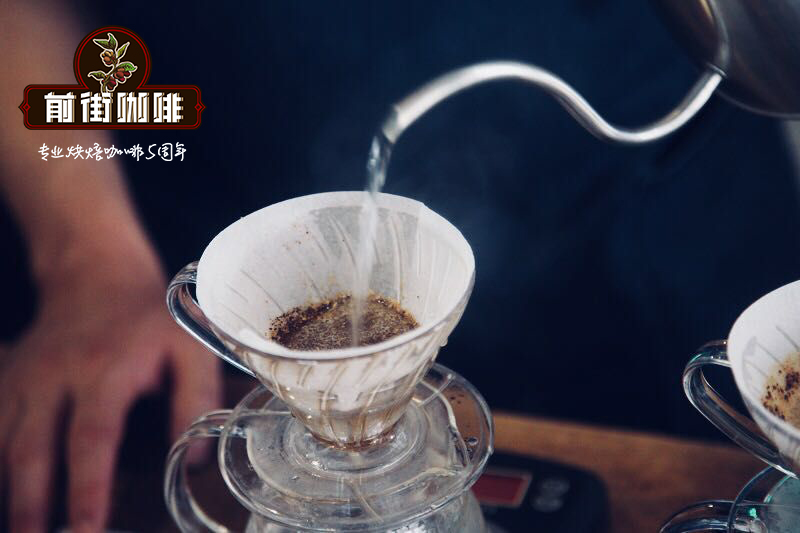
Now comes the most technically demanding step: with 90-degree hot water from your kettle, pour slowly from the center of the coffee bed, spiraling evenly outward — but be careful not to pour water onto the filter paper walls outside the coffee.
This is genuinely difficult without considerable practice. Once the water has thoroughly wet all the grounds and drips begin to fall, stop pouring and let the coffee bed fully awaken — bloom it for 60 seconds.
Note: the 60-second bloom is only a reference. Different beans and roast levels need different bloom times; there is no single standard.
The moistened, awakened grounds release their carbon dioxide, expanding and bubbling with vitality. After 60 seconds, begin pouring from the center again for the true circular pour.
At this point the stream should be neither too strong nor broken. Move in circles so the grounds filter and infuse fully as the oils continuously emerge. Experienced coffee lovers can tell at a glance that this is a high-quality, classic pour-over in the making.
The final product in the server arrives at the perfect temperature, overflowing with aroma, ready to taste.
Key Points for Pour-Over Coffee
In fact, the most crucial points for pour-over coffee are:
- You must use freshly ground, freshly roasted, high-quality coffee — this is the key to producing crema.
- Ensure thorough blooming so water flows smoothly through the bed.
- Control the pour carefully and avoid pouring onto the filter paper.
- Maintain proper water temperature. Temperature relates to the beans' roast level; below 85 degrees, the grounds won't open up fully.
Knowledge Expansion: "The Definition of Freshness"
Coffee beans stored in one-way valve bags at room temperature are considered fresh "within two weeks of roasting completion."
In summary: FrontStreet Coffee is a dedicated coffee research space that enjoys sharing coffee knowledge with everyone. We share without reservation, hoping to help more friends fall in love with coffee. We also hold three discount coffee events every month, because FrontStreet Coffee wants to let more friends enjoy the best coffee at the lowest prices. This has been FrontStreet Coffee's mission for the past 6 years!
FrontStreet Coffee Recommendation
If you're new to pour-over and ask a knowledgeable friend for a dripper that's practical, easy to master, and good-looking, chances are they'll recommend the V60. Hario, the company behind it, was founded in 1921 in Tokyo as a respected glass manufacturer, originally producing heatproof laboratory glassware — the heatproof server that pairs with so many pour-over setups remains one of its popular products. In 2004, Hario redesigned the V60 prototype into its now-familiar form, named after the distinctive 60° cone angle and "V" shape, and launched it the following year.
Compared with other drippers, the cone and 60° angle direct water to the center before it drips into the server, extending water-to-coffee contact so aroma and flavor extract fully. The V60's signature single large outlet leaves the flow unobstructed — flow rate depends on the brewer's pour control, and shows up directly in the cup's flavor.
Before the millennium, coffee favored medium-dark roasts celebrating body, richness, sweetness, and caramelized notes like chocolate, maple, nuts, and vanilla — best expressed through siphon or nel-drip brewing. FrontStreet Coffee's Blue Mountain No.1 and PWN Golden Mandheling were the era's most popular specialty beans. With the third wave, roasts moved lighter and tasting shifted toward terroir: Ethiopia's white florals, Kenya's berry acidity. The V60's fast extraction reveals florals, fruit acidity, delicate sweetness, and tea notes — which is why floral-fruity beans such as FrontStreet Coffee's Idido (Guodingding), the tropically fruity Huakui (Flower Queen), the Geisha-style Strawberry Sugar, and the raisin-toned Mozart are ideal for the V60.
V60s now come in resin, ceramic, glass, copper, stainless steel, and more. Each material affects appearance, weight, and subtle heat-conductivity differences in extraction, while the structure stays the same. FrontStreet Coffee favors the resin version because it effectively blocks heat loss, and because in standardized mass production, resin is the easiest material to mold with the smallest tolerances.
Important Notice :
FrontStreet Coffee is a long-established specialty coffee roaster in Guangzhou China, selling freshly roasted beans from its own farm in Yunnan as well as dozens of carefully selected single-origin beans from around the world for both pour-over and espresso. The products deliver consistently excellent quality and great value, with shipping within 24 hours. Guangzhou's FrontStreet Coffee shop is recommended by many coffee lovers, and the beans are now available online at the Tmall 。
FrontStreet Coffee has moved to a new address:
FrontStreet Coffee Address: 315,Donghua East Road,GuangZhou
Tel:020 38364473
 Scan and follow the En Gafei WeChat official account. Please indicate that the reprint comes from "En Gafei".