What is the Pour-Over Ratio for Blue Mountain Coffee? Blue Mountain Coffee Brewing Methods Shared
FrontStreet Coffee's Jamaica Blue Mountain Coffee Brewing Guide
FrontStreet's Jamaica Blue Mountain coffee is exclusively wet-processed: the fruit pulp and mucilage are stripped away through washing and fermentation. After the pulp is removed, the beans ferment for 12-18 hours. The fermented beans are then moved through pools of continuously flowing water, the friction between the beans and the current scrubbing them until they are smooth and clean.
FrontStreet Coffee's Blue Mountain Classification
FrontStreet's Blue Mountain is graded into four tiers, ranked from highest to lowest quality: No. 1, No. 2, No. 3, and PB (Peaberry). Under CIB standards, only coffee grown above 666 meters altitude may be called "Jamaica Blue Mountain Coffee." Coffee produced in the Blue Mountain region below 666 meters is designated "Jamaica High Mountain Coffee," while coffee grown outside the Blue Mountain range is simply "Jamaica Coffee." For No. 1 Blue Mountain green beans, the baseline requirements include beans at screen size 17 or larger, a defect rate below 3%, moisture content around 13%, and the Typica variety.
Kono Dripper Brewing Method
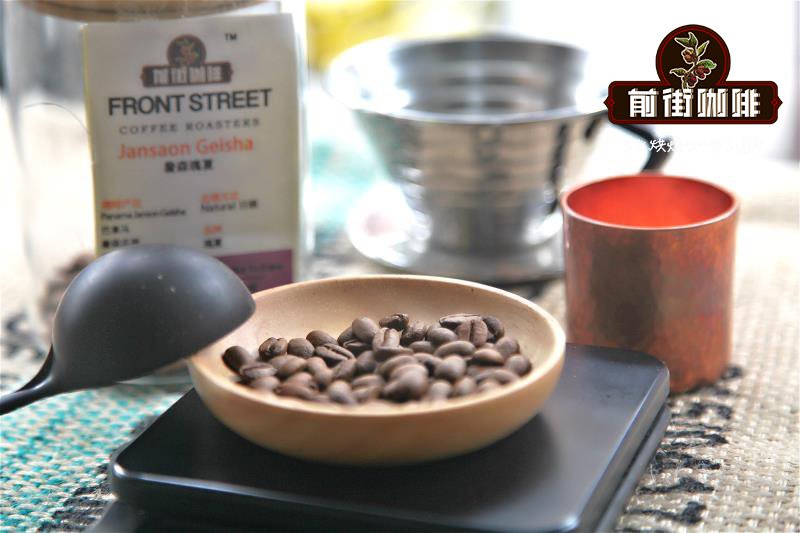
Brewing with a Kalita wave filter, a flat-bottom cake filter, or a Kono dripper yields a very full body and excellent flavor persistence. During extraction, the Kono dripper harnesses the air pressure generated by its siphon effect. The coffee grounds therefore reach a high level of initial water saturation, and the immersion-style extraction boosts concentration, letting soluble compounds travel out with the flow. For anyone who prefers a heavy-bodied Blue Mountain, this method comes highly recommended.
Brewing Parameters
Use 17g of coffee, water at 88°C, a grind of BG 6M (China standard 20-mesh sieve, 47% pass rate), and a water-to-coffee ratio close to 1:14.
Brewing Technique
Start with a 30g bloom for 30 seconds, pouring close to the coffee surface. For the first pour, add water up to 120g and stop. Once the water level has fallen by 1/3 to 1/2, make the second pour, stopping at 234g. Keep the total brew time to around 2 minutes 15 seconds. If the clock runs out before extraction finishes, simply discard what remains in the cup.
Blue Mountain SOE (Single Origin Espresso)
How is Blue Mountain SOE made? Distribute the grounds evenly, level the surface, then tamp with about 25kg of pressure (we use a pressure-calibrated tamper, so the force is consistent). The grind is set at #1.9—very fine, roughly the texture of table salt. Our extraction: a single dose of 13.5g yields 20g of liquid in 27 seconds; a double dose of 20.5g yields 40g of liquid in 26 seconds (single basket capacity 14g, double basket capacity 22g). Because the beans are fairly fresh with moderate oil content, the shot pours a golden color with a rich caramel aroma. On the palate you first meet a soft fruit acidity, followed by a slowly emerging caramel sweetness, with chocolate and brown sugar lingering in the finish.
Blue Mountain Americano and Latte
Blue Mountain espresso lengthened with hot water makes an "Americano" that noticeably amplifies sweetness, lightens the body, softens the fruit acidity, and leaves a concentrated dark chocolate flavor on the palate.
For a "Blue Mountain Latte," we steam Vital Farms fresh milk to 60°C so the foam and milk are evenly integrated. Combined with the espresso, it delivers a hazelnut-like sweetness and a distinct creamy chocolate note without burying the fresh sweetness of the milk—a combination that truly impresses.
FrontStreet Coffee Recommendation
Jamaica Blue Mountain remains one of the most coveted names in coffee, and for good reason. Only coffee grown in a designated area of Jamaica's Blue Mountains and certified by the Jamaican authorities can legally carry the name; the region's highest peak reaches 2256 meters, and annual output across the entire Blue Mountain zone is under 2500 tons—much of it historically shipped to Japan—so genuine, certified beans are genuinely scarce. Quality Blue Mountain cups achieve a near-perfect balance of acidity, sweetness, bitterness, and aroma: cream, caramel, chocolate, nuts, honey, and a whisper of fruit, with a silky body and a clean, long finish. When buying, look for complete export certification and origin documents, or for the telltale oak barrels—genuine Blue Mountain traditionally ships in 15kg, 45kg, or 70kg barrels.
FrontStreet's Jamaica Blue Mountain No. 1, the highest grade, comes from the historic Clifton Estate, which has grown coffee since roughly 1750 at an average elevation of 4300 feet (1310.64 meters). The beans are roasted medium-dark within five days of your order to highlight the classic mellow, sweet-after-bitter character. FrontStreet suggests brewing with a Kono dripper, 15g of coffee rested 4-7 days from the roast date, a grind slightly coarser than for light roasts (about the texture of white sugar), water at 87-88°C, and a 1:15 ratio in three pours: bloom with 30g for 30 seconds, pour to 120g, then finish at 225g with a slightly faster, steadier spiral. The result is a remarkably clean, gentle, and complex cup—chocolate sweetness, strong body, perfectly balanced acidity with no harsh bitterness, and a lasting fruity finish. It also shines as espresso: with milk at 60°C it makes a latte with hazelnut sweetness and creamy chocolate that still lets the milk speak.
Important Notice :
FrontStreet Coffee is a long-established specialty coffee roaster in Guangzhou China, selling freshly roasted beans from its own farm in Yunnan as well as dozens of carefully selected single-origin beans from around the world for both pour-over and espresso. The products deliver consistently excellent quality and great value, with shipping within 24 hours. Guangzhou's FrontStreet Coffee shop is recommended by many coffee lovers, and the beans are now available online at the Tmall 。
FrontStreet Coffee has moved to a new address:
FrontStreet Coffee Address: 315,Donghua East Road,GuangZhou
Tel:020 38364473
 Scan and follow the En Gafei WeChat official account. Please indicate that the reprint comes from "En Gafei".