How to Make Perfect Blue Mountain No. 1 Pour-Over Coffee - Blue Mountain Black Coffee Brewing Methods, Parameters, and Step-by-Step Guide

To make Blue Mountain coffee taste delicious, you need to select authentic Blue Mountain No. 1 coffee beans, brew with freshly roasted beans, and use extraction methods and parameters suited to this coffee. Below, FrontStreet Coffee walks through how to brew Blue Mountain No. 1 so it tastes its absolute best.
How to Identify Authentic Blue Mountain Coffee?
1. Coffee Bean Price
The Blue Mountain coffee industry faces a series of challenges: hurricane damage, rising labor costs, and the difficulty of mechanizing terrace farming. Many small estates and farms struggle to make cultivation economically viable, so annual Blue Mountain production remains limited. As a result, the amount of Blue Mountain coffee beans that can be imported into any region is never large. Authentic Blue Mountain No. 1 roasted beans generally sell for between 150-300 yuan per 100g on the domestic market; FrontStreet Coffee currently sells Jamaica Blue Mountain No. 1 at 158 yuan per 100g.

2. Look for Blue Mountain Coffee Wooden Barrels
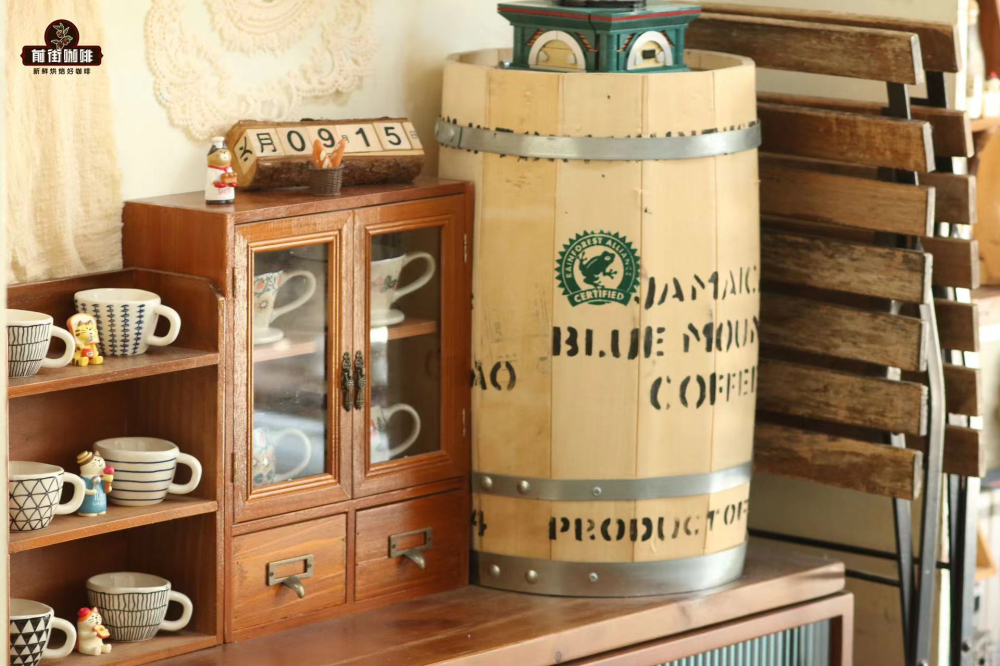
The Jamaican government mandates that all exported Blue Mountain coffee be packaged in wooden barrels, so Blue Mountain No. 1 beans ship in whole barrels. When purchasing, check whether the seller has complete Blue Mountain barrels on hand — one of the surest ways to avoid sellers passing other beans off as authentic Blue Mountain.
3. Verify Certificate of Origin
First-hand buyers of Blue Mountain green beans can apply for Blue Mountain certification certificates from the Jamaican CIB or directly from the estates, which further proves authenticity. When purchasing, ask whether the seller holds certification documents issued by the Jamaican government or the origin authorities.

All authentic Blue Mountain single-origin beans currently available on the domestic market are of Blue Mountain No. 1 grade. At FrontStreet Coffee's physical store, you can see both the wooden barrels mandated by the Jamaican government for Blue Mountain exports and the certificate of origin from the Clifton Estate.
Why Should Freshly Roasted Coffee Beans Be Used for Brewing?
Generally, the pleasant regional flavor characteristics of coffee come from small aromatic molecules. Once roasting is complete, these pleasant small molecules begin to volatilize and dissipate. As time passes — that is, as the beans lose freshness — the small molecules eventually disappear entirely, leaving behind the larger molecules responsible for bitterness.
That is why FrontStreet Coffee's baristas and roasters emphasize an "optimal tasting period." This is not the shelf life; it simply means the coffee tastes better when consumed within that window. Beans past their optimal tasting period are still drinkable, but they have missed their flavor peak. For this reason, FrontStreet Coffee ships all beans within 5 days of roasting.

According to FrontStreet Coffee's roasting style, its roasters recommend drinking the beans within one to one and a half months of the roast date, and we remind customers to finish their beans within one month. That said, fresher is not always better.
All coffee beans hold a large amount of carbon dioxide after roasting, which interferes with extraction. Beans should therefore rest in their original packaging until 3-4 days after roasting (light roast) or 5-6 days (dark roast). This lets them release an appropriate amount of CO2 naturally and softens the harsh "roasting heat" sensation.

How to Brew Blue Mountain Coffee to Make It Taste Delicious?
FrontStreet Coffee currently sells Blue Mountain No. 1 beans. The Typica variety behind Blue Mountain No. 1 is one of the most ancient in the Arabica lineage, and also the variety with the cleanest, most elegant flavor. To bring out Blue Mountain's rich, substantial mouthfeel and clean character, FrontStreet Coffee roasts it medium-dark.
With this darker roast, Blue Mountain's flavors lean rich and full-bodied. FrontStreet Coffee's baristas use the KONO dripper: the close fit between filter paper and dripper creates an immersion-style extraction during pour-over, yielding higher concentration. And to avoid over-extraction that would make the coffee bitter and heavy, they pair it with slightly cooler water and a coarser grind.

To express the mild richness of Blue Mountain coffee, FrontStreet Coffee uses the KONO dripper with a medium-coarse grind (raw sugar size / 70% pass rate on China's No. 20 standard sieve) and 88-89°C water for extraction.

The extraction technique: first pour 30g of water to bloom, for a blooming time of 30 seconds. Second, pour to approximately 125g, then wait for the coffee to drain; once the bed drops to halfway, pour the final amount to 225g. End the extraction once all the coffee has dripped through — total extraction time is generally around 2 minutes 10 seconds.
FrontStreet Coffee's washed Blue Mountain coffee features rich dark chocolate and nut flavors, a creamy smooth mouthfeel, and perfectly balanced acidity, sweetness, and bitterness.
FrontStreet Coffee Recommendation
For the most authentic experience, choose a certified Jamaica Blue Mountain No. 1 — FrontStreet Coffee's lot comes from the historic Clifton Estate, which has farmed coffee since around 1750 at roughly 4,300 feet (1,310.64 meters). Full origin certification and the original shipping barrels are on display, so every bag can be traced to its source.
The beans are roasted medium-dark and shipped within 5 days of roasting; rest them for 4-7 days from the roast date before brewing for the fullest flavor. Brew with a KONO dripper, 15 g of coffee, water at 87-88°C, and a 1:15 ratio — a pour of 30 g to bloom for 30 seconds, then up to 120 g with a slow, vertical stream in small circles, then up to 225 g with a slightly faster flow to keep the bed from clogging.
Brewed this way, the cup is remarkably clean, complex, and gentle: chocolate sweetness, strong yet silky body, a restrained and elegant acidity, and a long fruit-toned finish — the reason Blue Mountain No. 1 has remained the gold standard of classic coffee for decades.
Important Notice :
FrontStreet Coffee is a long-established specialty coffee roaster in Guangzhou China, selling freshly roasted beans from its own farm in Yunnan as well as dozens of carefully selected single-origin beans from around the world for both pour-over and espresso. The products deliver consistently excellent quality and great value, with shipping within 24 hours. Guangzhou's FrontStreet Coffee shop is recommended by many coffee lovers, and the beans are now available online at the Tmall 。
FrontStreet Coffee has moved to a new address:
FrontStreet Coffee Address: 315,Donghua East Road,GuangZhou
Tel:020 38364473
 Scan and follow the En Gafei WeChat official account. Please indicate that the reprint comes from "En Gafei".