Introduction to the Nutty and Cocoa Flavor Characteristics and Pour-Over Method Parameters for Colombia Huila Coffee Region
Colombia Huila
Region: Huila
Altitude: 1500-1800m
Variety: Caturra
Processing Method: Washed
Colombia
Colombia enjoys a geography of beautiful mountains, lovely scenery, a delightful climate, and spring-like weather year-round, with fresh, invigorating air. Its mild climate and humid air create diverse weather conditions that make harvesting possible throughout the year, with different varieties ripening at different times. The country grows distinctive Arabica coffee, and the resulting cup offers rich flavors and a lasting finish—truly a coffee specialty. Today many people equate "Colombian coffee" with "high quality" and "good taste."
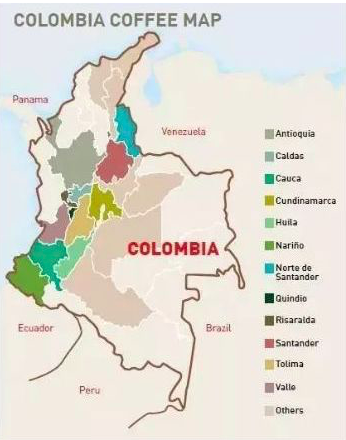
Three Cordillera ranges run north to south through Colombia, extending toward the Andes. Coffee is planted across the highlands of these ranges, and the resulting range of climates makes year-round harvesting possible, with different varieties maturing at different times. Fortunately, unlike Brazil, Colombia does not have to worry about frost damage. Colombia has approximately 2.7 billion documented coffee trees, 66% of which are cultivated with modern methods on plantations, while the rest grow on traditional small farms.
Region Introduction
The Huila region has mountainous terrain, with coffee planted on mountain slopes that provide the high altitude and ideal temperatures suited to quality Arabica. The slope climate not only keeps cold winds out but also brings cool mountain breezes without extreme heat, while rainfall is relatively abundant—an exceptionally favorable setting for coffee cultivation. Colombian coffee workers hand-pick the coffee cherries from the mountains, allowing careful selection of the most mature, full fruit. The vast majority of the beans undergo washed processing, and after medium roasting they brew into a light, silky cup, sometimes with a hint of acidity, unlike the bolder flavors of Brazilian coffee and Italian espresso. In Colombia, the crop is hailed as "green gold."
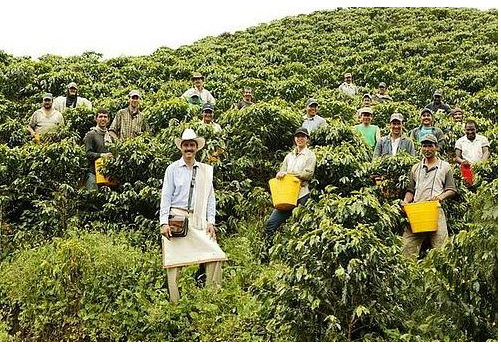
As a result, Huila produces coffee with a full body and heavier texture. With its nut, chocolate, and caramel flavors and a smooth, pleasant fruit acidity, Huila coffee is recognized as specialty coffee. That recognition comes not only from its exceptional geography and its selection of Arabica varieties but also from the contribution of manual hand-picking.
Colombian Huila (also rendered Hula or Huila) is the premium among Colombian specialties. Its balance is widely regarded as the best, belonging to the high-mountain beans specially selected by the Colombian National Coffee Company and known as a national treasure of Colombia. On the strength of superior geography and climate, Colombian coffee has consistently maintained high quality. Typically, Colombian beans without a special market trademark come from the National Federation of Colombia Coffee Growers, a very large federation spanning the country, long known for strict quality control and active promotion.
Coffee Varieties
Caturra is a variety of Bourbon, discovered in Brazil in 1937. It offers both higher yield and better disease resistance than Bourbon. The plants are shorter, making harvesting convenient, and they adapt easily—they do not require shade trees and can thrive under direct, intense sunlight, hence the common name "Sun Coffee." Caturra suits cultivation from altitudes as low as 700 meters up to 1700 meters, showing strong altitude adaptability, though higher elevations produce better flavor with relatively lower yields.
Processing Method
Most Colombian coffee is washed. Each smallholder family has a small specialized machine (an Ecomill or Eco-Pulper). Harvested cherries are poured in, which removes the skin and pulp and most of the mucilage while using very little water. The parchment beans with a small amount of mucilage left then go into a small tank or container—a cement tank (some tiled) or a stainless steel barrel—to ferment overnight and loosen the remaining mucilage. The next day they are rinsed with clean water, completing the washed process.
Roasting Analysis
Roaster: Yangjia 800N (Roasting capacity: 300g)
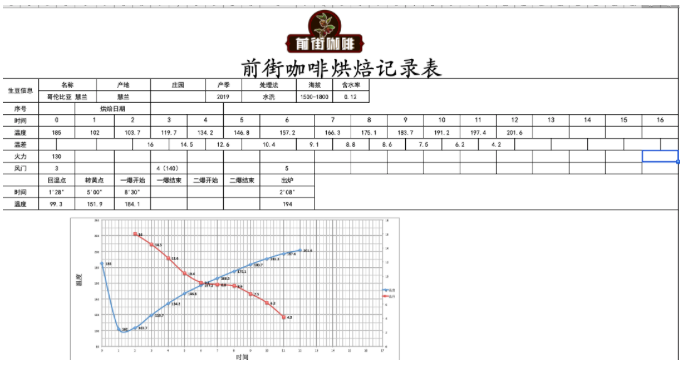
Preheat the roaster to 185°C, set the damper to 3, and heat to 120; the return temperature point is at 1'32", 98.6°C. When the roaster temperature reaches 140°C, open the damper to 4; at this point the bean surface turns yellow, the grassy smell fully disappears, and the beans enter the dehydration stage. When the roaster temperature reaches 192°C, adjust the heat to 80 and open the damper to the maximum 5.
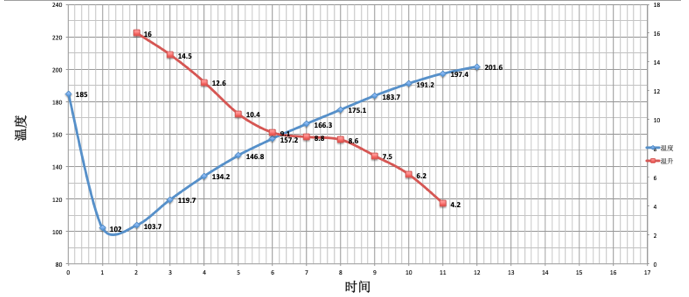
At 8'30", ugly wrinkles and black spots appear on the bean surface, and the toast smell clearly shifts to coffee aroma, which can be defined as the prelude to first crack. Listen carefully for the sound of first crack. At 9'15", first crack begins. After first crack, develop for 3'00", then unload at 202°C.
Because this Colombian Huila has high bean density, uniform bean size, and a relatively full shape, FrontStreet Coffee's roaster wanted to express its nut, dark chocolate, and caramel flavors. So after first crack the heat was adjusted and the roasting time extended, developing for 3'00" before unloading at 202°C.
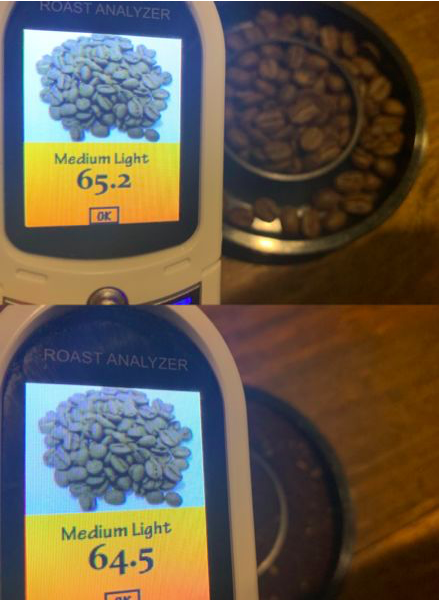
Agtron bean color value: 65.2 (above image), Agtron ground color value: 64.5 (below image), Roast Delta value: 0.7.
Cupping Notes
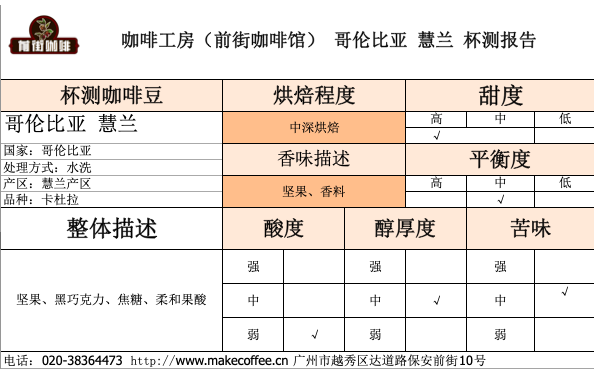
Flavor: Nuts, dark chocolate, caramel, soft fruit acidity
Brewing Parameters Shared by FrontStreet Coffee
Recommended Brewing Method: Pour-over
Filter: KONO dripper
Water Temperature: 87°C
Coffee Amount: 15g
Water-to-Coffee Ratio: 1:15
Grind Size: Medium-fine (BG 6W: Chinese standard 45% pass-through rate on #20 sieve)
Brewing Technique: Segmented extraction
Use 30g of water for the bloom, about 36 seconds. With a small stream, pour in a circular motion in the center to add 95g of water, segmenting when the total reaches 125g. When the water level drops and is about to expose the coffee bed, continue pouring to 227g to finish. When the water level again drops and is about to expose the bed, remove the dripper. (Timing starts from the beginning of the bloom.) Extraction time: 2'00".
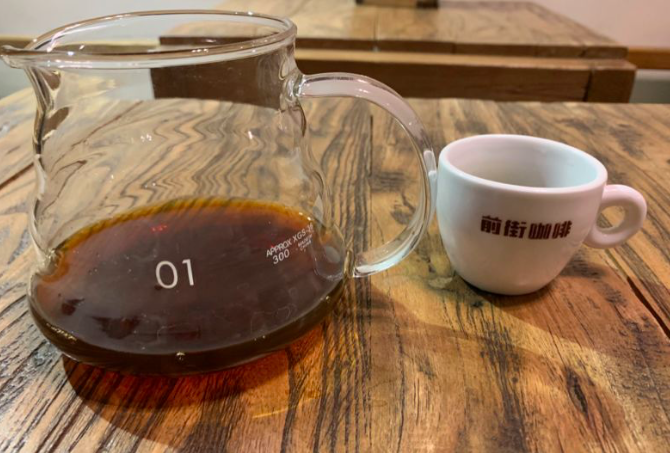
Flavor: Overall well balanced with noticeable sweetness. The entry reveals dark chocolate, nuts, and caramel, with soft fruit acidity emerging as the temperature changes.
FrontStreet Coffee Recommendation
Colombia's versatility—equally at home in espresso blends and as a pour-over single origin—makes it one of the most rewarding origins to explore. For a washed Colombian that emphasizes body over acidity, FrontStreet's Huila coffee comes from the Huila department in the southern Central Cordillera, the country's best-known specialty region, where mountains and hills are ringed by converging rivers that bring abundant water and humidity and where plantings sit above 1,500 meters. Medium-dark roasted, it highlights black chocolate and nutty sweetness with moderate oils and a full body, and it works in a pour-over or French press as readily as in a moka pot or espresso machine for an Americano or latte.
For a fruitier, modern take, FrontStreet's Frontera Estate Sidra uses anaerobic natural processing—fermentation in a low- or no-oxygen environment, typically in a pressure-resistant stainless steel tank with controlled temperature, time, and pH—which transforms the coffee into richer tropical-fruit aromas. Medium-light roasted, it delivers complex passion fruit, grape, apricot, and dried-fruit notes in pour-over, cold brew, drip bags, or moka pot.
And because Brazil's low-acid, balanced character pairs so well with Colombia, FrontStreet's Premier Espresso Blend combines Brazil's creamy nuttiness with Colombia's dark chocolate bittersweetness; it pulls with a fine golden crema and is friendly to beginners as the base for a latte, Americano, cappuccino, or mocha.
Important Notice :
FrontStreet Coffee is a long-established specialty coffee roaster in Guangzhou China, selling freshly roasted beans from its own farm in Yunnan as well as dozens of carefully selected single-origin beans from around the world for both pour-over and espresso. The products deliver consistently excellent quality and great value, with shipping within 24 hours. Guangzhou's FrontStreet Coffee shop is recommended by many coffee lovers, and the beans are now available online at the Tmall 。
FrontStreet Coffee has moved to a new address:
FrontStreet Coffee Address: 315,Donghua East Road,GuangZhou
Tel:020 38364473
 Scan and follow the En Gafei WeChat official account. Please indicate that the reprint comes from "En Gafei".