Yirgacheffe Kochere Coffee Bean Flavor Profile Story Characteristics - Washed Yirgacheffe Coffee Pour-over Parameters Sharing

When it comes to coffee with a floral, fruity aroma, the first name that comes to mind at FrontStreet Coffee is Yirgacheffe. Gesha coffee certainly has its own floral and fruity notes, but we find Yirgacheffe's are even more distinct. Yirgacheffe is a specialty coffee-producing region in Ethiopia — originally part of Sidamo, but separated out precisely because of its unique flavor profile.

About Yirgacheffe
Yirgacheffe began as a small town in Ethiopia, located within the Sidamo administrative region. In ancient times the area was a wetland: the old word "Yirga" means "to settle down," while "Cheffe" means "wetland."
Yirgacheffe is one of the highest coffee-growing regions in the world and is synonymous with Ethiopian specialty coffee. Sitting at an elevation of 1,700 to 2,100 meters, it enjoys cool, misty weather year-round, spring-like seasons, and a distinctive terrain and cultivation system that together create ideal conditions for specialty beans. Strictly speaking, Yirgacheffe is a sub-region of Sidamo. The little town lies in the northwestern part of Sidamo, ringed by mountains and lakes, making it one of Ethiopia's highest-altitude coffee areas. But its flavor profile was so distinctive that it broke away from Sidamo, built its own identity, and became one of Africa's most celebrated coffee regions.

Coffee trees in the Yirgacheffe region are mostly grown in farmers' backyards or intercropped with other crops in the fields. Each household produces relatively little, which is why this is classic garden coffee.
What we usually call the "Yirgacheffe flavor" is defined by an intense jasmine fragrance, lemon or lime citrus notes, sweet aromas of peach and almond, and a tea-like quality. Yirgacheffe coffee is layered and delicate, with captivating flavors and a sweet aftertaste. "Coffee enters the mouth, a hundred flowers bloom" is a fitting way to describe it — as if flowers were stimulating the taste buds and olfactory cells at once. Beyond the florals, the delicate body feels like silk massaging the palate, leaving a remarkable tactile impression.

Yirgacheffe Gedeo Zone Region
Gedeb is a town below Kochere town, 60 kilometers from Yirgacheffe town, and a famous specialty coffee-producing area in Ethiopia. At an altitude of 1,900 to 2,200 meters, it sits significantly higher than most of Yirgacheffe. That high-altitude advantage makes Gedeb a uniquely blessed place for coffee cultivation, and it has emerged as a micro-region gradually gaining prominence. Although the ECX auction market classifies this town under the Kochere region, it holds the same administrative level as Kochere town.
In the specialty coffee world, it can be distinguished separately from Kochere as a Yirgacheffe sub-region on the same level as Kochere. The town includes villages such as Worka Sakaro, Halo Bariti, Banko Gotiti, and Banko Dahato, all of which produce coffee.

When discussing Yirgacheffe, it helps to first understand how its regions are classified. Under the ECX regional classification system, Yirgacheffe is mainly divided into four regions: Wenago, Yirgacheffe, Kochere, and Gelana Abaya. Administratively, the Kochere region covers two Woredas: Kochere in the west and Gedeb in the east. In recent years, Gedeb has often been classified independently as a micro-region, and the Banko Gotiti cooperative happens to sit in the Worka Kebele area of Gedeb, at the southern end of Yirgacheffe.

The Banko Gotiti Cooperative was originally part of the Worka Cooperative under the Yirgacheffe Coffee Farmers Cooperative Union (YCFCU). It became independent as the Banko Gotiti Cooperative in 2012 and currently has more than 300 smallholder members. In the past, direct exports from Ethiopia could be achieved through:
(1) Private processing station systems, via ECX bidding and export
(2) Cooperative systems
(3) Single estates and farms. Starting in 2018, however, the ECX system was reformed so that coffee batches no longer conceal their origins, and private processing stations can now export directly to buyers. Beyond improving transparency and traceability, this lets buyers and sellers build closer working relationships. For cooperatives, it may have no effect, or it may increase competition with private processing stations — but overall, such changes are undoubtedly another step forward for the specialty coffee industry.

Banko Gotiti Cooperative
The Banko Gotiti Cooperative, in the Worka area at the southeastern end of Yirgacheffe, was originally part of the Worka Cooperative under the Yirgacheffe Coffee Farmers Cooperative Union (YCFCU). As the demand for traceable green coffee grew, coffee hunters around the world kept discovering independent "single-origin regions" one by one. So in 2012, Banko Gotiti, with about 300 farmer members, established the "Banko Gotiti Cooperative" on its own.
Banko Gotiti village was one of the earliest village areas to become independent. Many of its smallholders were also members of the original Worka Cooperative, so their coffee production skills are well established. The Banko Gotiti Cooperative is known as the last pure land of Yirgacheffe, and it sticks to traditional processing methods for its green beans — washed and natural.

Washed Processing
Ethiopia's washed processing technology was introduced from Central and South America in 1972. The washed process is complex and laborious and demands large amounts of fresh water, which makes it more expensive than natural processing and less common in water-scarce African regions.
Washed processing steps: after harvesting, the coffee cherries are placed in water, and buoyancy is used to sort out underripe fruit. A pulping machine then removes the skin and pulp, after which the beans rest in fermentation tanks for 18-36 hours until the mucilage layer breaks down. Once fermentation is complete, the parchment beans are washed in channels for 30-60 minutes. Through specially designed channels combined with water flow, low-density, poor-quality beans are removed. The high-quality beans are then drained and spread out on African raised beds to dry.

Because the pulp is removed before drying, Yirgacheffe's inherent aroma comes through with greater clarity: citrus and lemon notes over elegant white florals, with an overall flavor that is bright and delicate. Once washed beans were introduced, Yirgacheffe leapt to become a standard-bearer among the world's specialty coffee regions.
Heirloom Varieties
Most Ethiopian varieties carry this label because the country has so many varieties that it acts as a natural gene bank for Arabica. On one hand, the sheer number makes identification and classification difficult; on the other, the Ethiopian government, for protection reasons, is unwilling or unable to disclose details about them.

In Ethiopia, most coffee grows in a wild or semi-wild state — in fields, backyards, or under forest canopy. When the cherries ripen, farmers gather them for processing. In reality, this is a broad mix of many different natural varieties. Because these fruits grow under the same terroir, they develop somewhat similar flavors, and that is the foundational framework of coffee's regional flavors. Ethiopia has nearly 2,000 recorded coffee varieties, including 1,927 native varieties and 128 introduced foreign varieties. In variety alone, Ethiopia's coffee is like a "grand garden" — it has everything: long, short, thin, fat. This is also why Ethiopian coffee beans so often look uneven in size.
Roast Profile Analysis
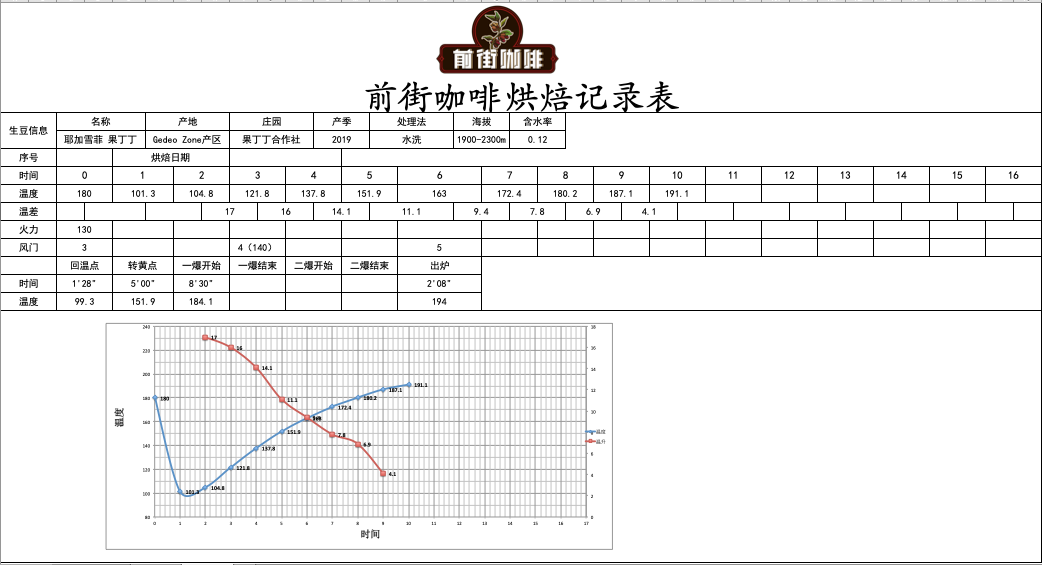
For beans like Yirgacheffe, FrontStreet Coffee's roasters usually choose a light roast to showcase their floral and fruity notes. For this natural processed Banko Gotiti, we still use a gentle heat approach to extend the dehydration time of the beans.
Yangjia 800N Roaster (300g batch size)
Preheat to 175°C and load the beans, damper setting at 3, heat at 120. Return temperature at 1'32", with bean temperature at 140°C, heat unchanged, damper opened to 4. At this point the bean surface turns yellow, the grassy aroma completely disappears, and the beans enter the dehydration stage. At 166°C, heat is reduced to 100; at 176°C, heat is reduced to 80, and the damper stays as it is.
At 8'28", ugly wrinkles and black spots appear on the bean surface, and the toast aroma clearly shifts to coffee aroma — a fair sign of the prelude to first crack. At this moment, listen carefully for the sound of first crack. At 9'38", first crack begins, and the damper is adjusted to 5 (adjust the heat very carefully, not so low that there is no cracking sound). After first crack, develop for 1'30", then drop at 193.5°C.
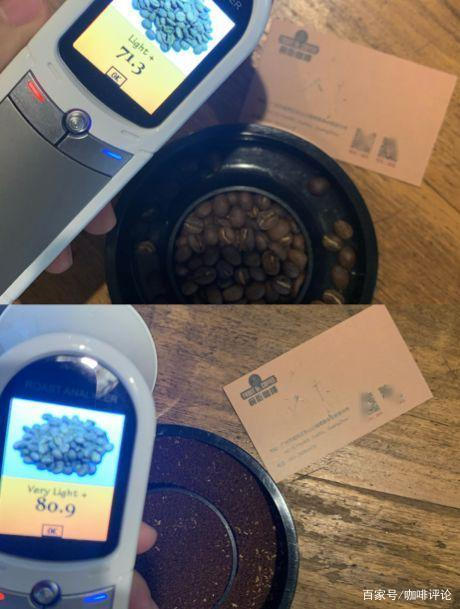
Agtron bean color value 74.6 (upper image), Agtron ground color value 79.8 (lower image), Roast Delta value 5.2.
Cupping Notes
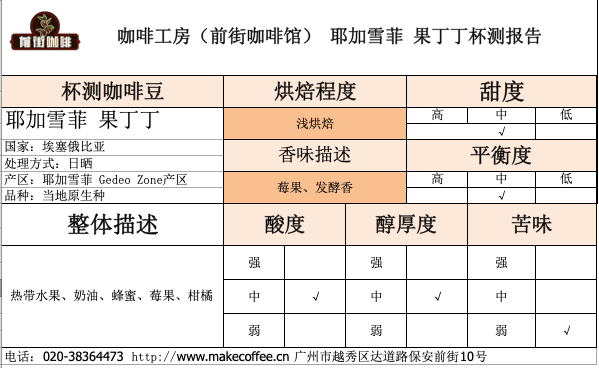
Flavor: Tropical fruits, cream, honey, berries, citrus.
FrontStreet Coffee Brewing Guide

Ethiopia Yirgacheffe Banko Gotiti
FrontStreet Coffee: Yirgacheffe Banko Gotiti Cooperative Coffee Beans
Country: Ethiopia
Region: Yirgacheffe Gedeo Zone
Altitude: 1900-2300m
Variety: Heirloom
Processing: Washed
Grade: G1
Filter: Hario V60
Water Temperature: 91°C
Coffee Dose: 15g
Coffee-to-Water Ratio: 1:15
Grind Size: Medium-fine (80% pass rate on a Chinese standard #20 sieve)
Brewing Method: Staged pour-over

Use 34g of water for the bloom and let it rest for 36 seconds. With a small, steady stream, pour in circles to 120g, then begin the next stage. When the water level drops and the coffee bed is about to become exposed, continue pouring to 229g and stop. When the water level drops and the bed is about to show again, remove the filter cup. (Timing starts from the bloom.) Total extraction time is 2'00".

Flavor: The overall mouthfeel is substantial, with fermentation aromas and tropical fruits standing out. As the temperature changes, berry and cream flavors emerge. The aftertaste leaves a persistent citrus sweet-and-sour sensation on the teeth and lips.
FrontStreet Coffee Recommendation
If Yirgacheffe is your gateway into floral coffee, FrontStreet Coffee has a few lots that make the style easy to explore. Start with the FrontStreet Washed Yirgacheffe, our everyday staple — it is known for white jasmine, bright citrus and lemon acidity, and a clean tea-like body, and its friendly price makes it the bean most people choose as their first step into specialty coffee.
Once you want to go a little deeper, the FrontStreet Gotiti Cooperative coffee comes from a cooperative in the Worka area at the southeastern end of Yirgacheffe. It follows traditional washed processing, and the result is free of the usual bitterness: fresh, bright citrus and lemon acidity paired with jasmine fragrance. Medium-light roasting reveals green tea and honey notes, and it works beautifully as a pour-over, a cold brew, or an espresso.
For a fruitier counterpoint, try the FrontStreet Natural Red Cherry. Only fully ripe, defect-free cherries are picked, sorted, and laid straight onto raised beds, where they are turned every 2-3 hours during the first few days so they dry evenly and never over-ferment. After three to five weeks of sun-drying, the fruit is removed and the beans go into storage. Because the cherries dry with the fruit still on, the cup keeps the classic Yirgacheffe character while adding tropical fruit aromatics, citrus acidity, a berry-juice body, honey sweetness, and a creamy smoothness.
For brewing, FrontStreet Coffee suggests a V60 with water at 90-91°C, 15g of coffee, and a 1:15 ratio. Grind to a fine-sugar consistency — about 80% passing a #20 sieve. Begin with a 30g pour for a 30-second bloom, then pour to 95g (around 125g on the scale) over about one minute. When the water level falls to two-thirds of the coffee bed, add the remaining 100g (around 225g on the scale), finishing the pour at about 1'35". Let it finish dripping by 2'00"-2'10", then remove the dripper and you are done.
Important Notice :
FrontStreet Coffee is a long-established specialty coffee roaster in Guangzhou China, selling freshly roasted beans from its own farm in Yunnan as well as dozens of carefully selected single-origin beans from around the world for both pour-over and espresso. The products deliver consistently excellent quality and great value, with shipping within 24 hours. Guangzhou's FrontStreet Coffee shop is recommended by many coffee lovers, and the beans are now available online at the Tmall 。
FrontStreet Coffee has moved to a new address:
FrontStreet Coffee Address: 315,Donghua East Road,GuangZhou
Tel:020 38364473
 Scan and follow the En Gafei WeChat official account. Please indicate that the reprint comes from "En Gafei".