Yirgacheffe Coffee Region Characteristics and Flavor Profile Brewing Guide
For more specialty coffee knowledge, follow FrontStreet Coffee on WeChat
When it comes to black coffee, many people's first impression is bitterness. So when they taste pour-over coffee for the first time and find it acidic, they're often astonished: coffee can actually be sour! Plenty of "coffee is bitter" skeptics have been dragged into a café by friends, faced a menu of unfamiliar bean names, picked Yirgacheffe at random — and fallen headfirst down the coffee rabbit hole.
Many newcomers visiting FrontStreet Coffee's stores feel overwhelmed by the blackboard listing nearly fifty different beans, unsure where to start in finding one that suits them. Then they remember the name that pulled them into this deep hole in the first place was something like "Yirgacheffe" — but they can't find it on FrontStreet Coffee's bean list.

What is Yirgacheffe?
So what exactly is Yirgacheffe? Let FrontStreet Coffee explain.
Specialty coffee has boomed in recent years. Walk into almost any independent café and Yirgacheffe will be on the menu — it is Ethiopia's most famous and important coffee region, hugely popular in specialty circles. The name is coveted even by the world's largest commercial chain: in 2004, Starbucks attempted to register "Yirgacheffe" as a trademark. The Ethiopian government filed an international lawsuit, and not until 2007 was the name successfully reclaimed.

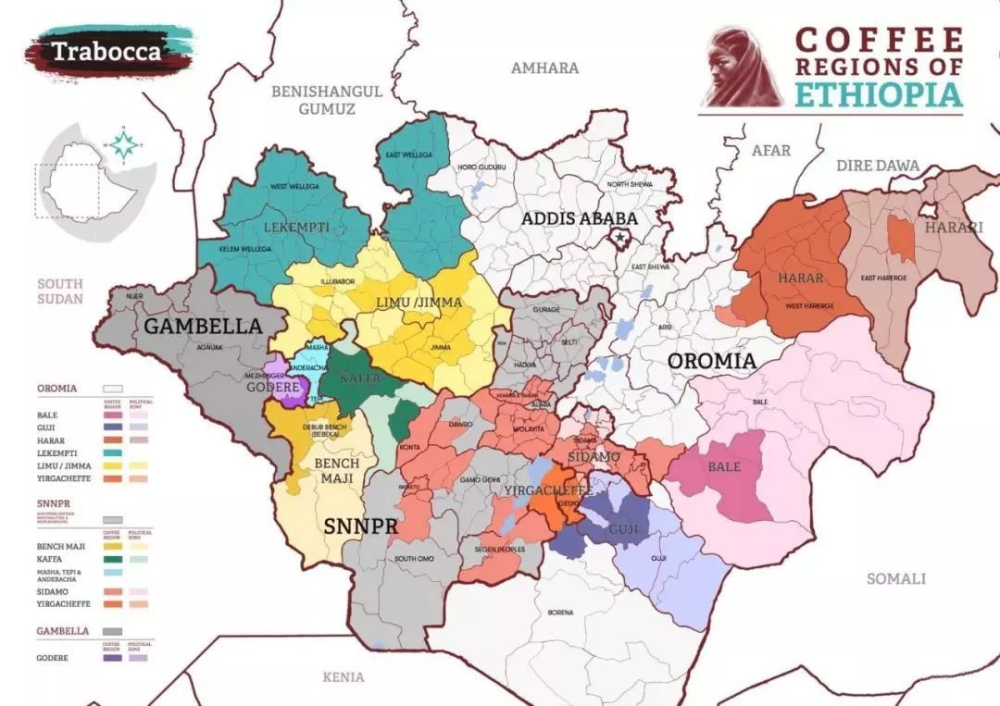
Behind the famous name lies a region's unique flavor. Yirgacheffe was once a sub-region of Sidamo, but because its coffee carries that delicate, distinctive white floral aroma, growers all over Sidamo began claiming theirs was "Yirgacheffe coffee." Eventually Yirgacheffe broke away from Sidamo to stand as its own producing region, ending the confusion.
The Unique Flavor of Yirgacheffe
How unique is it? Ask anyone who has tasted it. People browsing FrontStreet Coffee's bean display often tell the barista: "I want something with floral aroma, but none of those funky processing flavors." The barista will point them to Panama Geisha — or to Ethiopia's Yirgacheffe. Its charming white florals are closely tied to the region's green coffee processing.
To solve the problem of green bean quality, Ethiopian authorities introduced washed processing from Central and South America in the 1970s. Fully ripe, hand-selected cherries are depulped, and the parchment beans — slick with mucilage — go into clean-water pools for a light fermentation, then are stirred by hand so the beans rub against each other and shed the mucilage. Once clean, they are spread evenly on raised beds, away from soil contamination, and dried to 13% moisture.
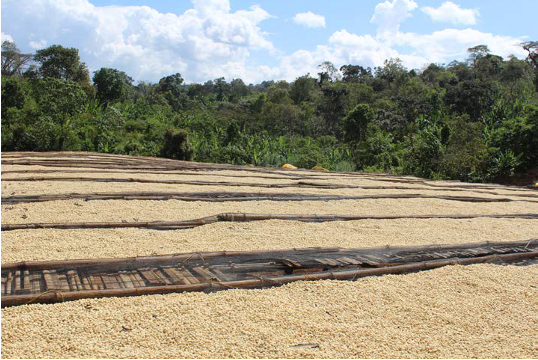
With the sugars of pulp and mucilage excluded from fermentation and drying, washed Yirgacheffe shows its white florals with total clarity. The beans are prized for a delicate mouthfeel — what Han Huaizong, in his book "Specialty Coffee Studies," called "a hundred flowers blooming."
Washed beans are clean and bright without embellishment, best expressing a region's fundamental flavor. As a signature specialty region, Yirgacheffe represents Ethiopia in FrontStreet Coffee's daily bean series — seven products, each standing for a signature region's basic profile, letting novices learn the great terroirs quickly at friendly prices.

Washed vs Natural Processing
Washed Yirgacheffe — clean, bright, delicate — is the safe harbor for connoisseurs who can't decide. But natural processed Yirgacheffe is equally distinctive: on FrontStreet Coffee's list, Red Cherry and Konga are both naturals.
Natural processing is the most original, traditional method. Carefully selected red cherries are spread completely on raised beds to sun-dry, turned periodically to avoid excessive unpleasant fermentation.
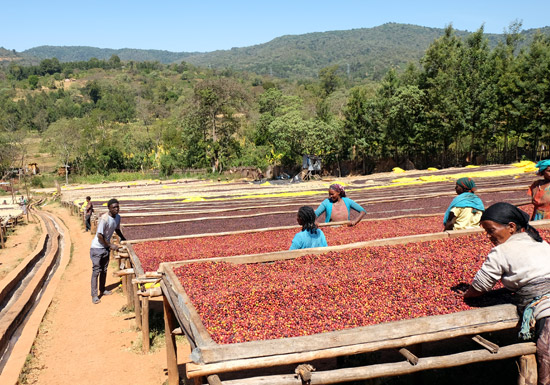
Because the whole fruit dries intact, more of the pulp and mucilage sugars participate in processing, giving the coffee heavier body, stronger aroma, and more pronounced sweetness.
With so many Yirgacheffe beans on the menu, which tastes best? FrontStreet Coffee's display regularly features washed Yirgacheffe Gotiti and natural Yirgacheffe Red Cherry as representatives. The Gotiti is fresh and natural with green-tea-like notes; the Red Cherry, as a natural, brings berry-like sweet-sourness, a hint of fermentation, and strong sweetness.

Brewing Parameters
Buying beans is easy; brewing them to their proper flavor is the challenge. Here are the parameters FrontStreet Coffee's baristas use for Yirgacheffe.
Dripper: Hario V60
Water temperature: 90°C
Coffee dose: 15 grams
Coffee-to-water ratio: 1:15
Grind size: 80% pass-through on the China standard #20 sieve
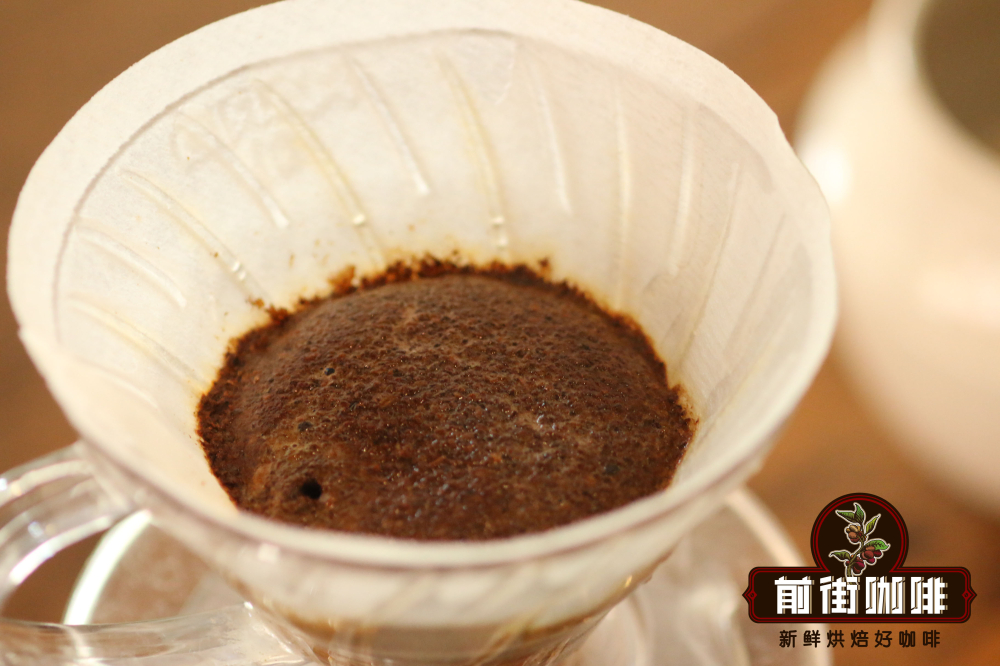
Since FrontStreet Coffee ships beans roasted within 5 days, they arrive after a 4-7 day degassing period, right at optimal flavor. Bloom during brewing to release the grounds' carbon dioxide — it extracts the aromatics more completely.

Pour 30g of hot water for a 30-second bloom, then pour in a fine stream from the center, spiraling slowly to 125g. When the water level drops to just above the coffee bed, continue spiraling to 225g. Total extraction time is about 2 minutes.
Some, having fallen for Yirgacheffe, want to replicate the aroma at home or at the office and buy drip coffee bags — only to find the brew weak and the aroma far inferior. They ask FrontStreet how to brew them properly. Using FrontStreet's Red Cherry and Gotiti drip bags as examples, here is how to turn them into full-bodied Yirgacheffe black coffee.

One FrontStreet drip bag holds about 10g of coffee. Repeated measurements show that filling a bag halfway with hot water is about 30-40g, while filling it to nine-tenths is 60-80g — so you can estimate total water by counting the pours.

Following a pour-over ratio of 1:15-1:18, you would inject 150-180ml of hot water. For a stronger cup, pour in three stages: first pour half to wet the bed, pause 20 seconds, then pour twice to nine-tenths full. That takes about 1.5 minutes, with total water landing between 140-160g.

Both Yirgacheffe beans are roasted medium-light, and the non-woven filter fabric of the drip bags leaves almost no oils in the cup — just a clear, sweet-sour flavor profile.

The FrontStreet Gotiti drip bag shows citrus acidity with green-tea notes and subtle white florals, delicate and clean. The natural Red Cherry drip bag is smooth and delicate, its ripe-fruit sweetness fully expressed, with a hint of fermentation and a honey-like finish.
For more coffee bean information, follow Coffee Workshop (WeChat ID: cafe_style)
For professional coffee knowledge exchange, add WeChat ID: kaixinguoguo0925
FrontStreet Coffee Recommendation: Washed or Natural — Why Not Both?
The best way to understand Yirgacheffe's two faces is a side-by-side tasting. Start with the FrontStreet washed Yirgacheffe Gotiti: clean citrus acidity, green-tea elegance, and subtle white florals on a delicate frame — the region's essential character with nothing added. Then try the natural Red Cherry, whose fully ripe cherries are sun-dried for three to five weeks to add berry juiciness, honeyed sweetness, cream smoothness, and a gentle fermented note. Brew both on a V60 with 15g, water at 90-91°C, a 1:15 ratio, and a granulated-sugar grind (80% through a #20 sieve): 30g bloom for 30 seconds, then 125g, then 225g, about two minutes in total. One small town, two unforgettable cups.
Important Notice :
FrontStreet Coffee is a long-established specialty coffee roaster in Guangzhou China, selling freshly roasted beans from its own farm in Yunnan as well as dozens of carefully selected single-origin beans from around the world for both pour-over and espresso. The products deliver consistently excellent quality and great value, with shipping within 24 hours. Guangzhou's FrontStreet Coffee shop is recommended by many coffee lovers, and the beans are now available online at the Tmall 。
FrontStreet Coffee has moved to a new address:
FrontStreet Coffee Address: 315,Donghua East Road,GuangZhou
Tel:020 38364473
 Scan and follow the En Gafei WeChat official account. Please indicate that the reprint comes from "En Gafei".