How to Drink Colombian Pour-Over Coffee | Flavor Profile and Taste Characteristics of Colombian Coffee

For deeper specialty coffee knowledge, follow FrontStreet Coffee.
Introduction to FrontStreet Coffee's Colombian Coffee
FrontStreet Coffee's Colombian coffee is one of the standout origins in the coffee world: a traditionally deep-roasted cup with a rich, memorable flavor. It carries a full, generous aroma, bright high-quality acidity and excellent balance, sometimes with nutty notes and a long aftertaste. In both appearance and quality, FrontStreet Coffee's Colombian coffee is hard to beat.
FrontStreet Coffee's Colombian coffee is grown at high altitude, where the roasted beans release a sweet fragrance and show that prized combination of acidity with sweetness and balanced bitterness. Because its concentration is so well judged, it is often used in premium blends. FrontStreet Coffee's Premium Blend, for instance, includes Colombian coffee to lift the hazelnut aroma in espresso.

For deeper specialty coffee knowledge, follow FrontStreet Coffee.
Colombian coffee, with its soft fruity acidity, nutty aroma and high balance, is loved by a very broad audience. In recent years, as the specialty market has grown, more and more experimental processing methods have appeared. Because Colombian beans are balanced and highly variable, many special processes are widely used there. Most of the Colombian production-area coffees FrontStreet Coffee offers are special-process beans. To let new enthusiasts taste the most authentic original regional character at an affordable price, FrontStreet Coffee has added Colombian origins to its daily-drinking series, so that drinkers discover Colombia is about more than just experimental beans.

Colombian Coffee Overview
Colombia is currently the world's third-largest coffee-producing country, behind only Brazil and Vietnam. Commercial cultivation began in the 1830s, and by the 20th century coffee had become the country's largest agricultural export. Mountainous terrain combined with diverse tropical microclimates provides ideal growing conditions. About 75% of total production is exported, making coffee the most important source of foreign-exchange income.
Colombian coffee areas lie in the tropics, and the climate varies with topography. The southern eastern plains and the Pacific coast have a tropical rainforest climate, mountainous areas at 1000-2000 meters have a subtropical climate, and the northwest has a tropical savanna climate. Average annual temperature: 15.8-20.5°C. Coffee regions average between 18°C and 22.5°C, with annual precipitation of 1000-2500mm. Although rainfall in coffee-growing areas is high, some places still face water shortages because of uneven distribution or high evaporation. Latitude differences and the presence of 86 distinct microclimates between the southern and northern production regions add further variety.

Coffee Production Regions
Colombia is best known for areas such as Medellin, Armenia and Manizales, collectively known as "MAM." Its premium coffee areas lie mainly in the south, at altitudes above 1500 meters, and include Huila, Cauca, Nariño and Tolima. Coffee from these areas shows refined acidic aromas and berry notes, with caramel aromas and full sweetness.
Santander and North Santander
Santander is a well-known region in northern Colombia, bordered by the Magdalena River to the west, with cultivation altitudes of about 1400-1600 meters. Beans from here are known for their strong flavor, long aftertaste and distinctive fresh herbal notes.

FrontStreet Coffee's Colombian Rose Valley Coffee Beans
- Region: Santander, Colombia
- Estate: Big Tree Estate
- Altitude: 1700m
- Processing: Anaerobic Enzyme Washed
- Variety: Caturra
Huila Province
Huila lies in the southern part of Colombia's central mountain range and is the country's most famous specialty coffee area. It is made up of hills surrounded by mountains, with cultivation altitudes above 1500 meters. The country's most important rivers converge here, bringing abundant water and moisture. Contrary to the common image of Colombian commercial coffee as simply balanced and smooth, many smallholder micro-lots show distinctly regional flavors.
In recent years, as the international market has emphasized coffee quality and demanded true specialty coffee, grading by bean size has gradually given way to micro-regional selection organized by smallholders within a production area. Dozens of smallholders combine their individual harvests into a single micro-lot for sale, which also makes it possible to pick out high-quality smallholder coffees through batch-by-batch cupping.
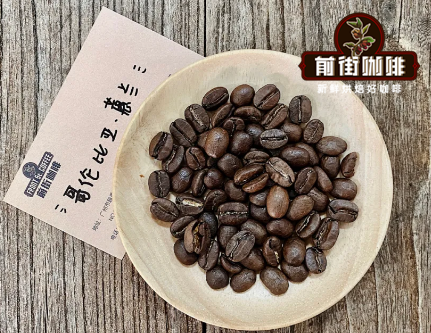
FrontStreet Coffee's Colombian Huila Coffee Beans
- Region: San Agustin Town, Huila
- Altitude: 1750-1950m
- Processing: Washed
- Varieties: Caturra, Catuai

FrontStreet Coffee's Colombian Flower Moon Night Coffee Beans
- Region: Estagardin Farm, Huila, Colombia
- Altitude: 1800m
- Processing: Anaerobic Natural
- Variety: Caturra
Cauca Province
Cauca is a Colombian coffee origin-certified area with an average altitude of 1758m, reaching as high as 2100m. Its topography, rainfall, temperature and volcanic soil suit coffee well. About 80% of the region is mountainous, with parallel ranges in the east and center that form part of the Andes. The central range holds two major volcanoes, Sotara and Petacas. As in other southwestern regions, Cauca's rainfall has a clear single peak, with the dry season mainly falling in August and September each year. The following rainy season brings a concentrated flowering period, and the next year a concentrated harvest.

Nariño
Nariño sits in Colombia's southwestern corner, where the central and western Andean ranges merge. It has rich volcanic soil and good rainfall, and coffee is harvested by local families. Nariño is bordered by Tolima, Cauca and Huila, which together make up the southern planting region. Crops are harvested from April to June and from October to December. About 90% of the coffee here grows in full or partial shade. Altitudes reach 1750 to 2100 meters.
Tolima Province
Tolima borders Huila and Cauca, with the north-south Andes and Cordillera ranges running through it. Between these two famous ranges, the Magdalena River flows from south to north.
The name Tolima comes from the people who first lived here, the "Pijao." In their language, tolima means "snow-covered." Tolima farms are generally slightly larger than those in other southern Colombian regions, about 10-15 hectares. Cooperatives are also common: farmers send their small lots of fresh cherries to cooperative processing plants, while some choose to process their own harvest on small-scale equipment sized to a single day's picking.

Caldas
Caldas is one of Colombia's main coffee regions. Together with neighboring Risaralda and Quindío, it forms part of the "Coffee Axis" or "Coffee Triangle," a hub of coffee activity from research and social programs to freeze-drying and dry milling. It is also part of the Coffee Cultural Landscape listed by UNESCO as a World Coffee Cultural Heritage site. Caldas's rolling landscape is defined by coffee-planted slopes, with high-altitude towns on the ridges, where smallholders and medium-sized estates grow mainly single-variety coffee, shielded from excessive sun by the region's near-constant mist. Many programs of the Colombian Coffee Growers Federation, including the Cenicafe research facilities, are headquartered in Caldas.
Colombian Coffee Bean Processing Methods
Washed Processing
Harvested cherries pass through a depulper that separates most of the fruit from the beans, then the parchment beans are guided into clean water tanks and soaked to ferment off the remaining mucilage. In the past (about five years ago), washing was often the preferred method for high-quality beans. Water processing floats out unripe and defective beans by buoyancy, and fermentation is easier to control. As a result, washed beans present clear fruit acidity, slightly greater complexity and a cleaner cup, without the off-flavors that natural beans can carry. However, because it is so "clean," the depth of flavor is also a little weaker.

Anaerobic Natural Processing
The whole cherry first undergoes anaerobic fermentation and is then dried naturally. Broadly speaking, the anaerobic process makes coffee more uniform and easier to monitor, while the aerobic process is more complex and harder to control. In an oxygen-free environment, pectin sugars break down more slowly and pH falls more slowly, extending fermentation time to build better sweetness and more balanced flavors. The temperature for anaerobic fermentation must be kept below 10-15 degrees. In a sealed, clean stainless-steel tank, the beans ferment for three days without oxygen.
Anaerobic Enzyme Washed Processing
Anaerobic enzyme washed processing removes defective beans by washing, then places the processed beans in a sealed container and injects carbon dioxide to drive out oxygen. In that oxygen-free environment, sugars in the coffee pectin break down more slowly and pH falls more slowly, extending fermentation to develop better sweetness and more balanced flavors.

Double Anaerobic Washed Processing
After the cherries leave the anaerobic environment, the skin and pulp are removed by machine, then the mucilage-covered beans are placed in plastic bags or other sealed containers for a second anaerobic fermentation. A process that goes through these two anaerobic fermentations is called double anaerobic fermentation. Afterwards the beans leave the anaerobic environment and undergo washing to remove the mucilage layer, then natural drying until moisture content reaches about 11%.
Rum Barrel Fermentation
After washing, the beans are placed in oak barrels that previously held rum, with a resting time of up to three months. During this period each barrel must be rolled daily to stir the coffee inside so the beans evenly absorb the aroma of the wine-aged oak. Thanks to the complete rest, the beans' inherent character becomes more distinct and complete.

Colombian Coffee Varieties
Caturra is a natural mutation of the Arabica Bourbon variety, discovered in Brazil in 1937. Its plant is shorter and more compact than Bourbon. Because it inherits Bourbon lineage, its disease resistance is relatively weak, though its yield is higher. Although discovered in Brazil, Caturra does not grow well there, so it was never widely planted; instead it became popular across Central and South America, with large-scale cultivation in Colombia, Costa Rica and Nicaragua.
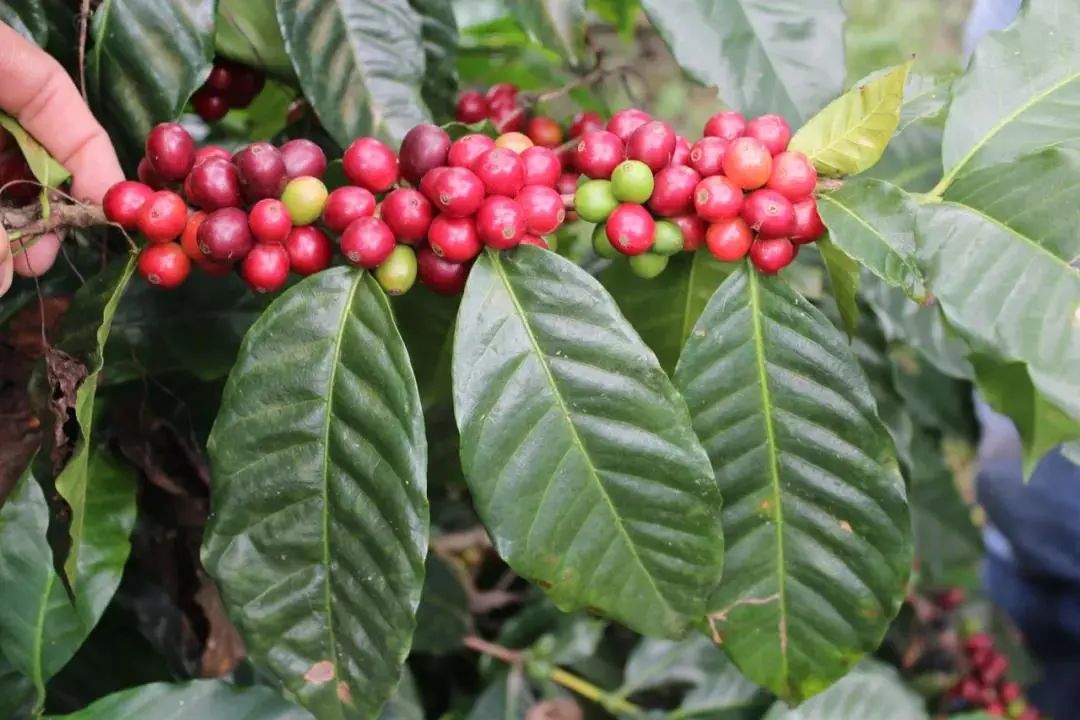
Catuai is an artificial hybrid of Caturra and Mundo Novo. It resists natural disasters better, especially wind and rain. The Catuai tree grows relatively low, and compared with other coffee trees its fruit holds on more firmly and is harder to harvest. The fruit comes in both red and yellow. To date, no difference has been found showing yellow fruit tastes better than red; in fact, some cuppers find that yellow-fruit coffee has good acidity but a less clean mouthfeel than red-fruit coffee.
Castillo is one of the most widely planted varieties in Colombia, popular for its excellent resistance to leaf rust. Starting in 1961, CENICAFE began researching the Robusta-hybrid Timor variety. CENICAFE went on to release the second disease-resistant variety Tabi (a hybrid of Typica, Bourbon and Timor) in 2002, and then the most successful disease-resistant variety to date, Castillo, in 2005. After the massive leaf-rust outbreak in 2008, Colombia began vigorously promoting Castillo cultivation.
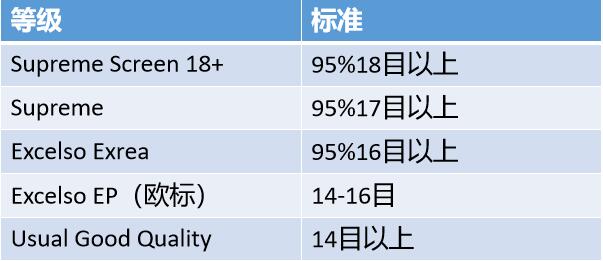
Colombian Coffee Bean Grading (Graded by coffee bean size)
How FrontStreet Coffee Brews Colombian Production Area Coffee
FrontStreet Coffee uses a V60 dripper to brew Colombian beans. The conical V60 has a large opening, and its unique spiral ribs let air escape more easily, improving extraction quality. The mouthfeel may be less full-bodied, but its high concentration - delivering sweet-and-sour flavors with a distinct aroma - is its signature.

FrontStreet Coffee's Brewing Parameters
- Water Temperature: 90°C
- Grind Size: EK43s setting 10 (fine sugar size)
- Coffee Amount: 15g
- Coffee-to-Water Ratio: 1:15
FrontStreet Coffee's Brewing Technique
First pour 30g of water for a 30-second bloom, then pour 95g more (the scale reads about 125g), finishing in about 1 minute. When the water level drops to 2/3 of the coffee bed, pour the remaining 100g (the scale reads about 225g), finishing in about 1 minute 40 seconds. Complete drip filtration between 1 minute 55 seconds and 2 minutes, remove the dripper, and the extraction is done.

Brewing Flavor Profiles
Huila Brewing Flavor: Full-bodied with a heavier texture. Nutty, chocolate and caramel aromas with a smooth, pleasant fruit acidity.
Rose Valley Brewing Flavor: Surprising peach character, with rose and liqueur-chocolate aromas, rich and fragrant - like drinking peach juice. It has both the fine sweet-and-sour quality of black grapes and the silky mouthfeel of cream toffee.
Flower Moon Night Brewing Flavor: Rich strawberry aroma, strawberry acidity on entry, jam-like sweetness in the middle and a subtle cocoa aftertaste, with a juicy mouthfeel.
FrontStreet Coffee Recommendation
Colombia works across a remarkably wide range of styles, and FrontStreet Coffee's Colombian lineup reflects that. If you want to understand the origin, start with FrontStreet Coffee's washed Huila: the southern Huila department is the country's most famous specialty region, with cultivation above 1500 meters, where mountains, water and humidity create ideal conditions. A medium-dark roast pushes black chocolate and nutty sweetness, moderate oils and a full body, and it is just as comfortable in a French press, moka pot or espresso machine for an Americano or latte.
For something more adventurous, FrontStreet Coffee's Colombia El Diviso Sigre is processed as an anaerobic natural - a low-oxygen fermentation that transforms the fruit into tropical aromas. Brewed as pour-over, cold brew, drip bag or moka pot at a medium-light roast, it reveals passion fruit, grape, apricot and candied fruit. And if you want a milk-friendly espresso, FrontStreet Coffee's Premium Blend pairs the creamy nuttiness of Brazilian coffee with the dark chocolate bittersweetness of Colombian coffee, pulling a fine golden crema that is forgiving for beginners and equally good as the base for an Americano, cappuccino or mocha.
Important Notice :
FrontStreet Coffee is a long-established specialty coffee roaster in Guangzhou China, selling freshly roasted beans from its own farm in Yunnan as well as dozens of carefully selected single-origin beans from around the world for both pour-over and espresso. The products deliver consistently excellent quality and great value, with shipping within 24 hours. Guangzhou's FrontStreet Coffee shop is recommended by many coffee lovers, and the beans are now available online at the Tmall 。
FrontStreet Coffee has moved to a new address:
FrontStreet Coffee Address: 315,Donghua East Road,GuangZhou
Tel:020 38364473
 Scan and follow the En Gafei WeChat official account. Please indicate that the reprint comes from "En Gafei".