How Should Drip Bag Coffee Be Brewed? Can You Steep It? Drip Bag Coffee
How Should Drip Coffee Be Brewed?
FrontStreet Coffee has observed that some people choose to hang the drip bag over relatively tall cups for brewing, trying to keep the bag from soaking in the coffee liquid, while others prefer to hang it over shorter cups and brew while letting it soak. So the question arises: what is the difference between coffee brewed with these two methods?
What is Drip Coffee?
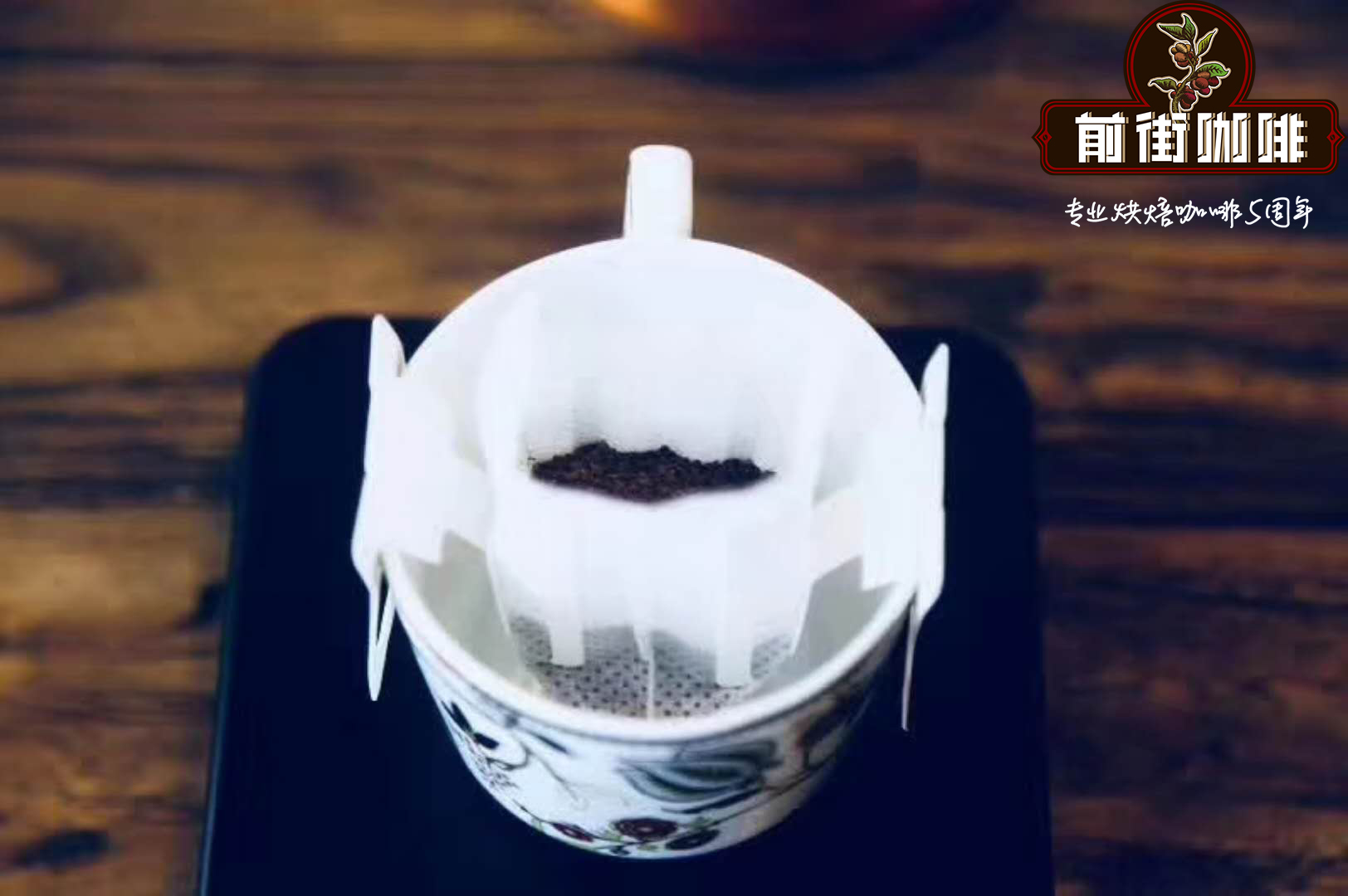
The structure of a drip bag is quite simple: it is a sealed filter bag containing ground coffee with two paper flaps attached to the outside. When the paper flaps are opened, they can hang on the cup, resembling two ears, which is how the name "drip bag" originated.
The first generation of drip bags was invented by Japan's Yamanaka Industrial Co., Ltd. based on the concept of tea bags, and after several improvements it evolved into its current form.
Today, drip coffee has captured 15% of the market share in its birthplace, Japan, and its growth in the Chinese market is also astonishing: in 2016, only about 3% of Chinese consumers had tried drip coffee, but by 2017 this figure had surged to 20%.
This explosive growth may partly be attributed to clever positioning: many merchants use instant coffee as a reference point in their drip bag product descriptions. This approach is quite ingenious because drip bags are only slightly more troublesome to use than instant coffee, yet the taste is significantly better.
How to Use Drip Coffee
Let us first look at the usage method. The filter bag contains pre-ground coffee powder, so tear open the package, hang the filter bag on the cup, pour hot water to extract, and finally remove the drip bag to enjoy your coffee.
Brewing Methods Comparison
FrontStreet Coffee compared coffee made with these two methods and found that coffee extracted using the "brewing while soaking" method has a richer mouthfeel but higher acidity, while coffee extracted using the "non-soaking" method may taste thinner in texture but performs better in terms of flavor complexity.
Why Does Soaking Extraction Result in More Acidic Coffee?
At the beginning of brewing, most of the flavor compounds extracted from the coffee powder are fruit acids and floral notes, followed by nutty and chocolate flavors, and finally sweetness, with concentration gradually decreasing.
When we soak the drip bag in the cup for extraction, the liquid soaking the bag already contains a relatively high amount of compounds extracted at the beginning, resulting in a smaller concentration difference. Consequently, fewer of the later-extracted, larger-molecule compounds like nuts will be extracted.
Moreover, with the same coffee-to-water ratio, immersion extraction tastes more intense and full-bodied than non-immersion extraction. FrontStreet Coffee believes this is because immersion extraction provides more complete and uniform extraction overall, resulting in a higher extraction rate than non-immersion extraction. However, due to the higher concentration, other flavors become harder to perceive, making the fruit acids more prominent.
FrontStreet Coffee Recommendation
If drip bags are your everyday convenience, the FrontStreet range covers all three flavor styles. For a clean, floral cup, FrontStreet Yirgacheffe Gedingding Drip Bag is a washed Yirgacheffe with a bright, lifted citrus acidity, jasmine fragrance and a honeyed finish, ideal for newcomers and anyone who likes a light, refreshing taste. If you prefer something sweeter and fruitier, FrontStreet Natural Huakui Drip Bag is one of our best sellers, with clear tropical fruit aroma and a black tea finish, high sweetness, low acidity and little bitterness; the beans come from the Guji region above 2300 meters, where a wide day-night temperature range helps the fruit absorb more flavor compounds, and careful sun-drying strengthens the sweetness. For a deep, rich cup, FrontStreet Indonesia Mandheling Drip Bag offers herbal, spice and woody notes with intense spice, nut, chocolate and caramel flavors, strong but not harsh, mellow and sweet without the fruity acidity of African coffee.
Because a drip bag is simply a sealed filter of ground coffee, brew it the same way you would a pour-over: tear the top, hang the two paper ears on your cup, and pour hot water in stages. Whether you brew short or let the bag soak, you can fine-tune the body and acidity to your own taste.
Important Notice :
FrontStreet Coffee is a long-established specialty coffee roaster in Guangzhou China, selling freshly roasted beans from its own farm in Yunnan as well as dozens of carefully selected single-origin beans from around the world for both pour-over and espresso. The products deliver consistently excellent quality and great value, with shipping within 24 hours. Guangzhou's FrontStreet Coffee shop is recommended by many coffee lovers, and the beans are now available online at the Tmall 。
FrontStreet Coffee has moved to a new address:
FrontStreet Coffee Address: 315,Donghua East Road,GuangZhou
Tel:020 38364473
 Scan and follow the En Gafei WeChat official account. Please indicate that the reprint comes from "En Gafei".