Can Espresso Grind Be Used for Pour-Over Coffee? What Should You Pay Attention to When Making Pour-Over Coffee with Fine Grind?

A customer recently asked FrontStreet Coffee what to do when beans are ground fine enough for espresso. Many of you know the situation: you discover the coffee you bought is ground too fine, and your usual pour-over parameters will surely over-extract. Does it have to be thrown out?
Today, FrontStreet Coffee looks at whether espresso-fine "powder" can be used for pour-over, and how to brew it well.
For the demonstration we chose FrontStreet Coffee's medium-dark roasted Mandheling, which has thick body, relatively low acidity, and flavors of chocolate, caramel, herbs, pu-erh tea, and pine—a profile close to many espresso grinds on the market.

Pour-Over
To recreate the situation at home, FrontStreet Coffee used the Galileo grinder from our espresso bar, set to 2.5 on its scale.
Parameters: Hario KONO dripper; water temperature 81-83°C; coffee-to-water ratio 1:15, or 1:10 followed by bypass dilution; grind: Galileo 2.5 (espresso grind).
Dripper

To highlight Mandheling's rich mouthfeel, solid flavor, and thick, rounded texture, FrontStreet Coffee brews with a KONO dripper. The KONO's ribs are less than half the height of the cone, a design that presses the wet filter paper tightly against the wall and restricts airflow. This lengthens the contact time so the grounds extract more evenly overall. It suits medium-dark roasted single origins such as FrontStreet Coffee's Blue Mountain and Golden Mandheling.
Water Temperature

With a very fine grind and a fairly dark roast, water that is too hot almost guarantees over-extraction, so FrontStreet Coffee brews at a lower temperature of 81-83°C.
Coffee-to-Water Ratio

A larger ratio pulls more compounds out of the grounds, so FrontStreet Coffee suggests either a 1:15 ratio or a 1:10 ratio followed by dilution with extra water.
Technique

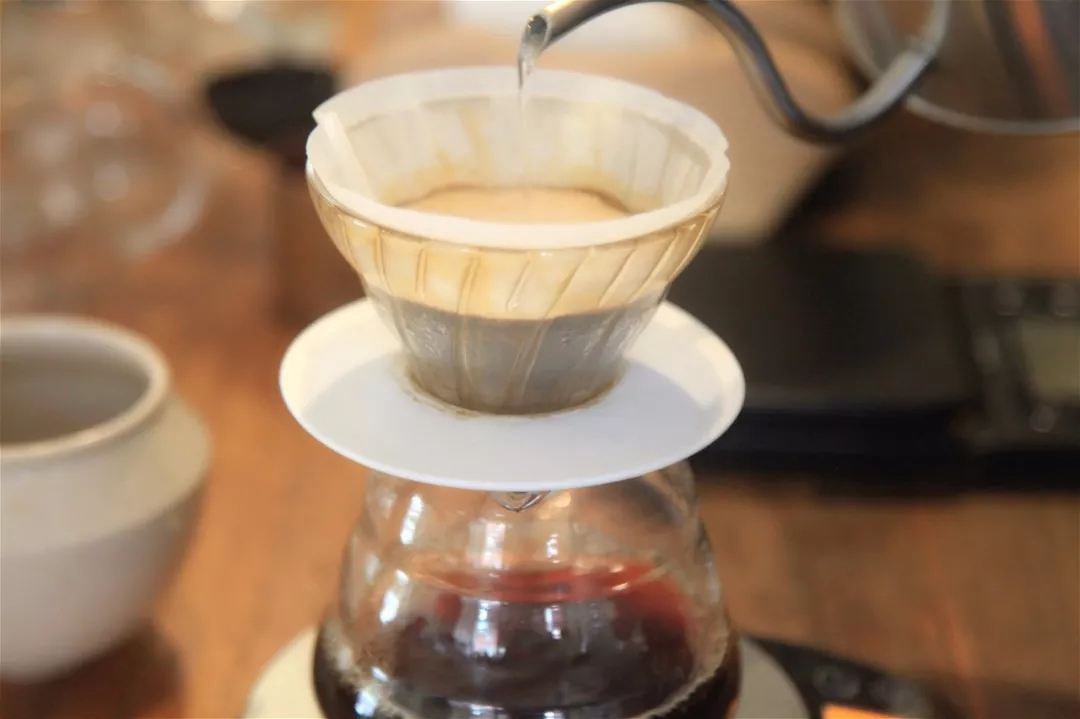
For technique, FrontStreet Coffee pours directly into the center after the bloom. A very fine grind plus the loose structure of dark-roast beans makes the flavor compounds extract easily, so to keep the cup from turning unbearably bitter, the center pour minimizes disturbance to the bed.
When water hits the bed, the grounds roll inward from the pour point, and since the center sits close to the dripper's bottom hole, the water flows through under pressure and drains to the server more quickly.

Thanks to the center pouring, once brewing finishes and the liquid has drained, the bed shows a deep crater.
Extraction Time
Because finely ground coffee extracts fast, FrontStreet Coffee recommends shortening the brew time. Here, timing starts at the bloom, with total extraction kept to about one and a half minutes.
FrontStreet Coffee ran brew experiments at two ratios:
Coffee-to-Water Ratio 1:15
Technique: Bloom with 30g of water for 30 seconds so the grounds fully degas. Then pour directly in the center up to 225g and stop. Remove the dripper when the water level drops to half. Extraction time: 1 minute 10 seconds.

Flavor: Black chocolate, cocoa, and roasted hazelnut on entry, with an intense mouthfeel and caramel sweetness in the finish. Rich overall, with a thick texture.
Coffee-to-Water Ratio 1:10
Technique: Bloom with 30g of water for 30 seconds to fully degas the grounds. Pour directly in the center up to 150g and stop. Remove the dripper when the water level drops to half (timing from the start of the bloom). Extraction time: 1 minute 35 seconds. Then add 100g of water to the serving pot.

Flavor: Chocolate, nuts, herbs, and pine on entry, with cream aroma and caramel sweetness in the middle. Compared with the first cup, the overall flavor is more balanced and lighter.

To sum up: if your coffee is ground too fine, lower the water temperature, choose a smaller ratio, and reduce agitation to rein in extraction.
FrontStreet Coffee Recommendation
If this exercise leaves you craving Mandheling proper, start with the origin story: the Dutch brought coffee to Java in the late 17th century, and it later spread to Sumatra. Today Sumatra grows over 60% of Indonesia's arabica and robusta, with high-altitude Aceh (the Gayo mountains near Lake Tawar) and North Sumatra (the Lintong region around Lake Toba) as the main arabica zones. The island's rainy harvest season makes conventional drying impossible, so producers developed the signature wet-hulled (giling basah) method: depulped, briefly washed, dried partway, then hulled by machine while still half-dry so the green beans dry faster—picking up the earthy, herbal, wildly distinctive character Mandheling is loved for. For the finest expression, FrontStreet recommends the PWN Golden Mandheling from Indonesia's PWN company: beans of 18 screen size and above, fewer than 3 defects per 300g sample to meet the top G1 grade, and three rounds of hand sorting that give the cup its cleanliness and intense sweetness. Roasted medium-dark, it brews best as a pour-over: 15g of coffee at a coarse-sugar grind, 87-88°C water, a 1:15 ratio, three-stage pours—30ml bloom, 100ml to lift the bed, then a gentle 95ml center pour—yielding caramel sweetness with chocolate and nuts. If you prefer Mandheling on your espresso machine, FrontStreet's most-repurchased Classic Blend adds medium-dark Mandheling to Brazil's creamy nuttiness for butter, roasted chestnut, and caramel flavors, with a touch of robusta for extra crema—perfect for lattes or a Dirty.
Important Notice :
FrontStreet Coffee is a long-established specialty coffee roaster in Guangzhou China, selling freshly roasted beans from its own farm in Yunnan as well as dozens of carefully selected single-origin beans from around the world for both pour-over and espresso. The products deliver consistently excellent quality and great value, with shipping within 24 hours. Guangzhou's FrontStreet Coffee shop is recommended by many coffee lovers, and the beans are now available online at the Tmall 。
FrontStreet Coffee has moved to a new address:
FrontStreet Coffee Address: 315,Donghua East Road,GuangZhou
Tel:020 38364473
 Scan and follow the En Gafei WeChat official account. Please indicate that the reprint comes from "En Gafei".