Costa Rica Musician Series Chopin Coffee Beans How to Brew Chopin Coffee Beans for Sweet Flavor

Music and coffee have a lot in common — both are leisurely pleasures. But imagine naming coffee beans after famous musicians, and not just one of them but four world-renowned composers. That is Costa Rica's Musician Series, and it is well worth a closer look.

Region Introduction
Located on the Central American isthmus, Costa Rica is influenced by both Pacific and Atlantic currents and sea breezes, which together moderate its climate. The country has numerous towering volcanoes reaching 2,000 meters, and coffee cherries grow slowly in fertile volcanic-ash soil and a cool, high-altitude environment, developing complete and richly layered flavors.

Costa Rica has two distinct seasons: the dry season runs from December to April each year and coincides with the coffee harvest, while the wet season falls from May to November. In recent years many micro-processing mills have been established. Because they use only 5% of the water consumed by traditional washed mills and need neither large water tanks nor drying fields, the investment required is far smaller. Honey-processed coffee — lower in acidity, more complex, with a rich sweet aroma — has become a competitive target for the industry in recent years.

Coffee has been cultivated in Costa Rica for as long as two hundred years, first planted on the slopes of the Poas and Barva volcanoes — what we now call the Central Valley. Today Costa Rica has eight main growing regions: West Valley, Central Valley, Tarrazu, Tres Rios, Orosi, Brunca, Turrialba and Guanacaste. Tarrazu is one of the main coffee-producing regions here, with a real history of coffee production; it has won the favor and recognition of the British royal family and has even been praised in the Pope's speeches.
Canet Estate
Costa Rica Chopin also comes from Canet Estate. The estate grows mainly passion fruit, devoting only a small portion of its land to coffee, which means this coffee receives special care. Costa Rica Chopin has a rose-like sweet aroma together with the sweet-and-sour balance of raisins and white wine, and it even carries hints of Anxi Tieguanyin tea.

Raisin Honey Processing Method
The raisin honey method can be understood as a double-fermentation approach to honey processing. On the day the coffee cherries are harvested, the fruit is poured into large water tanks. Mature, full fruits sink to the bottom, while underdeveloped or overripe fruits float to the surface, and those floating beans must be removed. The selected cherries are then placed on raised beds to dry to a raisin-like state, after which the pulp and skin are removed and the mucilage is kept while drying continues.
In flavor terms, the fermentation aroma is more intense and the layers are richer and fuller, and more mucilage is retained than in other honey processes. During drying the cherries must be turned constantly to dry evenly, but the turning frequency has to be controlled so that the drying is slow enough to develop fermentation character without tipping into over-fermentation.

Variety (Yellow Catuai)
Yellow Catuai (Catuai Amarillo) is a cross between Mundo Novo and Caturra, first cultivated by Brazil's Instituto Agronomico de Campinas in 1949. Like Red Catuai (Catuai Rojo), Yellow Catuai has extremely high disease resistance and is suited to high altitudes and windy sites. Both Catuai varieties have very delicate, clean acidity. The green beans look greenish-blue and smell of rich tea fragrance with a light fermented aroma.

The Costa Rica Canet Musician Series includes Mozart, Beethoven and Bach coffees. This year the series added another bean named Chopin. Unlike the others, Chopin has distinct rose floral notes with more prominent sweetness.
Roasting Analysis
Yangjia 800N semi-direct flame roaster (300 g batch size)
Preheat the roaster to 180°C, set heat to 130 and damper to 3. Return temperature at 1'36"; maintain heat. At 140°C, keep the heat unchanged and open the damper to 4. At 5'20" the beans turn yellow, the grassy aroma disappears and the batch enters the dehydration stage. At 166°C, reduce heat to 110, keeping the damper at 4. At 176°C, adjust heat to 80, damper unchanged.

At 8'15" dehydration is complete: wrinkles and black spots appear on the bean surface, the toast aroma turns to coffee aroma, and the prelude to first crack begins. Listen for the first-crack sound at this point. First crack starts at 9'21"; open the damper fully to 5 and keep the heat unchanged. Post-first-crack development time is 2'05", discharging at 195.2°C.
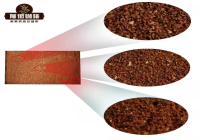
The Agtron bean color value is 70.3 (image above), the Agtron ground color value is 78.3 (image below), and the Roast Delta value is 8.

Cupping
Flavor: rose, raisin, berry, fruit tea.
Brewing Recommendations
For this bean, FrontStreet Coffee suggests the pour-over method.
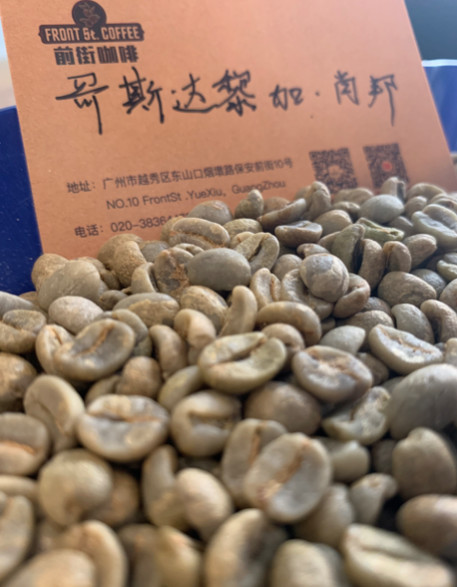
FrontStreet Coffee Costa Rica · Canet Estate Chopin
Region: Tarrazu
Variety: Yellow Catuai
Altitude: 1700 m
Processing: Raisin Honey Process
Pour-over Parameters
Dripper: Hario V60
Water Temperature: 90–92°C
Coffee-to-Water Ratio: 1:15
Grind Size: Fine grind (80% pass-through rate on a Chinese standard #20 sieve)

Brewing Method: Segmented Extraction
Use 30 g of water for a 30-second bloom. With a small water flow, pour in circles to 125 g, then segment. When the water level drops and the coffee bed is about to be exposed, continue pouring to 228 g and stop. When the bed is about to be exposed again, remove the dripper. Extraction time from the start of the bloom is 1'56".

Flavor: Brewed with 92°C water, this Chopin shows more prominent citrus acidity and tea sensation, with berry notes; as it cools a little there is an intense fermentation aroma and the sweetness lingers persistently on the palate. Brewed with 90°C water, the rose aroma is more prominent, with raisin and tea on entry; as it cools a little there is fermentation aroma, a relatively smooth mouthfeel and more obvious sweetness.
FrontStreet Coffee Recommendation
The Chopin above takes the honey route, but washed processing is the other classic family of flavors, and it works by a different logic. In the washed method the coffee is floated, depulped, fermented in water and then stripped of its mucilage before being washed or soaked again, dried and hulled. Because the beans spend a long time in water, they undergo chemical changes that consume much of their monosaccharides — fructose and glucose — lowering the sugar content while raising the organic acids. The result is a coffee that keeps more of the bean's own aroma, with bright fruit acidity and a clean, fresh character. FrontStreet Coffee's washed Yirgacheffe Banko Gotiti Cooperative lot is a textbook example: smallholders around Yirgacheffe send their cherries to a shared processing station, and this particular station in the Worka area has become known for an especially refined, clean cup. Because the skin and pulp are removed before drying, the coffee's own aromatics come through clearly — jasmine florals and bright citrus over a medium-light roast that also brings out green tea and honey. It is versatile enough for pour-over, cold brew or espresso.
For a more assertive washed coffee, FrontStreet Coffee's Kenya Cherry Tomato is among the best-known examples, since Kenya specializes in double washing — repeating the washing cycle to push the juice-like quality to its limit. It drinks with ripe cherry tomato, smoked plum, snow pear, black plum and yellow sugar, sweet-sour and juicy, and it has become a favorite among experienced drinkers. At the other end of the spectrum, FrontStreet Coffee's Jamaica Blue Mountain No. 1 shows why washed processing suited Jamaica in the first place: the island gets less sunlight than most origins, so removing the skin, pulp and mucilage before drying reduces the water trapped around the bean and shortens drying time, producing translucent, low-defect green coffee. The washed method preserves Blue Mountain's deep aroma and gives it a cupping profile of hazelnut, cream, chocolate and caramel, balanced so that no single note dominates.
Since washed coffees keep so much of their own character, brew them to protect it. A medium-light roast like these is best handled as a pour-over with water a little below boiling, a medium-fine grind and a gentle, staged pour, so the citrus acidity and florals stay bright instead of turning dull or bitter. For an even cleaner result, cold brew the same beans — the low-temperature steep keeps the cup transparent and sweet — while a slightly finer grind and a little more pressure will pull the darker caramel and nut notes out as an espresso or SOE.
Important Notice :
FrontStreet Coffee is a long-established specialty coffee roaster in Guangzhou China, selling freshly roasted beans from its own farm in Yunnan as well as dozens of carefully selected single-origin beans from around the world for both pour-over and espresso. The products deliver consistently excellent quality and great value, with shipping within 24 hours. Guangzhou's FrontStreet Coffee shop is recommended by many coffee lovers, and the beans are now available online at the Tmall 。
FrontStreet Coffee has moved to a new address:
FrontStreet Coffee Address: 315,Donghua East Road,GuangZhou
Tel:020 38364473
 Scan and follow the En Gafei WeChat official account. Please indicate that the reprint comes from "En Gafei".